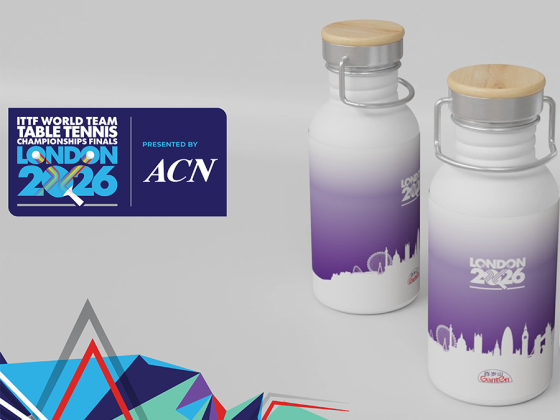
On Earth Day, the ITTF, Table Tennis England and Ganten are taking a significant step towards improving how its World Championships are delivered for the next century, with the ITTF World Team Table Tennis Championships Finals London 2026 Presented by ACN becoming the first edition of the event to have sustainability integrated into its strategy, planning and delivery.
At the heart of this commitment is a meaningful shift in how the World Championships approaches hydration. Where previous editions used around 30,000 single-use plastic bottles, London 2026 will reduce this to fewer than 3,000 reusable, recycled stainless-steel alternatives.
Every player and coaching staff member will receive a Ganten bottle upon registration, with refill stations available throughout OVO Arena Wembley and Copper Box Arena for the duration of the Championships, from 28 April to 10 May.
Early estimates suggest this could avoid hundreds of kilograms of plastic waste and several tonnes of carbon disoxide emissions, representing a 90% reduction in single-use plastic by bottle count. These figures are indicative, based on typical bottle weights and publicly available tools, with final verified data to be published after the event.
The initiative is a concrete step in the ITTF’s broader commitment to gradually phasing out single-use non-recycled plastic across its major events, made possible through the unwavering support from Ganten, WTT’s Global Premier Water Partner. A reduction of that scale is not a marginal adjustment. It is a change to how a World Championships operates, and a standard the ITTF intends to build upon at every future edition, together with its partners.
On the field of play, only the official Ganten bottle provided at registration may be brought past the call area and on to the court, with a water dispenser available at every player bench. Doping control stations and medical areas will continue to provide sealed single-use bottles in line with applicable requirements.
On its own, this is not a revolution. It is a long-overdue and symbolic shift, one that may seem simple but has taken significant work to implement. Athlete routines, safety requirements and operational complexity have all shaped the pace of change. Yet this issue matters, not because plastic bottles represent the largest part of the event’s footprint, but because they are one of the most visible aspects of it, and one deeply embedded in the habits and culture of sport. That visibility creates an opportunity: to engage players, teams, event organisers and fans in a wider conversation, and to make meaningful change tangible.
The hydration initiative is one part of a broader sustainability programme developed jointly by the ITTF and Table Tennis England, covering water stewardship, waste reduction and sustainable travel across both venues. Read more about how London 2026 is approaching sustainability here.
The Championships aspires to meet the standards of the ITTF Sustainable Event Label, being introduced as part of the ITTF Centenary year. In pursuit of that ambition, the organising committee will publish a sustainability report after the event, documenting outcomes, carbon footprint data, and learnings to inform every future edition of the ITTF World Table Tennis Championships.
The sport returns to London this year, the city where the first ITTF World Championships were held in 1926. One hundred years on, the ambition shared by the ITTF and Table Tennis England is not only to celebrate that history, but to ensure the next century of the World Championships is built on a more sustainable foundation.
Latest news