It is always a pleasure to hear from former England players and their families and to learn more about their table tennis history to add to the rich heritage of English table tennis.
So, I was delighted to be in contact with Angela Wade, the daughter of former England international Rene Stott, later Mrs Bate. It gives an interesting insight into the table tennis years before, during and after the Second World War, as well as a personal history.
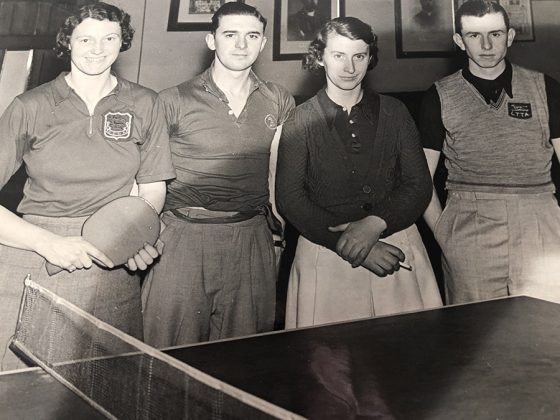
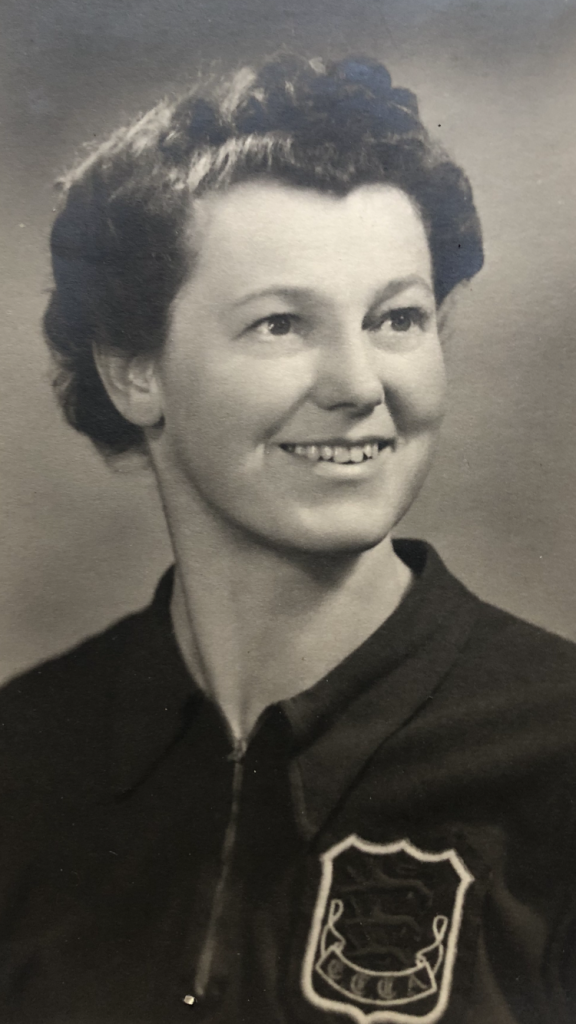
Born on 1 November 1912 in Leeds, Yorkshire, Winifred Irene Stott was known as Winnie or Rene. She was a Yorkshire lass through and through and loyal to Bramley Liberal Club, the only club she played for and of which she was the secretary. She was also secretary of the Bramley Invitation Tournament (Ashby Cup) in 1938-39 and on the Leeds Executive Committee in 1937-38.
Rene was of the generation of players whose playing career was interrupted by the Second World War, nonetheless this did not stop her playing amongst some of the elite players in England.
Not only an excellent table tennis player, Rene also enjoyed hockey, netball, cricket and tennis. She later played golf, a game loved by her husband, Edward “Eddie”, who was a member of the Cobble Hall Golf Club playing off a handicap of five.
Rene started playing table tennis after seeing an exhibition match at Bramley, near Leeds. On being interviewed on 3 December 1938 by Jack Batty, a prominent figure in Manchester, Rene said: “I was so fascinated by the skill of the players and the speed at which they played, that I immediately joined the club.
“But I think it was Mrs Hilda Amies of Pontefract who unknowingly inspired me to start seriously. I kept meeting her at tournaments, and she always knocked me out. I knew she was an English international, and consequently, I stood rather in awe of her, but I said to myself that someday I would beat her, and in due course, after practising hard, I secured my first win over an English international by defeating Mrs Amies.”
Rene went on to say: “Although I had been playing regularly for over three years, the first big Championship I won was the Scarborough Open in 1936, when I beat Mrs Amies in the final. Since then, I have hardly missed a big tournament.”
After watching that exhibition match which started her career playing table tennis, Rene went on to participate in a number herself, often with some of England’s and the world’s best players.
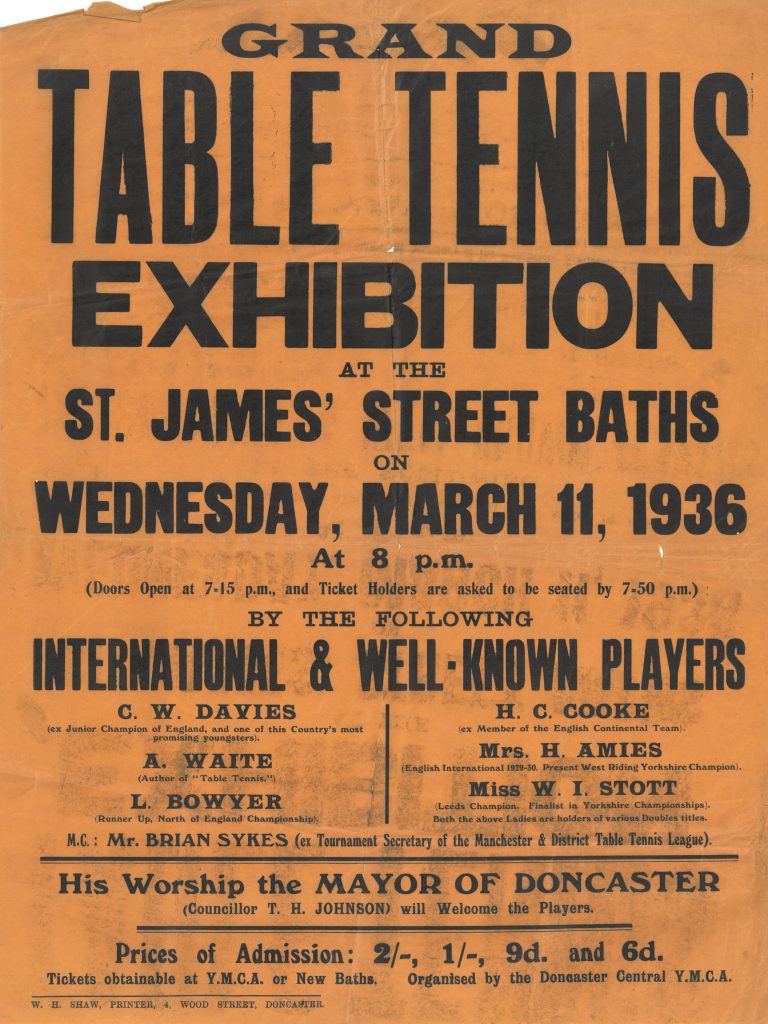
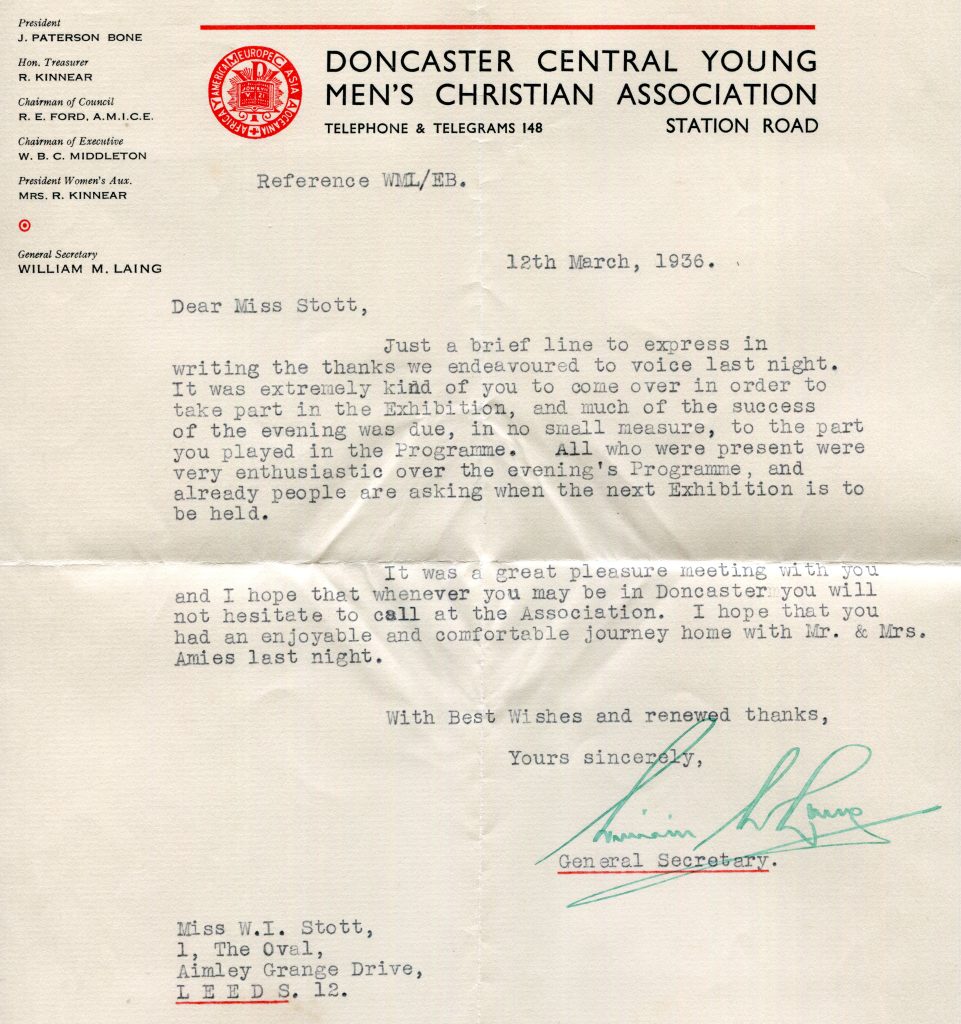
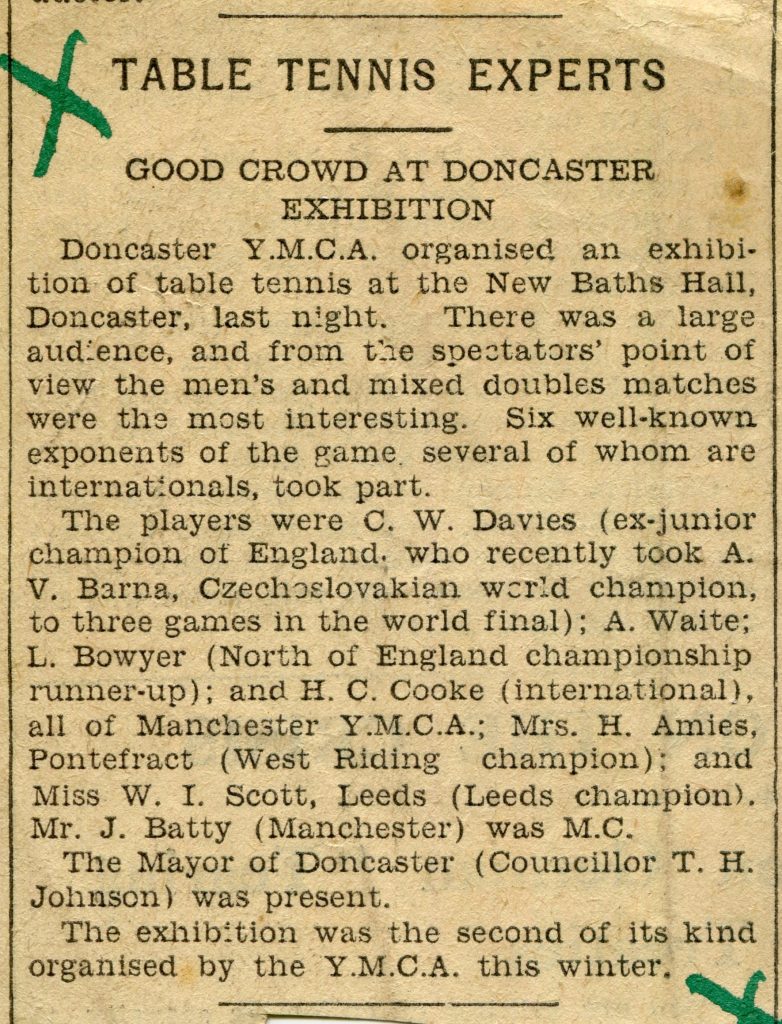
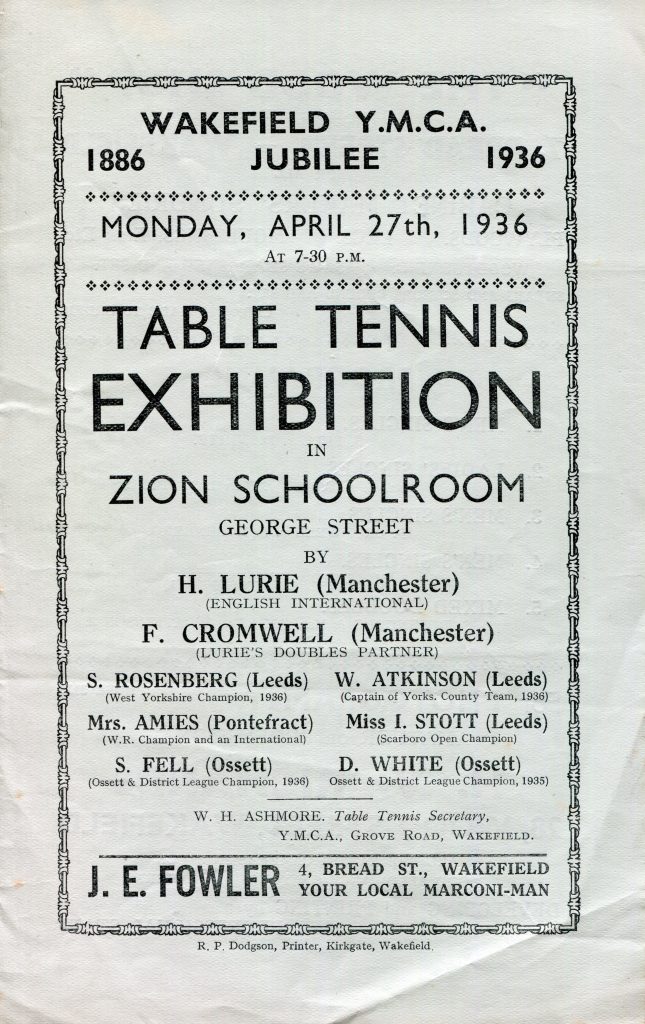
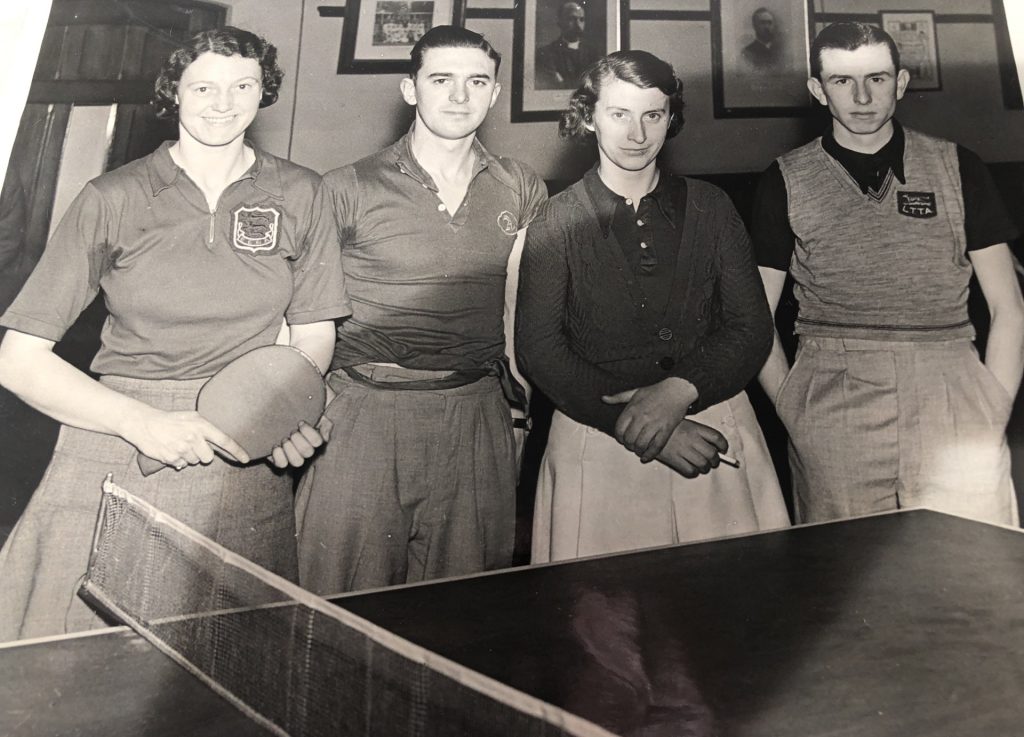
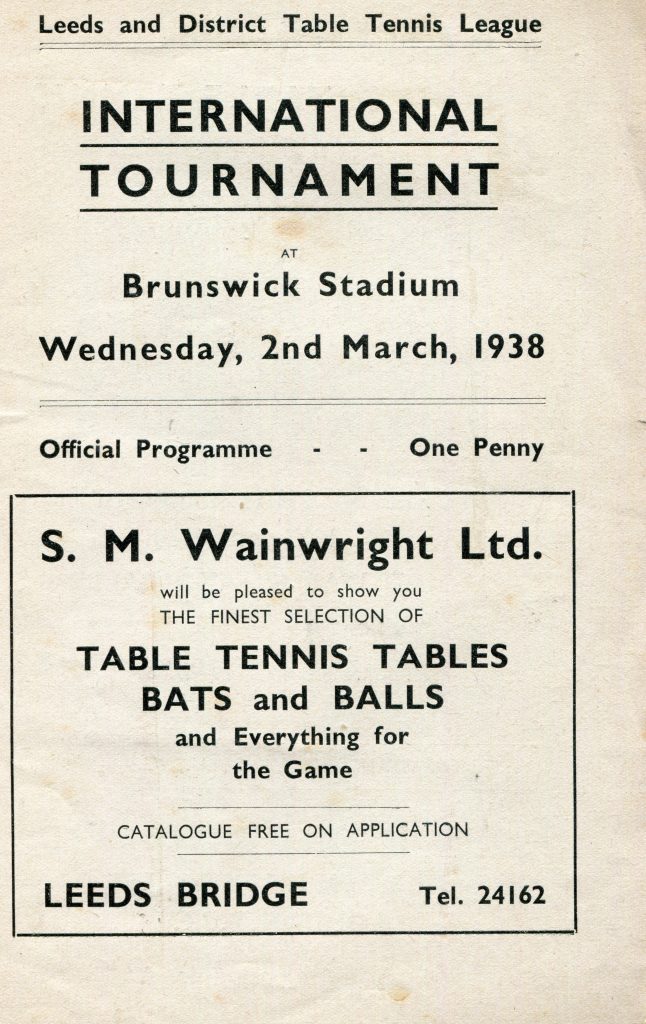
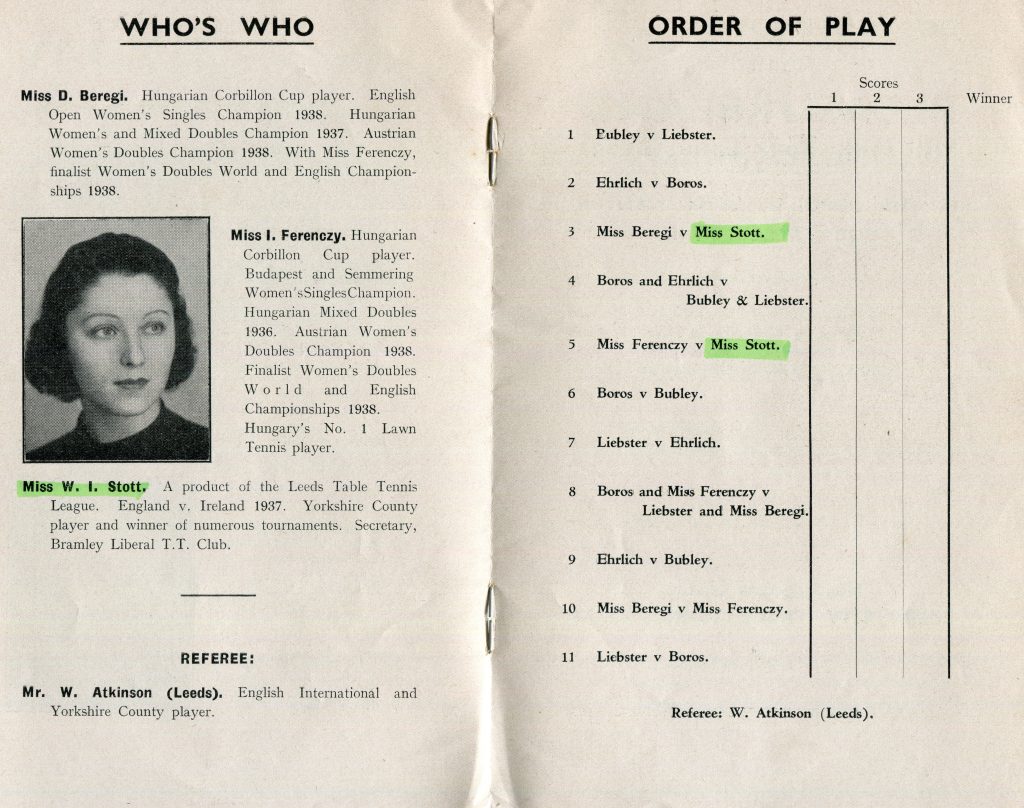
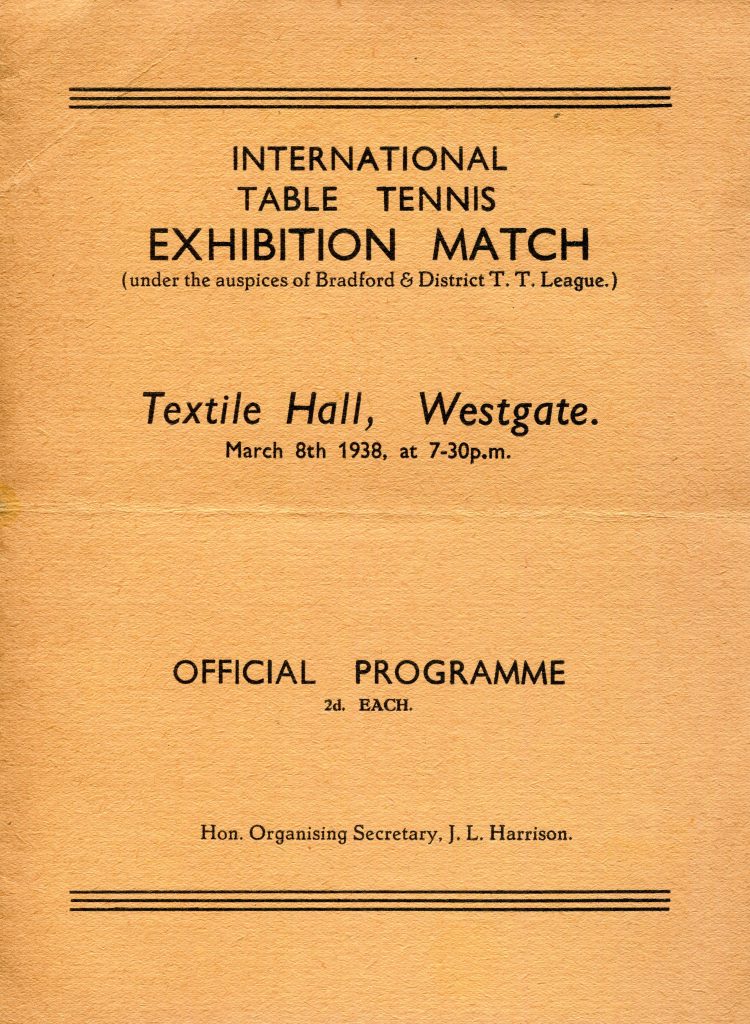
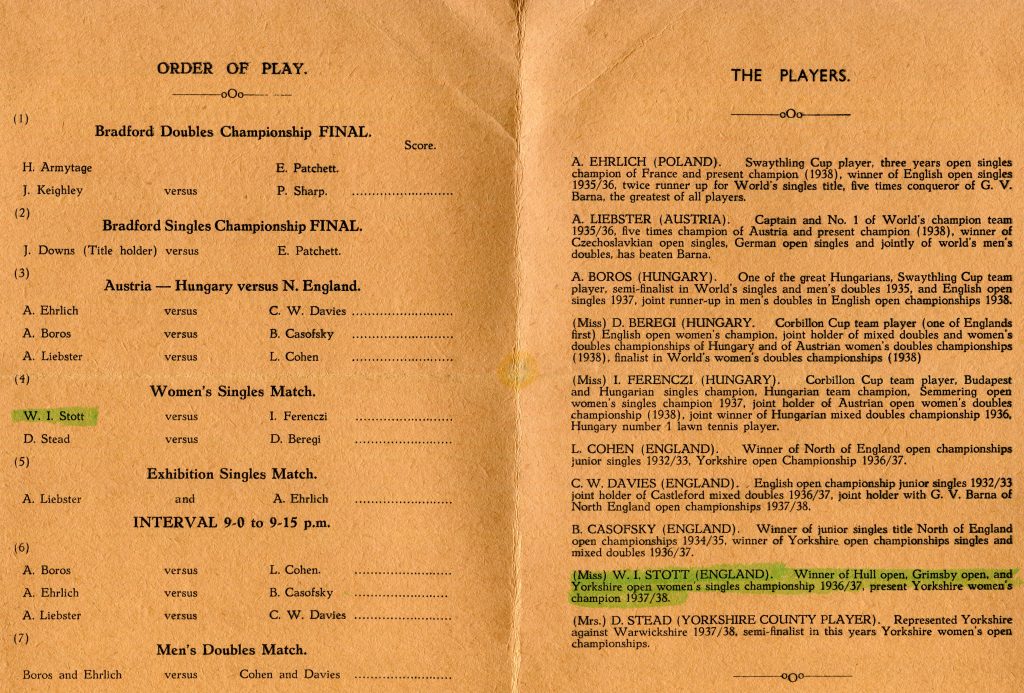
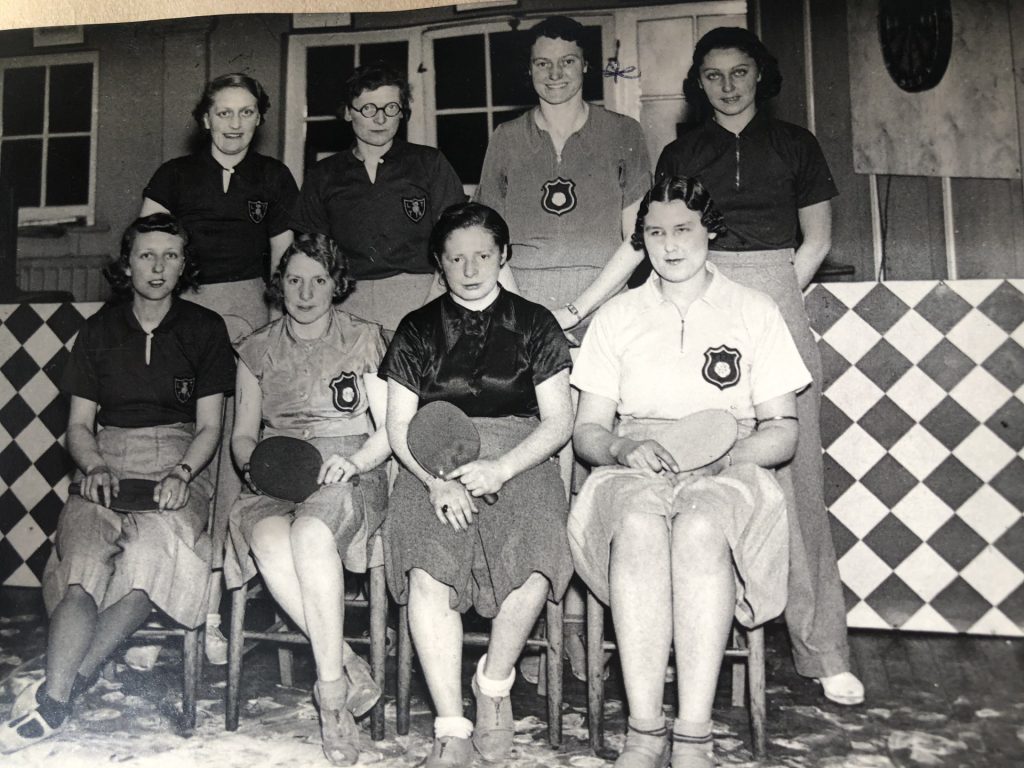
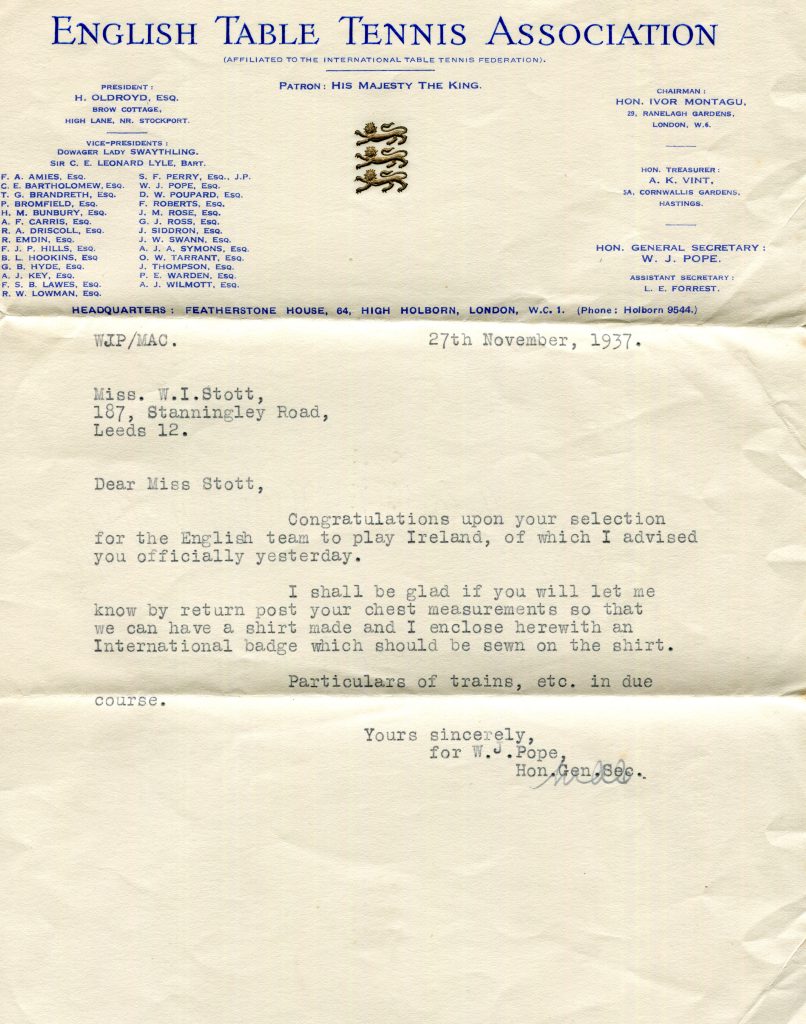
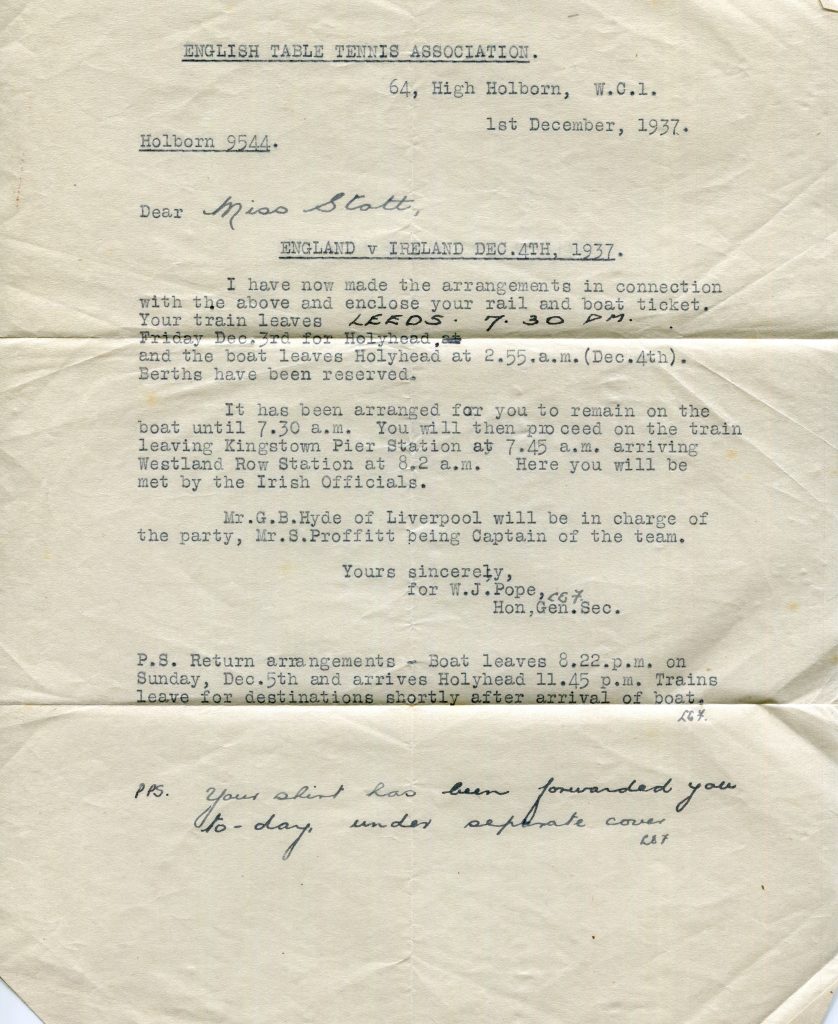
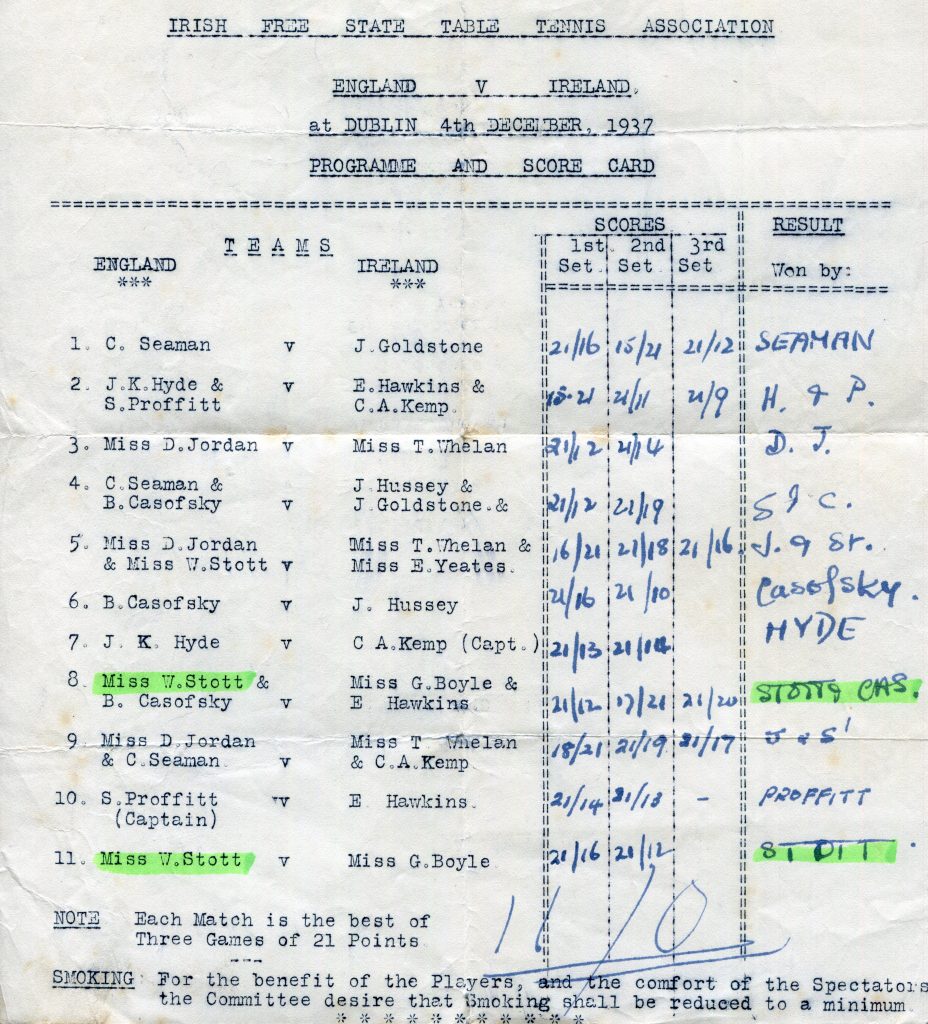
Rene’s first international match was against Ireland on 4 December 1937 in Dublin. It was a successful debut with Rene winning all her matches.
“When I was first selected to play for England, against Ireland, I thought it almost too good to be true,” she said. “My chief recollections of the trip to Dublin are the cordial reception and generous hospitality which was accorded to us everywhere, the long wait for trains and lack of sleep on the way home, and most important of all, the fact I won all my games in my first big international match.”
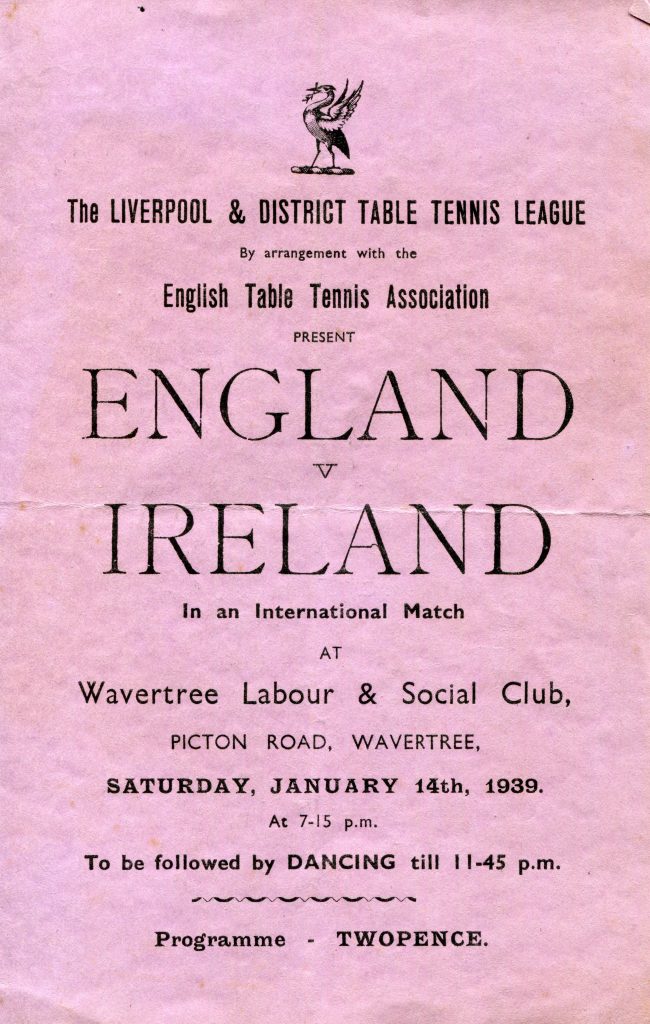
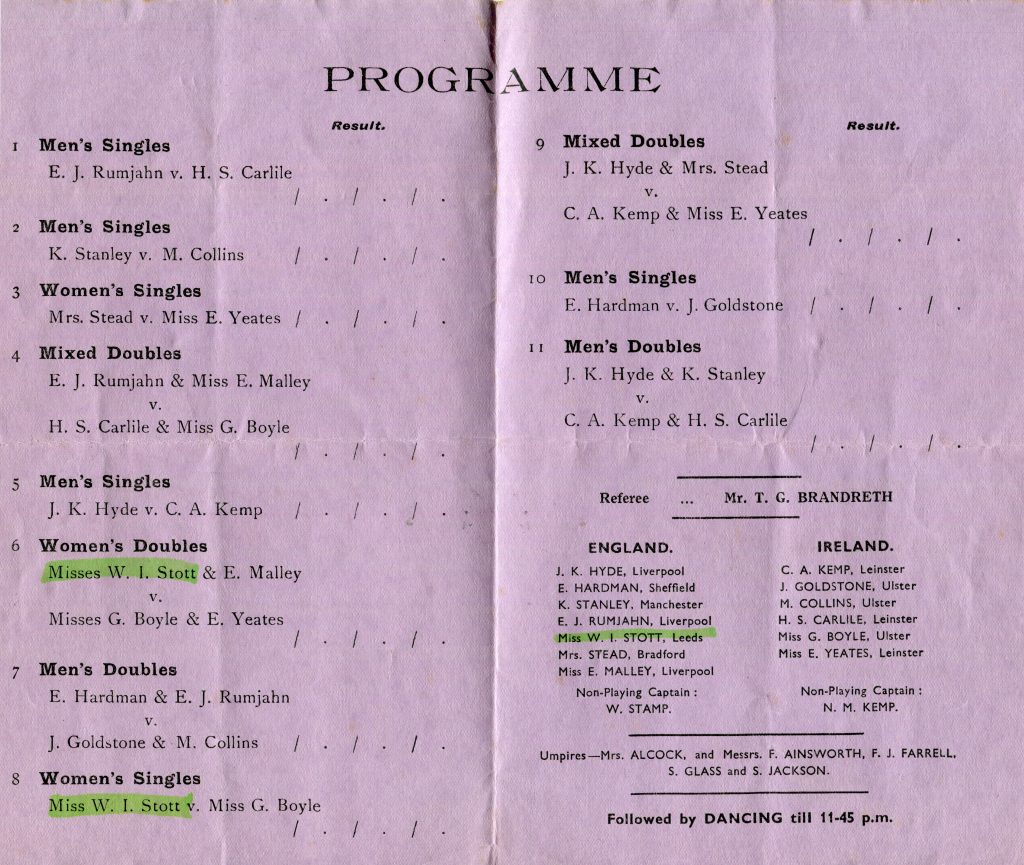
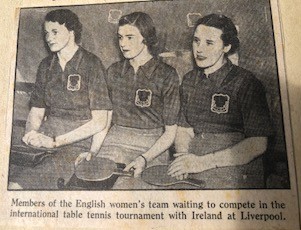
Rene went on to play against Ireland again on 13 January 1939 in Liverpool and although the team won 7-3, Rene lost her singles to Miss G Boyle -16, 16, -17 and women’s doubles playing with Edith Malley was a -10, -15 loss.
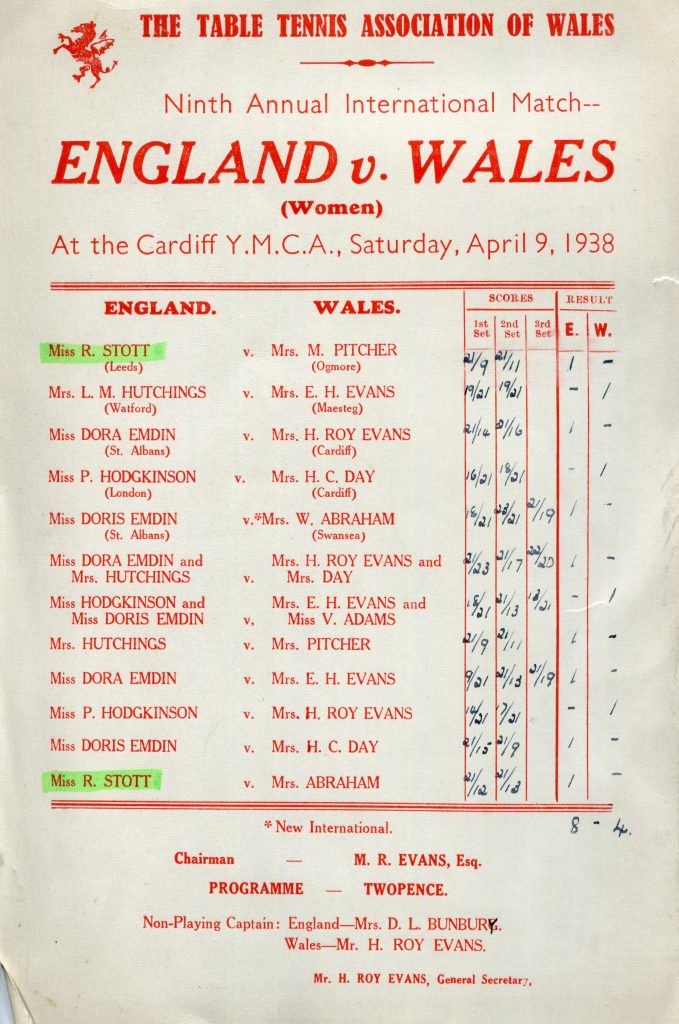
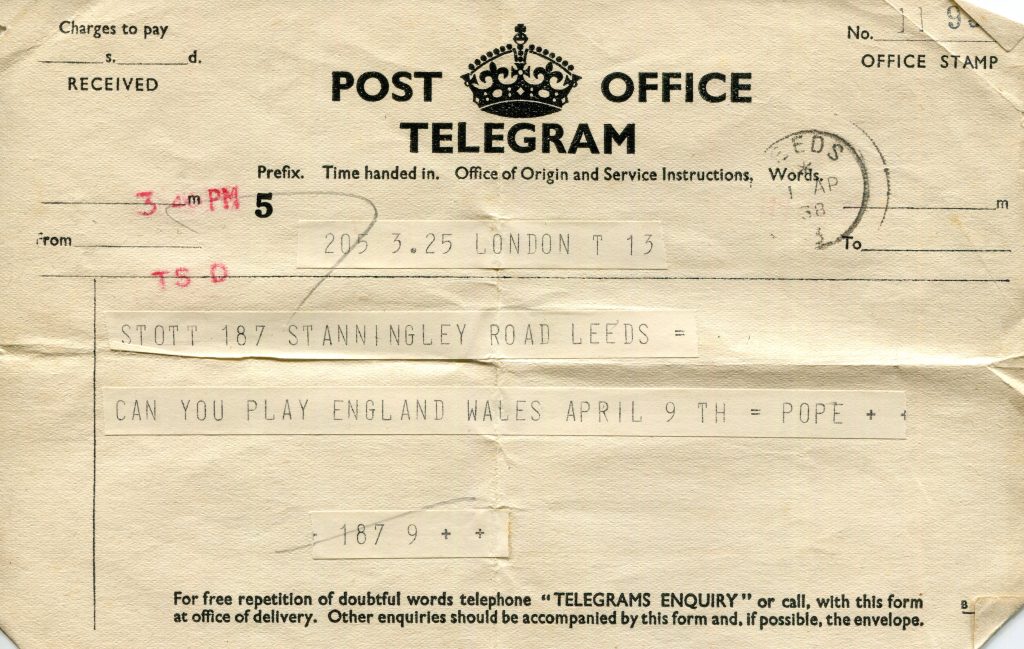
Her second international match was against Wales on 9 April 1938 at Cardiff YMCA and this was a successful occasion with Rene winning both her singles in England’s 8-4 victory. How lovely too, to receive a telegram asking if you can play for your country.
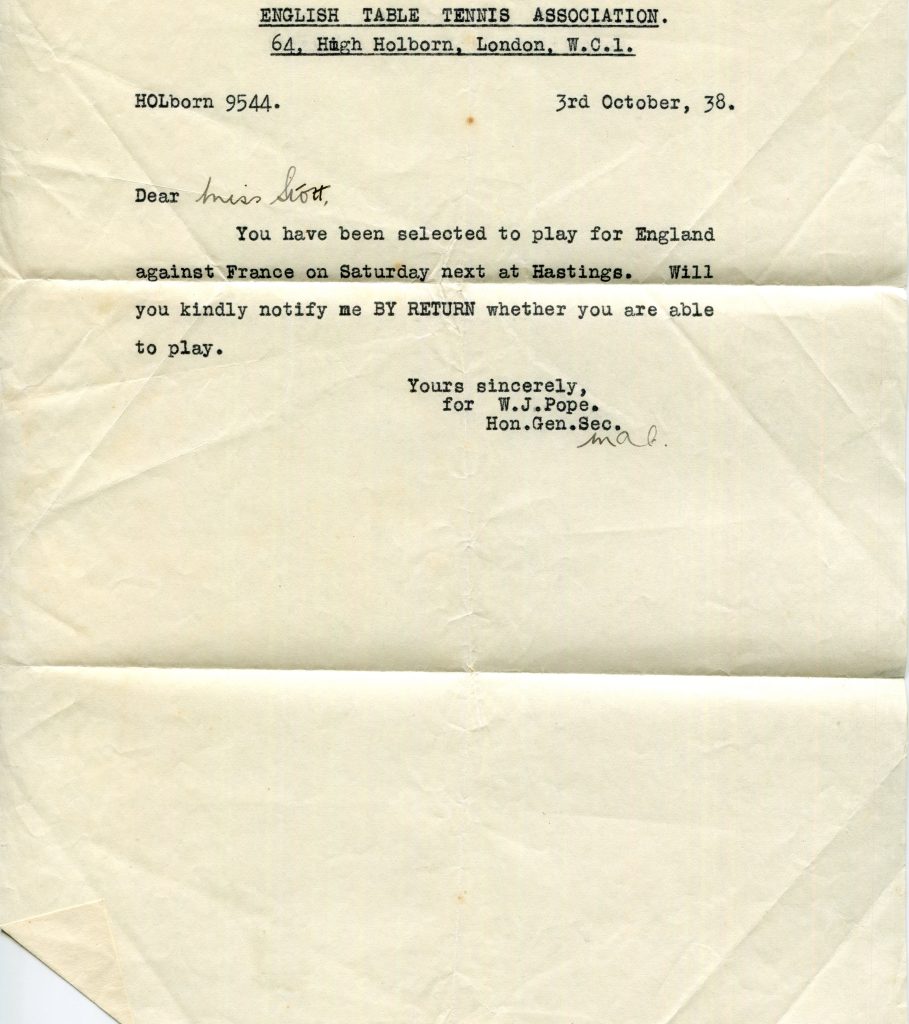
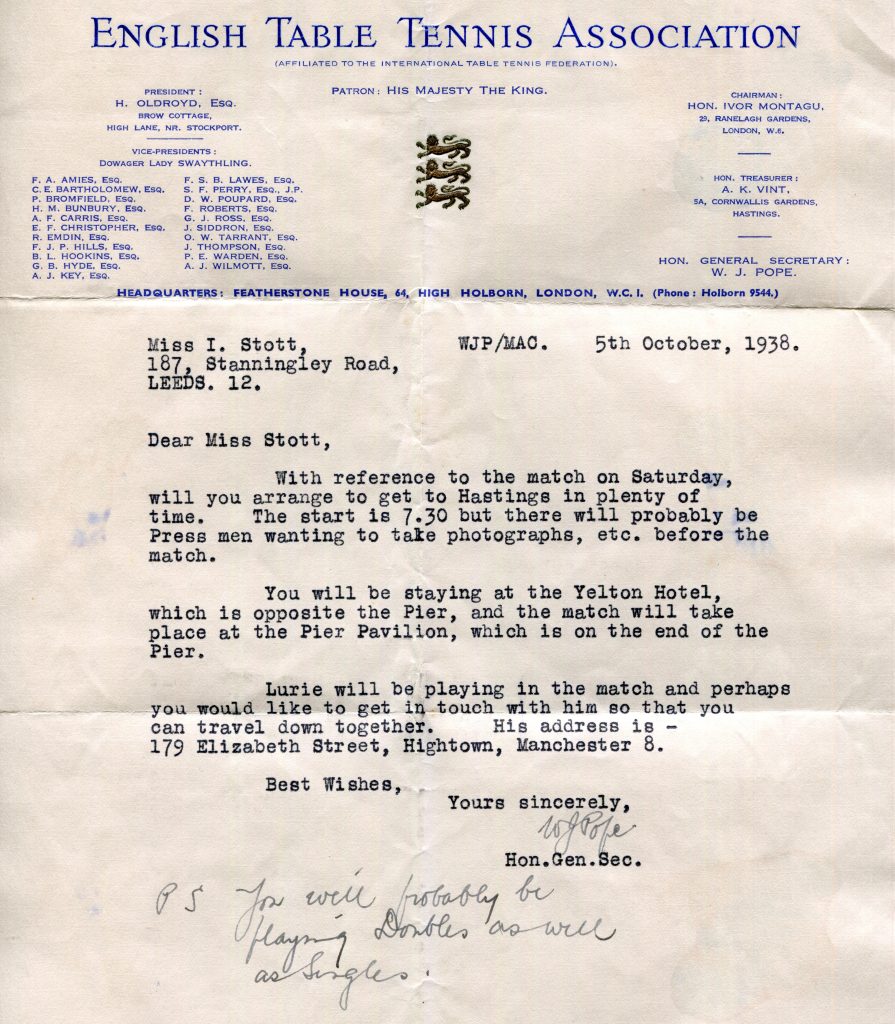
There was one more international, against France. A trip to the south coast town of Hastings on 8 October 1938 for a fixture which England won, although Rene lost her singles match and the mixed doubles with Ernie Bubley.
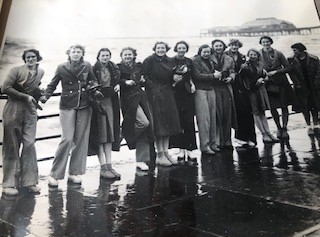
However, the French were so impressed with Rene that they specifically asked for her to play in their Open Championships in Paris. She travelled with Edward to London and then across the Channel to Paris in December 1938.
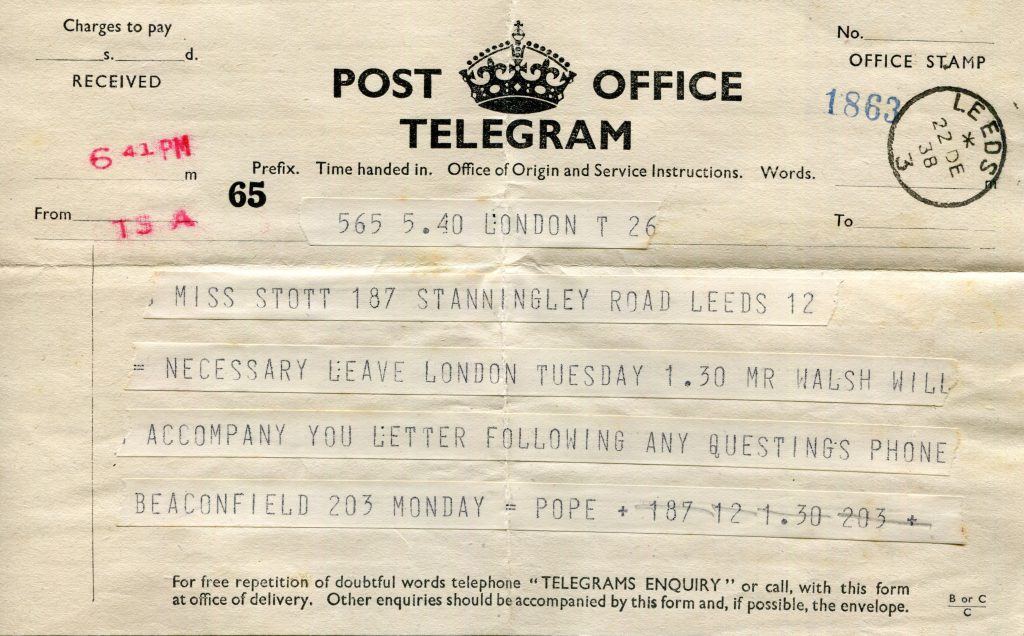
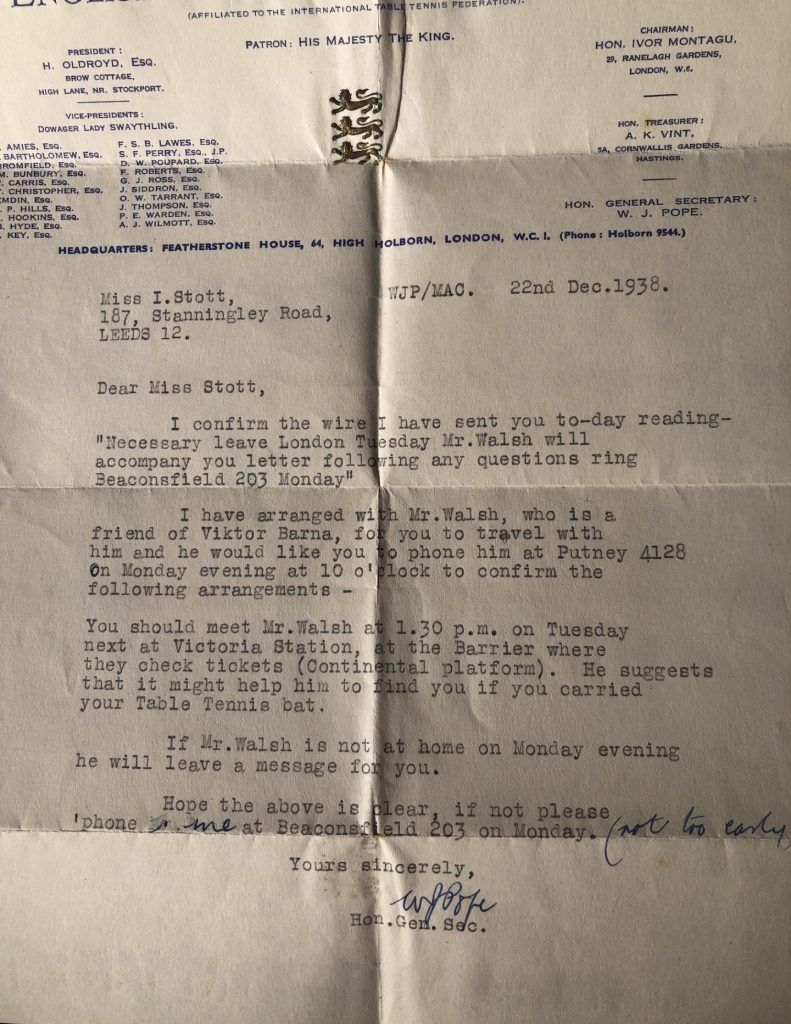
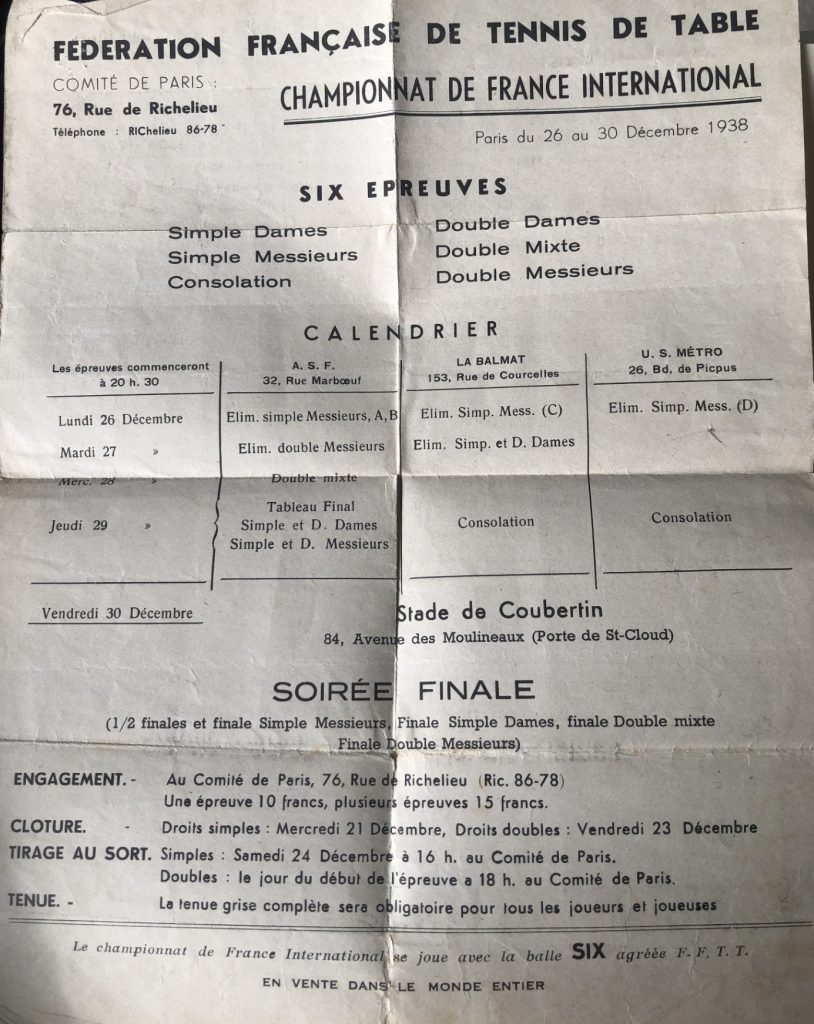
The winner of over 50 titles, Rene was hoping to play in England’s Corbillon Cup team in Cairo in 1939. Rene was selected to play in the trials for the Corbillon Cup team. Regrettably, all leave was cancelled at the Government offices where she worked and so Rene was unable to attend the trials. Ultimately, it was decided not to send a women’s team to Cairo and so her opportunity to realise her dream was lost.
Often playing in women’s doubles with Hilda Amies, whose influence started her playing, the pair won titles in the East of England Open, Grimsby Open, Hull Open, North & East Riding Open and West Riding & Yorkshire Open, with Betty Steventon she won the Lancashire Open. Singles titles came in the East of England Open, Grimsby Open, Hull Open, Leeds Open, Pontefract Open, Scarborough Open and Yorkshire Open. Rene also won seven mixed doubles titles, a number with fellow Yorkshire international, Stanley Rosenberg.
At the Yorkshire Closed, Rene won the women’s singles title four times, winning the first ever title in 1937 and women’s doubles and mixed doubles twice, all before the war.
A county player of note for Yorkshire both before and after the Second World War, she played in all Yorkshire’s 12 county matches before 1939 and seven more after the war. Her last appearance was in 1949. Rene also played in a number of Yorkshire inter-league matches and represented Leeds in the J M Rose Bowl, the women’s national inter-league championships. In 1938 a Women’s Division was formed in the Leeds League mainly due to Rene’s influence and support of women playing.
The English Open was only second to the World Championships in status and Rene played in 1936, 1937 and 1938. She reached the quarter-finals in the women’s singles in 1936 and the same stage twice in the women’s doubles with Hilda Amies, in 1936 and 1937.
During the Second World War there were a number of exhibition matches played throughout England to raise funds for the British Red Cross Fund, the Prisoners of War Fund and other similar charities. Rene played in at least two, one in Pontefract on 6 February 1941 along with two of the world’s best players, Victor Barna and Richard Bergmann as well as England internationals William ‘Billy’ Atkinson and Hilda Amies, plus George Mitton. Another, on 13 December 1943, was in aid of the Prisoners of War Fund and again Victor Barna was there to help raise funds.
By the mid-1950s Rene’s involvement with table tennis diminished. By this time, she had not only played for her league, her county and her country but won many Open and Closed titles. She had participated in a number of exhibition matches to promote table tennis and more importantly to help raise funds for war charities. If it hadn’t been for the war, it is impossible to say how much more Rene would have achieved.
When asked, Rene said she attributed her success to plenty of sleep, no smoking or drinking.
From the White Rose, Yorkshire TT Magazine, April 1948: “Rene has always rendered the greatest possible service to her city, her county and her country and has thus earned the grateful thanks of all supporters of the game.”
What a lovely tribute.