
Table tennis is often described as a fast and unpredictable sport where matches are shaped by players’ instincts. But beneath every rally is a deeper layer shaped by mathematics, as a new academic research book explains.
The monograph, called Spin, Speed and Strategy: A Mathematical Guide to Table Tennis by Dr Xiu Ji brings together years of academic research and real playing experience to explain how the sport really works.
It distils vast, complex physical phenomena into clear, formulated models, providing a comprehensive map of every aspect of the sport.
From lecture hall to league matches
Dr Ji has an academic background in engineering and advanced computing, receiving her PhD in Artificial Intelligence from Cardiff University in 1998. She has spent her career teaching mathematics, physics, control engineering and systems engineering at university level.
The author’s journey into table tennis started casually, playing at the university student union during lunch breaks in 2016.
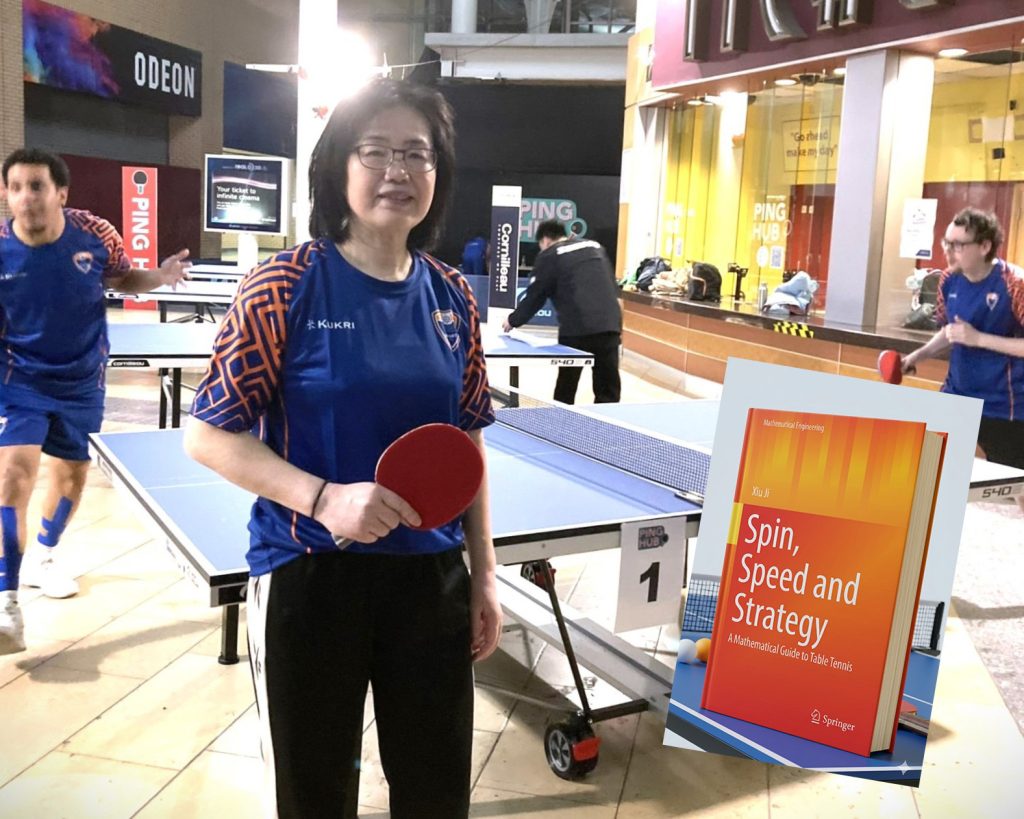
“I quickly fell in love with the sport,” she said, “and by 2020, I crossed over into competitive local league play, starting in the Wilmslow Local League. Today, I compete in the middle divisions of the Wilmslow, Trafford, and Manchester leagues.
“The inspiration for this book came naturally as my academic world and my new passion collided. Around 2016, I began leading and supervising university student research projects dedicated entirely to table tennis.
“Over the past decade, my students and I have explored almost every technical facet of the sport, which laid the perfect foundation for this monograph.
“I absolutely could not have written this book without first-hand knowledge of the sport. While my mathematical and engineering background provided the tools, it was my lived experience as a player and an active member of the table tennis community that provided the substance.”
Breaking down the game
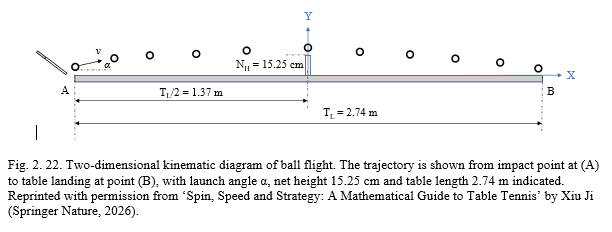
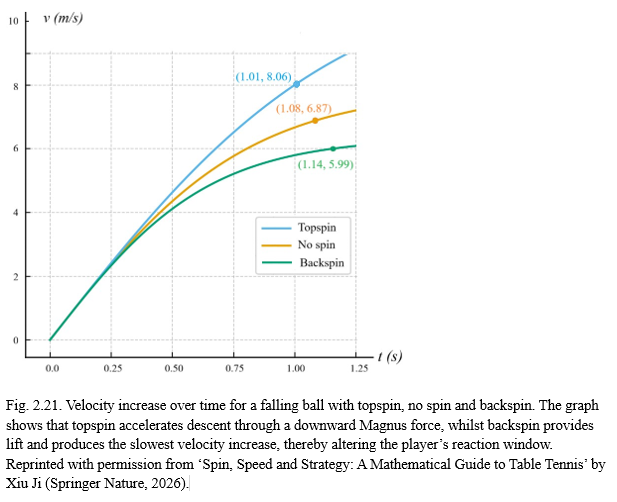
So what does maths actually tell us about table tennis?
First, it helps explain how the ball behaves. Using high-speed cameras and tracking systems, researchers can measure how fast the ball is travelling and how much spin it has, which in turn dictates how the ball moves through the air and how it bounces on the table. What might look like a simple shot is a complex interaction between speed, angle and rotation.
Second, maths helps us understand equipment. By modelling how the blade, sponge and rubber layers behave on impact, researchers can study how energy is transferred from the bat to the ball and explain why some rubbers produce more spin, while others offer more control.
The book uses a notation system to describe rallies, shots and tactics using symbols and simple codes, as shown in the below example.
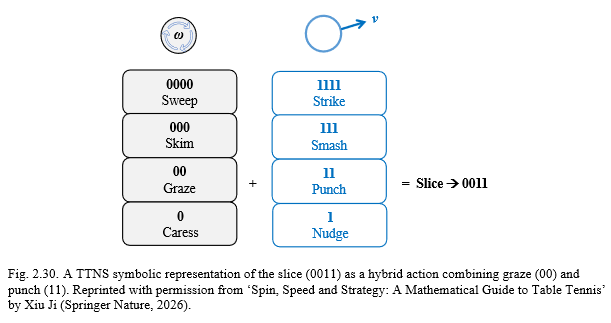
Instead of relying on memory or opinion, every serve, return and rally can be recorded in a structured way.
Over time, these patterns reveal how players win points, how styles differ and what decisions lead to success.
In a nutshell, Dr Ji’s work shows that by measuring these elements, players and coaches can better understand why certain shots are effective.
“When I play, I play to win, and like every player, I lose a lot!” says Dr Ji. “But as an engineer, I view defeat as a data point; it is the best lesson for coming back and playing better!
“Beyond that, I am fascinated by the people I meet from all walks of life in the local leagues. I initiate conversations, asking about their personal journeys into table tennis, discussing how to counter specific playing styles, or analysing why a certain match went well or poorly.
“In fact, I have dedicated this book to the players of the Wilmslow, Trafford, and Manchester leagues. They provided the living laboratory for the ideas, hypotheses and systems I formulate in the book.”
What can players and coaches gain from a mathematical understanding?
Traditional coaching advice often focuses on individual tips. But in reality, no single rule works in every situation.
This is where a mathematical approach can help. By understanding the whole game – not just isolated techniques – players can make better decisions during matches. It is less about memorising what to do, and more about recognising patterns and adapting quickly.
Dr Ji says: “As a sport, table tennis is defined by natural contradictions. It is a constant tug-of-war between attack and defence, speed and spin, stability and disruption, or trying to end a point immediately versus engaging in a long rally. Because of this, conventional coaching advice can often be partial or even contradictory. What works in one split-second scenario fails in the next.
“When you are in the heat of a match, isolated on the table, a single rigid tip won’t save you. A player must rely on their own resources and judgement to quickly adapt to difficult situations and find a way to win. To do that effectively, you need a sound grasp of the wholeness of the game.”
Dr Ji admits that the complex mathematical research is unlikely to be accessible to the average player. However, she believes there are lessons they can still find helpful.
“What a league player, elite athlete, or coach can learn from this book is a profoundly better, holistic understanding of the game,” she says.
“My dream is that coaches and players will use the lens of this book to challenge their own assumptions, see the game differently and apply these mathematical insights to their own training.
“I have benefited from table tennis immensely, and this monograph is my way of paying it back. There is no royalty. A sport this beautiful and intricate deserves a mathematical understanding.”
Published by Springer, the book is aimed at the academic market, including university libraries and research institutes. However, ebook and Kindle versions are available – and anyone with university library access can usually download the digital chapters for free via SpringerLink.
Latest news