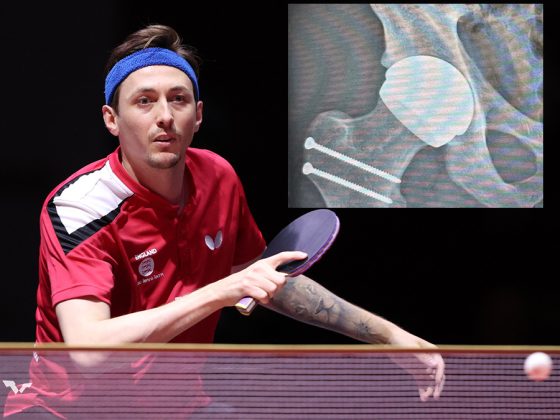
This X-ray shows the result of the leading-edge surgery which aims to get Liam Pitchford back to his best and competing at the top of the world game.
Liam has had a hip resurfacing operation, an evolution of a similar procedure which prolonged British tennis ace Andy Murray’s career. It was carried out on 1 December in London by world-renowned specialist Professor Damian Griffin.
The X-ray shows the ceramic surface which has been added to the top of Liam’s right femur, where it sits in the hip socket.
The operation was needed because of a combination of cartilage damage and bone friction in the joint, which Liam has been managing for some time. However, the lack of mobility and associated pain got to the stage last year where a more permanent solution had to be found.
The image also shows two temporary pins holding in place the bone where it was deliberately broken to facilitate the operation, and which is now healing.
Liam was on crutches after the operation, but still able to work on his upper body and use a static bike. He is now off the crutches and has moved to the next stage of his rehabilitation.
The operation was carried out to give Liam the best possible chance to compete at his best in the run-up to the 2028 Los Angeles Olympic Games – if he qualifies, it would be his fifth successive Olympics.
You have to go back to just before his first Olympics, on home soil in London in 2012, for the starting point of the journey which has led to this point.
“I’ve known about the issue for a long time – I first saw a doctor about it just before the 2012 Olympics,” said Liam.
“Where the top of the femur fits into the socket wasn’t moving the way it should, which caused the bone to catch against the hip socket and restricted movement in the hip.
“When I first went to the doctor, he said I didn’t need the op, and I did six weeks of rehab and then carried on and kept on top of it until covid.
“Since then, it’s been up and down – some weeks I was good but some weeks it got worse, particularly the more I travelled and the more I played.
“So, in the back of my mind, I knew I probably needed an operation, but it’s not an easy decision to make.
“I knew Paul (Drinkhall) and Dave (McBeath) had similar operations and it takes a long time to come back. That weighed on my mind, so I tried to play through it.
“In late 2024 I was having issues again. By last February, I couldn’t go into a squad session for any time without a sharp pain. When you’re trying to compete at the highest level, it’s not good and it was all that was on my mind.
“I had an MRI scan and spoke to Professor Griffin and at that point, I was ready to have it done. But there were some big events coming up, so I tried to play through it for a little bit longer.
“We went on a pre-season camp to Spain for a week and I tried to do a bit more training. I was sharing a room with Sam (Walker) and I felt my hip go, and I said to Sam it hadn’t been like that before.
“I couldn’t practise before the Sweden Smash (in mid-August) and couldn’t play well. It got to the point where I knew I couldn’t compete anymore.”
The first step was a keyhole procedure in London’s Harley Street which involved injecting dye into Liam’s hip to check the extent of the damage.
Liam then discussed his options with Professor Griffin and England physio Justin Lucas-Hill and it was agreed a hip resurfacing, which Professor Griffin recommended, was the best way forward. The operation was carried out at a hospital in St John’s Wood.
“We spoke about my goal to get to LA and do five Olympics and he said I needed to have it now,” said Liam.
“He cut part of the bone off, dislocated the hip, shaved the bone down and made it the right shape. He put a ceramic coating at the top of my femur and in the lining of my hip socket and then put the bone back which he’d cut off, and screwed it in with two metal screws.
“I’ve got quite a big scar down the side of my right hip now and I’m on crutches for six weeks then start my rigorous rehab.
“Because he didn’t have to cut through into any muscles, he thinks I can start slowly on the table in about three to four months (from the operation), which is quicker than I was expecting and the best-case scenario, really.
“It’s feeling a lot better and I’ve been able to do some work on the bike and some upper-body work set by Dave Hembrough (from Sports Science partner Sheffield Hallam University) and Justin.
“Professor Griffin said nothing is guaranteed, which I knew, but I needed to do it to play pain-free and give myself the best chance to compete at the top again.”
Latest news
- GB performance
- Competitions
Three new events added to popular Swansea Open - entries open
- Counties and Leagues