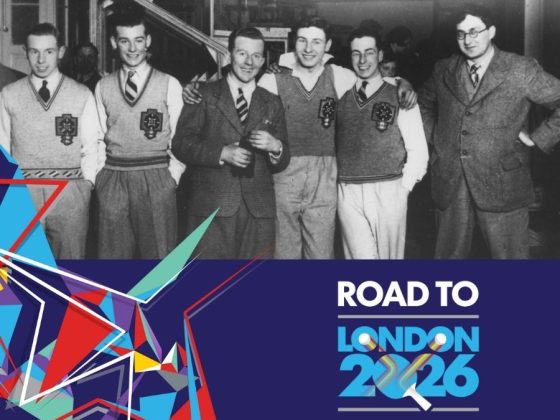
In the latest instalment of our series on England’s World Championships performances over the years, Diane Webb (Chair of Archives, Museum and Records Committee) looks at the Championships in 1930 and 1931.
Keep an eye on our website and social media platforms for a host of features in our Road to London 2026 series – and click below to secure your tickets for London 2026.
1930, Berlin
It was men only for England at the 1930 Championships in Berlin, with no female players travelling to Germany. England’s team were not the strongest as four top players were unable to attend – there was no Charles Bull, no Adrian Haydon, no David Jones and no Fred Perry.
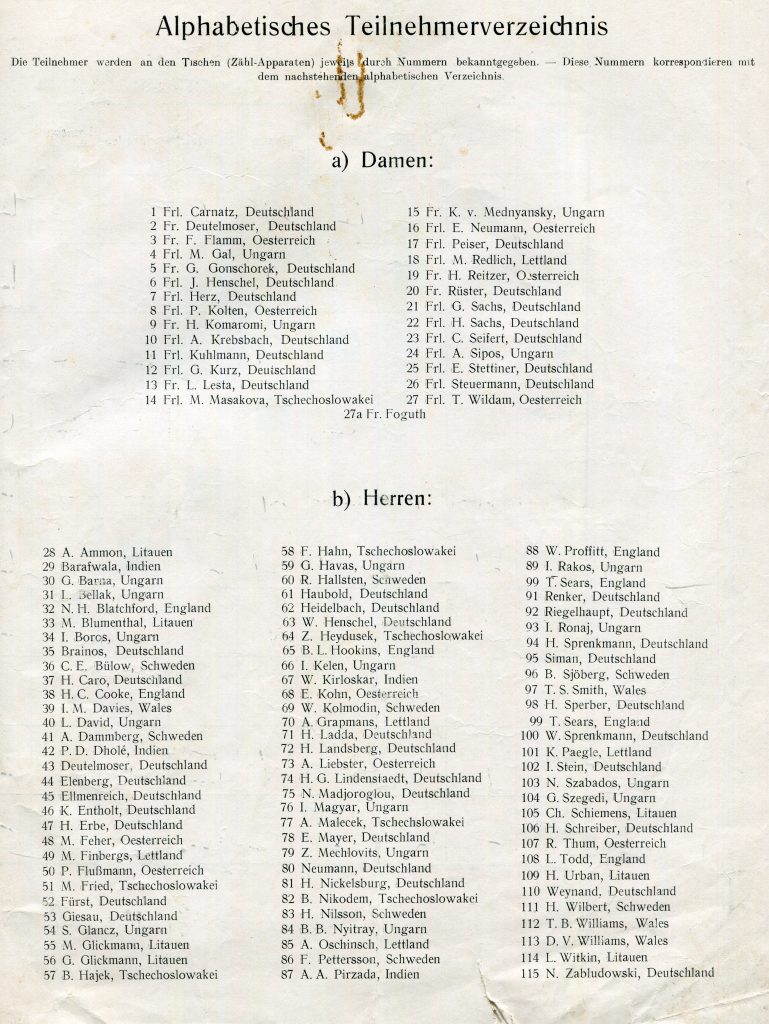
Hungary dominated the Championships, winning every event and gaining four silver medals in the individual events too. In the Men’s Team they won every fixture, Sweden was second, only losing to Hungary, whilst Czechoslovakia were in bronze medal place with losses to the two teams above them. The Hungarian team was star-studded – Victor Barna, Laszlo Bellak, Lajos David, Istvan Kelen and Miklos Szabados.
England’s quintet of Victor Blatchford, Cliff Cooke, Bernard Hookins, Stanley Proffitt and Tommy Sears finished in sixth place with wins over Germany 5-4, India 5-4, Lithuania 5-2 and Wales 5-1. Their losses were to Austria 0-5, Czechoslovakia 2-5, Hungary 0-5, Latvia 1-5 and Sweden 3-5. As well as the official England team, 22-year-old Leslie ‘Les’ Todd also played.
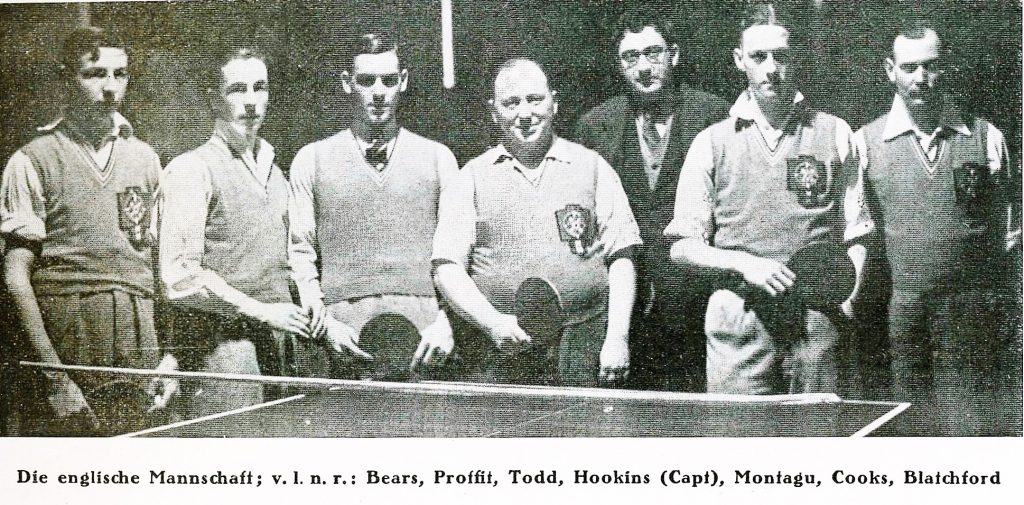
Barna, who was beginning to emerge as a world class player in Budapest the year before, cemented his status, winning the Men’s Singles with a fine win over Bellak in the final while David and Kelen finished with the bronze medals making it a clean sweep for Hungary. England’s Blatchford and Proffitt reached the round of 16 while Hookins and Sears went out in the round of 64 and Cooke and Todd in the round of 128.
The Women’s Singles was yet another title for Maria Mednyanszky, making it four in a row, defeating fellow Hungarian Anna Sipos in the final with two Austrians in bronze medal position, Josefine Kolbe and Gertrude Wildam.
The Men’s Doubles saw Barna take his second title, playing with Szabados, the pair defeated Austrians Alfred Liebster & Robert Thum in the final. Bellak & Glanz, and Swedes Valter Kolmodin & Hille Nilsson took the bronze. Blatchford with Hookins and Cooke with Proffitt were defeated in the round of 16 and Sears & Todd lost in the round of 32.
The two Women’s Singles finalists combined to take the Women’s Doubles title with a win over fellow Hungarians Magda Gal & Marta Komaromi. Four Austrian players were losing semi-finalists, Kolbe & Etta Neumann, and Helly Reitzer & Wildam.
Les Todd was the best English player in the Mixed Doubles, playing with Frau Lesta of Germany he reached the round of 16. Cooke and Proffitt both played with German ladies, Fraulein Seifert and Fraulein Kurz respectively, and went out in the round of 32.
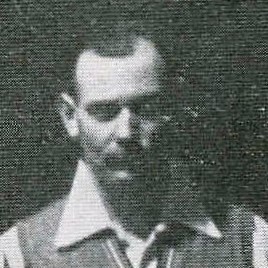
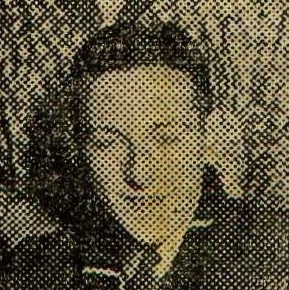
Cooke also played in the first known county match between Lancashire and Yorkshire in 1927 in Bradford, again playing with Proffitt and Pittilla. Cliff played cricket professionally for Lancashire. He lived to the grand old age of 102 and his son, Bob, recalls he was very active as a centurion, having photographs of him jet skiing when he was 100 years old.
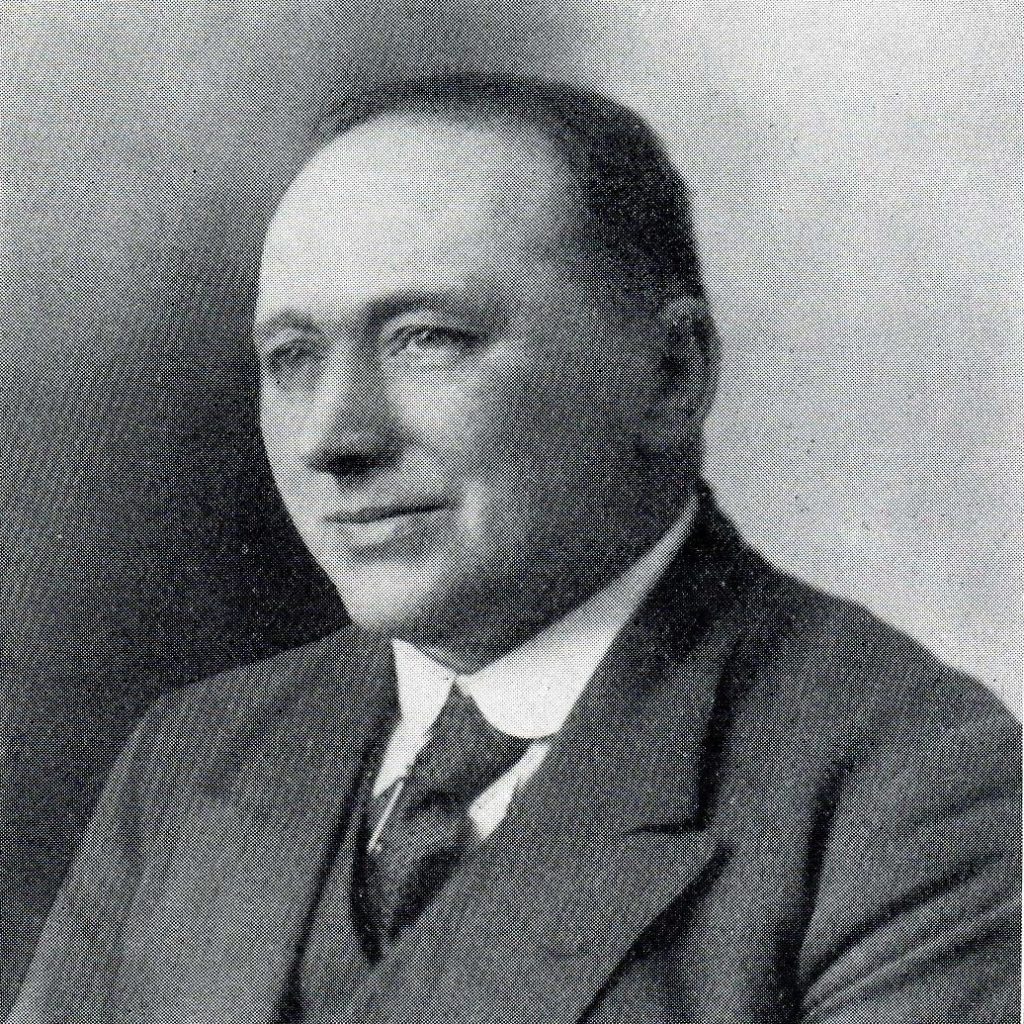
A significant administrator, Hookins became an ETTA Vice-President in 1931 after serving the Association as its Honorary Secretary and Treasurer for the 1929-30 season. He was one of the four founders of the Yorkshire County Association and became its President as well as being its secretary. He held several other positions including Northern Counties Secretary, West Riding TTL President, Whitby & DTTA Chairman and ETTA representative and the same for Doncaster & DTTL. Hookins also served on the ETTA Northern Counties group as secretary and was an Executive Council Member for West Riding, an Executive Committee Representative for Directly Affiliated Clubs and Area Committee Yorkshire County Secretary.
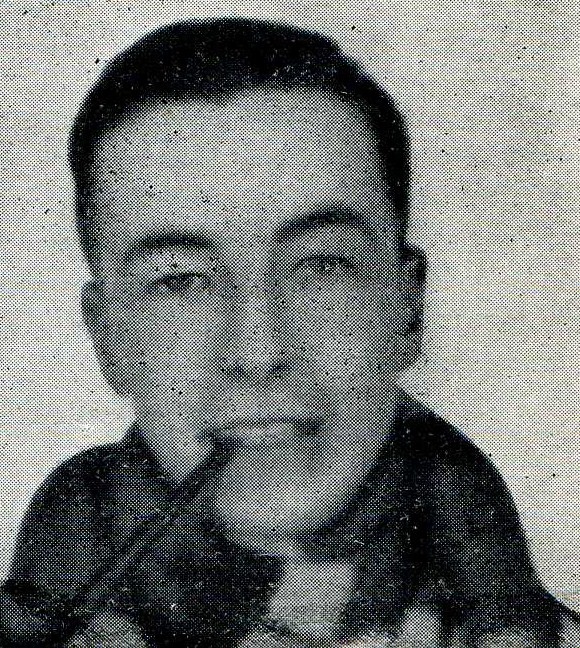
Proffitt played in several English Opens and numerous other domestic Open tournaments winning several events in the Welsh Open, Hertfordshire Open, Home Counties Open, Hull Open, Kent Open, London Open, Merseyside Open, North of England Open, North London Open, Pontefract Open, South London Open, Sussex Open and West Middlesex Open. A champion at the Lancashire County Closed in the Men’s Singles in 1929/30 who played for the county in the Premier Division of the County Championships. A participant in several exhibition matches before the Second World War, Proffitt continued after 1945 playing them as a stage act. He was described as a stylish left-hander, always very fit and a shrewd tactician.
Proffitt became one of the first Approved Coaches in 1950/51 when the coaches’ qualification was brought in and went on to captain England. Other ETTA positions included a Selection Committee member, Registered Players Committee member and Registered Players Panels Commission Member (northern Representative). He was also secretary and Lancashire representative on the County Championships Committee.
As well as being a table tennis international Proffitt was an excellent cricketer, a left-handed batsman and slow-left-arm bowler who played for Lancashire 2 XI and also professionally for Essex. He later took up marathon running and weight training and continued coaching youngsters at Manchester YMCA. He was the longest serving member at the YMCA when he died aged 88 years after joining in 1921.
After serving six years in the army, Proffitt continued playing after he had served and helped popularise table tennis with a plethora of articles in several journals.
A popular player who was also a generous one who bequeathed the Stanley Proffitt Fund, a Swaythling Club International Award presented annually to help young and promising players with their training.
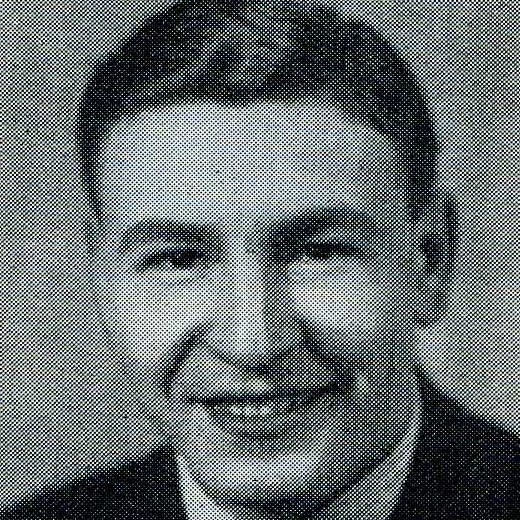
There was success at the English Open 1933/34 and 1935/35 when playing with Victor Barna the pair won the Men’s Doubles; he was runner-up with David Jones in 1932. A prolific player on the Open tournament circuit in England he had numerous wins. In the London Business Houses League, playing for W H Smith’s, he won the Men’s Singles three times and Men’s Doubles once. In June 1935 he had the unusual experience of playing in an international tournament at Lane’s Club in Baker Street, London, mainly to try out a slate table.
A regular participant in exhibition matches, Sears was a member of the ‘All England Exhibition Circus’ along with Stanley Proffitt, Maurice Bergl, Gilbert Marshall, Eric Findon and Hugh Jones. With others he played at the Concert Hall, Broadcasting House and the Daily Express theatre.
During the Second World War, Sears served in the Royal Corps of Signals. At the fall of Singapore he was captured by the Japanese and forced to work for nearly four years on the infamous Death Railway. On his return to England, he didn’t achieve quite the same standard as before but still took an enormous amount of pleasure in playing. His time and energy went more into helping others, particularly working with juniors, and serving on several ETTA committees – National Selection & Coaching Committee, Selection Committee, Coaching Committee, Selection and Ranking Committee, Victor Barna Award Committee, Junior Committee and Junior Panel. Sears initiated and helped develop the ITTF Youth Commission and served as a member of its committee from 1955-59. A qualified coach becoming an ETTA Approved Coach, gaining a Basic Coaching Diploma and later an Approved Senior Coach qualification.
Sears captained England at both women’s senior and junior level for over 10 years including taking three youngsters on a lengthy tour of Sweden in 1951 and he helped run training courses at Lilleshall National Recreation Centre. Ivor Montagu reports “he developed to an art the system of captain’s reports on matches and tours, analyses of players, conditions etc. with constructive suggestions”.
Montagu held Sears in the highest regard and described him “As a player and as a man, he was astute, deep, economical of movement, a stylist, a strategist, resolute, conscientious in all he undertook, unobtrusive, unselfish, loyal, a philosopher. A true friend, a model linch-pin of a model family”.
What a wonderful tribute to a great man who contributed so much.
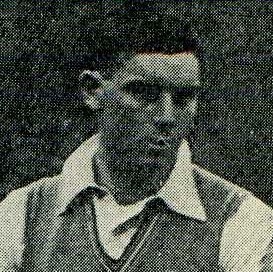
A left-handed table tennis player who made his international debut in the 1929/30 season against Wales, Berlin was the only World Championships he played in. However, he also played in several English Opens which were regarded as second only to the Worlds and achieved success at the Merseyside Open in 1929/30 where he won the Men’s Doubles with Cliff Cooke and was the Mixed Doubles winner at the West Middlesex Open in 1932/33 with Daphne Roberts.
1931, Budapest
It was a return to Budapest where the World Championships had been held two years previously. Hungary again dominated the Championships not only taking all the titles but also four silver medals and five bronze on home territory. The daytime tournament matches were played in the State Room of the Lovas Fencing School and the evening matches at the Sportarena. Matches were played between 9am-1pm, 3pm-6pm and 7pm-11pm.
There was a much stronger squad representing England this year with most of the players who were unable to go to Berlin in 1930, present in Budapest. The full squad was Charles Bull, Adrian Haydon, David Jones, Stan Proffitt and Tommy Sears with Ivor Montagu the non-playing captain. Also travelling were Don Foulis and Corti Woodcock. There were no female players from England.
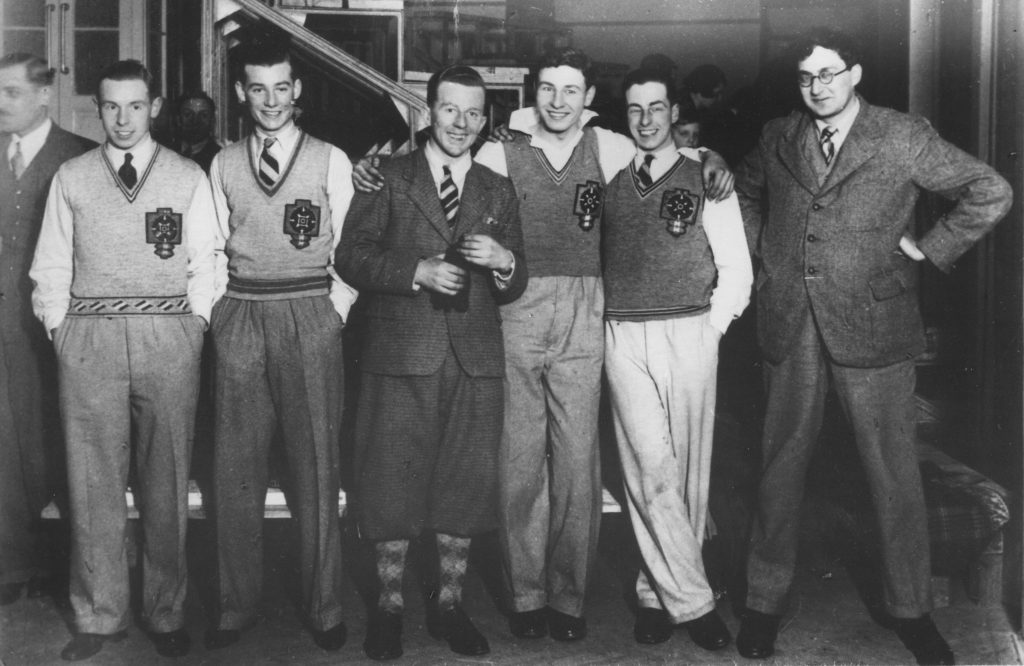
Eleven teams entered the Men’s Team event. The additional strength in England’s team was reflected in their results with eight wins and only two losses.
Corti Woodcock wrote an extensive report on the World Championships in the April 1931 edition of Table Tennis Illustrated. According to his report, nominations for the England team were requested from every League and a series of trials were conducted to determine the final line-up. The final trial took place in London on 17 January and the final selection was agreed unanimously by the selectors. Setting out only three weeks later did not leave much time to make arrangements for those going to Budapest.
The party left London on 8 February and arrived in Budapest in the early hours of Tuesday, the 10th. Bath, breakfast and bed followed for the team players while Foulis and Woodcock went to the hall where the Hungarians were practising and realised “for all the hope we had of getting our hands on the Cup, we might as well have stayed at home and prayed for it to drop from the sky”.
The afternoon of the 10th saw England, despite being somewhat travel weary and still stiff from their lengthy journey, get off to a good start against Lithuania 5-1. Not such a challenging match which helped the players adjust to the fast tables.
There were two matches on Wednesday which resulted in two wins, Romania 5-4 and Germany 5-4. The Romania match wasn’t as tight as the scoreline suggests but it was nearly disaster against Germany. The team were 4-2 down but managed to claw back to gain the win 5-4. Proffitt had injured his hand in a motorbike accident just before he left England and started slowly but improved as the Championships went on as his hand began to heal.
Thursday, two more matches and two more wins, 5-0 against India, who were England’s travelling companions, and Yugoslavia 5-1. There was only one match on Friday and it was another win for England against Latvia 5-2 which saw England go into the last day undefeated.
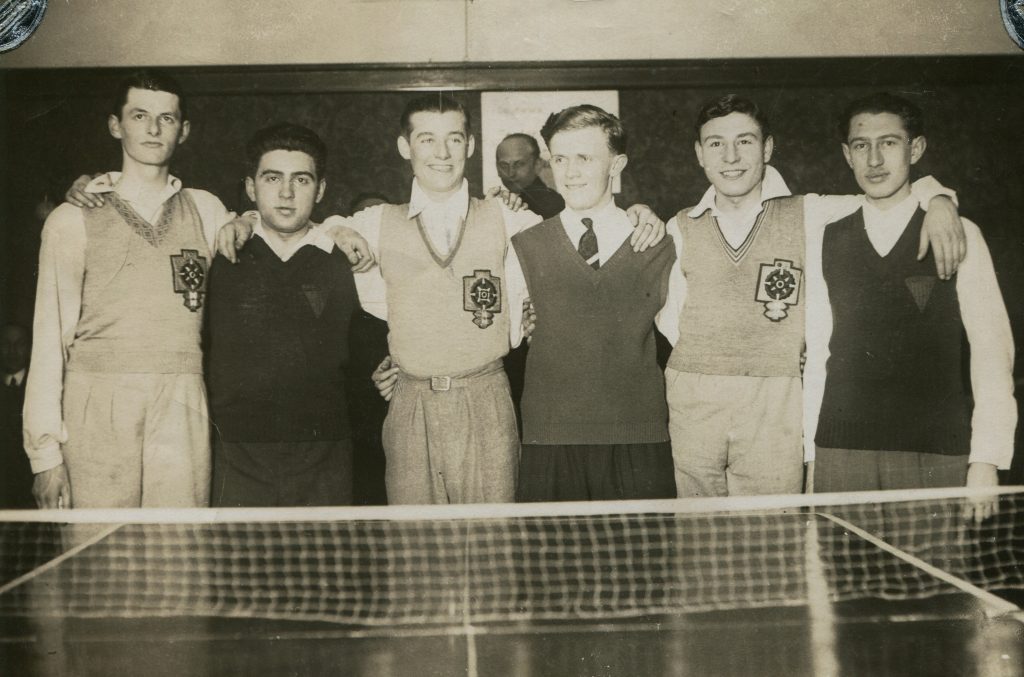
It was a long day on Saturday with four matches for the England men. It had been anticipated by the organisers that England and Hungary would be undefeated by this stage of the Championships. So, with an eye on the box office this match was scheduled for prime time. Earlier in the day, England had played Sweden and it was a 5-3 win. England then started their match against Czechoslovakia and were 2-1 down at the tea interval, this match wasn’t continued until later as the match against Hungary was scheduled straight after the interval.
Refreshments taken, the match against Hungary began. Bull versus Barna were first on the table. It was close, especially in the deciding third game, however, Barna came out on top 14, -11, 20. Bull later played Szabados and it was another close match again it was the Hungarian who was the victor with the score 19, 20. Haydon lost to Barna 10, 9 and also lost to Kelen 20, 12. The third England player, Jones, was another Szabados victim 20, 12. So despite the strength of the Hungarians, the English players did not disgrace themselves and gave the opposition a bit of a fright.
The match against Czechoslovakia then resumed! Perhaps not unsurprisingly, after the disappointment of the Hungary match, England lost 3-5. The final match for England was against Austria and that resulted in a 5-1 win.
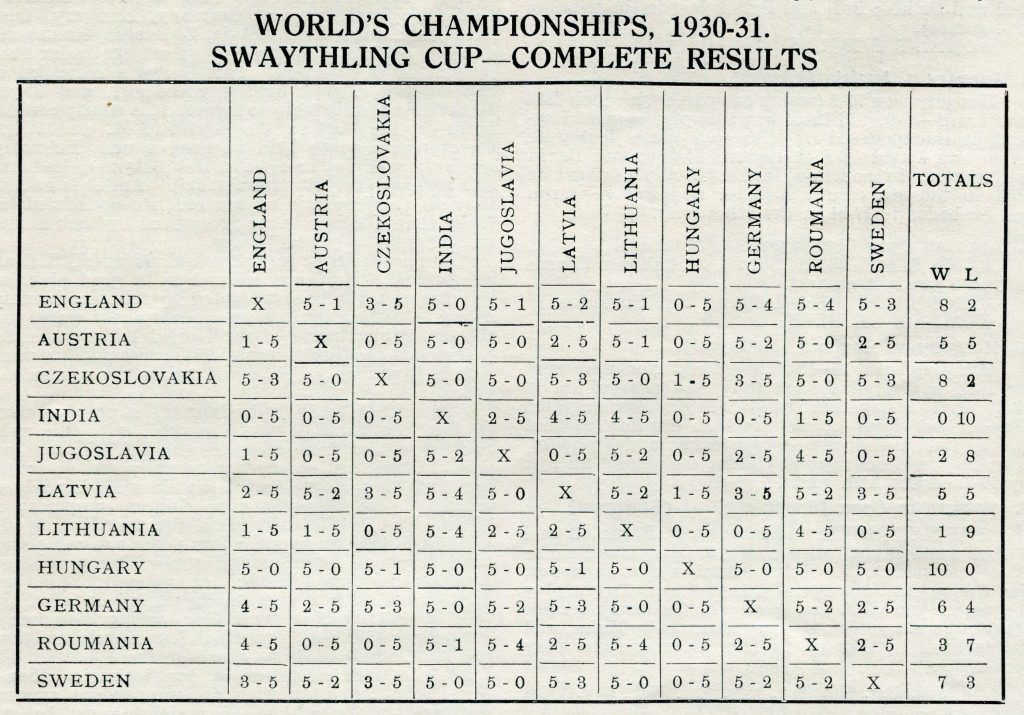
Hungary were the undefeated champions, winning all their matches with the loss of only two games. England and Czechoslovakia came equal second with eight wins and two losses apiece. Games score for England 43 to 26 and for Czechoslovakia 44 to 19.
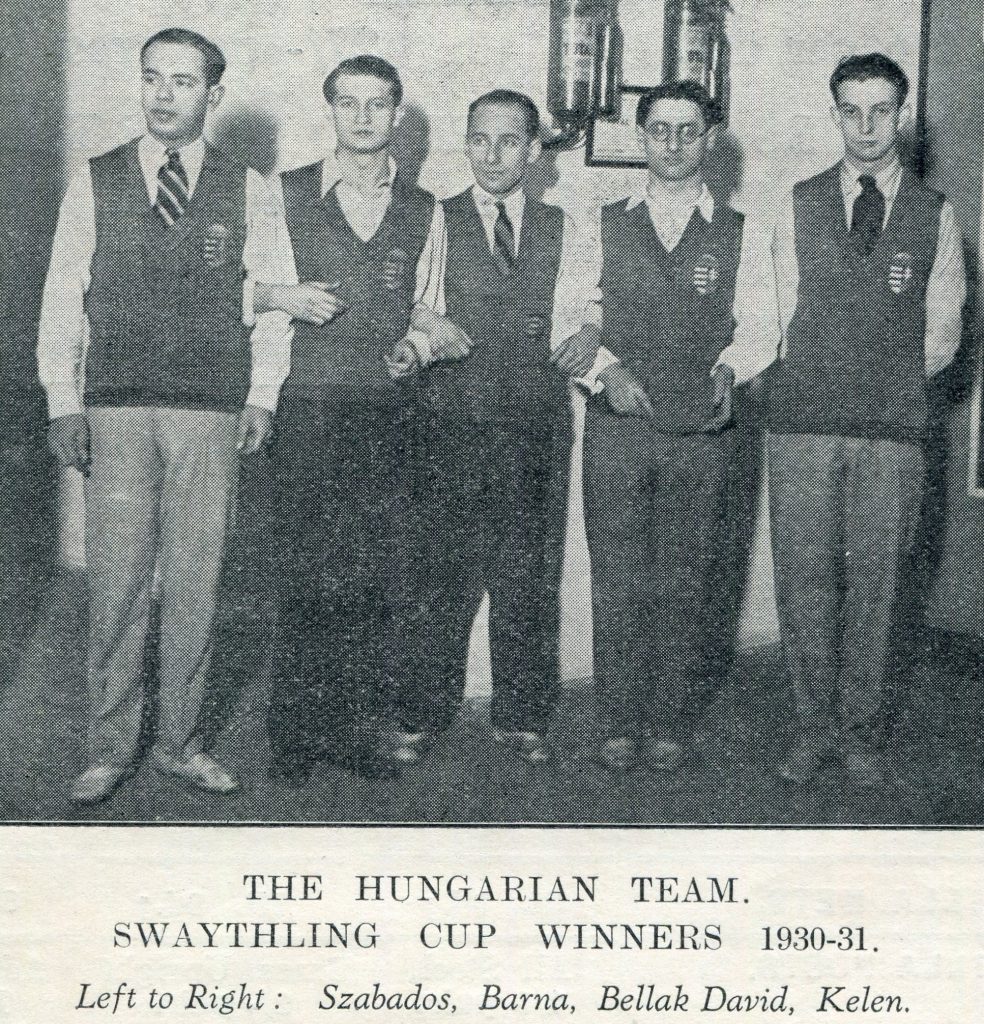
Apart from the team event there were no other medals for England’s men. Proffitt was best placed in the Men’s Singles with a good performance that took him through to the quarter-finals. Bull had the misfortune to meet the eventual winner, Miklos Szabados, in the round of 16 but challenged him with a 13, 15, -14, 19 score. Montagu, in his first match, met Victor Barna and went down 8, 10, 9. Also out in the round of 64 were Haydon, Jones and Sears, whilst the two who went as independent England players, Don Foulis and Corti Woodcock, were knocked out in the round of 128. Defending champion Barna was unable to hold onto his title, falling to Szabados in a hard-fought final with the score 13, 22, 14 in favour of Szabados.
In the Women’s Singles event, Maria Mednyanszky triumphed for the fifth time defeating Mona Ruster-Muller of Germany in the final with the score of 8, -16, 8, 13. There was a limited entry of 16 participants in this event.
The two Men’s Singles finalists teamed up to take the Men’s Doubles title, fellow Hungarians Istvan Kelen & Lajos David were the runners-up with the finals score 15, 16, -20, 18. Bull & Jones lost in the round of 16 whilst Haydon & Sears, and Proffitt & Foulis went out in the round of 32. The pair of Montagu & Woodcock went out the round earlier.
Women’s Doubles saw only seven entries and holders Mednyanszky & Anna Sipos retained their title with a 7, -19, 17, 13 win over Magda Gal & Lili Tiszai of Hungary.
Szabados ended up a quadruple gold medallist and Mednyanszky a triple gold medallist. The pair joined forces in the Mixed Doubles to beat Barna & Sipos in the final 13, 18, -16, 18. Haydon with Ruster-Muller were quarter-finalists losing to Barna & Sipos -19, 15, 15, 17. The other English players all teamed up with Hungarian ladies. Round of 16 players were Jones & Fekete, Bull & Zalane, Proffitt & Darvasne whilst Foulis & Vida, and Sears & Garane went out in the round of 32.
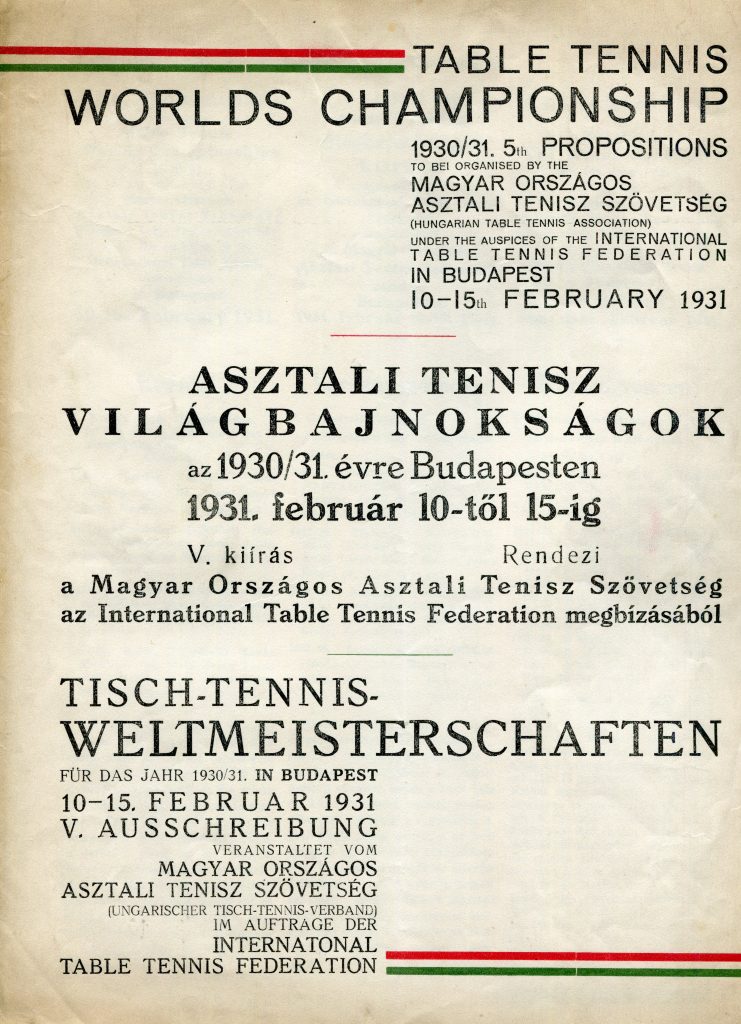
The paper setting out the propositions showed that the same format as previously was being used. Five players could make up the team with three of them playing each match, the best of nine games. Once one team had reached five wins the remaining games were not played. Cost of entry, eight pengoes for singles and 16 pengoes for doubles. There was a Men’s Consolation event costing four pengoes to enter.
Woodcock reported that everywhere they received “most generous hospitality and cordiality”. However, he wasn’t so enamoured with the behaviour of some of the home spectators. “I am bound to say that I found them unruly, ill-mannered and unsporting. Making every allowance for desperately keen partisanship, there is no excuse for frantically applauding your own man when he gets a lucky net-cord and for booing and hissing when the opponent gets one. There is an interminable buzz of conversation which no reproofs can still, people wander to and fro across the line of sight and merchants are allowed to hawk oranges and chocolates without any kind of restraint”.
After the World Championships more was planned for the England players. The day after the Championships there was a visit to a beautiful new club which amongst other facilities included a full-size tennis court. Tuesday afternoon saw a visit to the headquarters of a winery, a most enjoyable trip, followed by an England versus Hungary international in the evening. Another match ensued on Wednesday evening. Woodcock did compliment the Hungarians on their hospitality and the time after the World Championships was enjoyed and appreciated by all.
The party then split up with Montagu going to Constantinople for business, Foulis, Jones and Sears travelled on to Vienna whilst Bull, Haydon, Proffitt and Woodcock went to the German Championships in Stettin. Here Haydon reached the semi-finals before he was defeated by Barna, the eventual champion. This group then stopped in Berlin for a pleasant couple of days sight-seeing and playing before the trek home, accompanied by the Hungarian players.
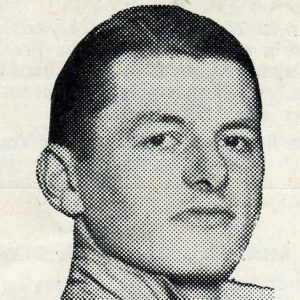
Don Foulis: A Yorkshireman by birth but who played for Lancashire. Foulis was born in Eccleshall Bierlow on 13 December 1908 and made his senior international debut against Wales in 1929/30, he also played against them in 1930/31 and won four caps against the Irish Free State. He played in three World Championships including once in the Swaythling Cup in 1933/34 when the team finished seventh. Foulis won five titles at the Merseyside Open and three more at the Midland Open and North of England Open. At the Liverpool Closed he won the Men’s Singles four times, the Men’s Doubles five times and the Mixed Doubles twice. He played for the Lucern Club until 1938 when he retired from playing. A participant in the first National League match, Liverpool versus Blackpool on 21 November 1936 which saw victory for his side 9-0, Foulis also represented Lancashire in county matches.
An administrator as well as a player, Foulis was secretary for his club, Lucern TTC, Chairman and ETTA representative for the Liverpool League and a member of the ETTA Selection Committee as well as representing England at the Budapest Congress.
Foulis had some good innovative ideas – some of which were introduced much later. In 1947 he suggested the England team have an official uniform and also advocated, with the formation of youth clubs, local league players and clubs “adopt” a club to get youngsters interested in playing, he was also interested in organising table tennis in every school. When conscription was in force, he suggested using the armed forces as an outlet for improving the game of keen youngsters. In 1950 his ideas included letting players know their start time of their first match in Open Tournaments and having a qualifying event, also restricting entries as numbers had reached very high levels which made for very late finishes. Ideas which today are accepted as the norm.
Foulis was a good lawn tennis player and represented Lancashire on numerous occasions, he was possibly a lawn tennis international.
Foulis’s memory lives on in the Liverpool League when the Don Foulis Cup was presented in 1952 as a Ladies Handicap Cup Knock-out competition, the first winner was Mrs J Lloyd.
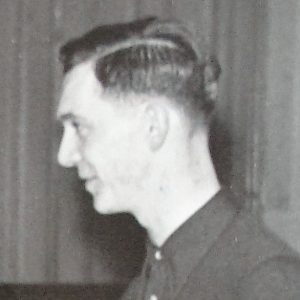
Richard David Jones, known as David: Ranked number one in England and five in the world, David Jones was one of the top players at home and abroad. Born in Hillingdon, London on 20 October 1908, Jones played for England in the Swaythling Cup in 1931, 1932, 1933 and 1934 gaining one silver and one bronze medal in the team events plus a bronze in 1932 with Charles Bull in the Men’s Doubles. He twice beat Victor Barna in matches in the Swaythling Cup.
Jones’ international debut was against Wales in the 1928/29 season and he gained a further cap against France in the Dinard Cup and one each against Hungary and the Irish Free State, plus two more against Wales. In the English Open he was runner-up to Miklos Szabados of Hungary in 1932 in the Men’s Singles and in the German Open in 1932/33 won the Mixed Doubles with Astrid Krebsbach of Germany. He also won titles at the City Open, Hertfordshire Open, Midland Counties Open, Sussex Open and West Middlesex Open. Playing in the London League for the Whitefields Club he was a League triple winner in the Men’s Singles. In 1932 he won the “Sunday Referee” Nationwide tournament.
Jones was interviewed in 1935 and described the turning point of his career: “My first tour round England, with Fred Perry and Charlie Bull. After two weeks, during which time I played at a different town every evening, I had only lost one game. It was the result of these matches which gave me the confidence which I consider is essential if a player is to reach international standard”, and his most brilliant victory: “England were losing by four matches to three to Germany in the Swaythling Cup when I had to play their number one player. I was playing as England’s third man and had already lost to Germany’s number two and number three. My unexpected win over their number one player (who reached the Semi-Final of the World’s Singles Championship that year) saved the match for England”.
As Jones became more well known, he brought out his own bat, the ‘Attaka’ which sold for 3s 6d.
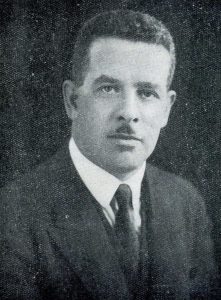
C Corti Woodcock: A very interesting character whose impact on English table tennis was immeasurable, he was one of the most influential and forward-thinking Chairman of the ETTA. Born in Romford, Essex on 23 June 1899. Woodcock’s one known success at table tennis was winning the West Essex League Men’s Singles title in 1934/35. His passion and influence on the game was not so much in playing but in other directions.
Before becoming involved with table tennis Corti Woodcock volunteered as a teenager in the First World War, during which time he was severely wounded and gassed. Despite this, he went on to lead a very full and accomplished life. Woodcock held a prodigious number of positions across both table tennis and golf, serving not only in England but also internationally – he held various local and county roles including being President of Essex in both sports.
For three years from 1933 Woodcock was the ETTA Chairman and served on a whole range of committees – too many to name. Woodcock worked himself into the ground with his commitment. He was given the honour of ETTA Vice-President in 1931 and became an Honorary Life Member in 1956, having previously in 1937 been made an Honorary Life Member of the US Association. As well as representing England He England at various ITTF Congresses, also represented Australia, New Zealand, the United States and Canada at various times. His other foreign involvement included acting as non-playing captain for the New Zealand team at the 1950 World Championships. Woodcock captained several England teams in international matches and in their Swaythling Cup and Corbillon Cup teams in 1934.
His earliest position was Secretary at the famous St Bride (All England) Club and it was whilst in post he learnt that Fred Perry had won the World Men’s Singles title and “With unrestrained elation, Corti immediately dashed out, bought and presented the “St Bride’s Vase” – which remains today that most coveted of trophies for the Singles’ Championship of the World”.
Other strings to his bow included President of Chelmsford League, Chairman and President of Essex County, Vice-President of both the Central League and the Guildford & District League as well as being founder and Chairman of the West Essex League. He represented the ETTA on the British Sports & Games Association and the Sunday Freedom Association.
A noted referee, umpire and organiser, Woodcock officiated at numerous Open tournaments and international matches. Perhaps his most prestigious appointment was umpiring the Men’s Singles final in the 1935 World Championships. He also acted as compere and MC at several major events and championships.
Another area in which he excelled was writing, Woodcock was founder and the first editor of the English publication Table Tennis and he wrote articles for this and other publications. This extended over a 30-year period and they were written with authority, wit and wisdom, at times he could be forthright and candid but always knowledgeable and thoughtful.
Woodcock could be controversial and his standards and values were of the highest, he challenged anything that was detrimental to the sport and promoted everything that was good. During his three years at the helm of English table tennis the whole concept of the sport was changed. Leslie Woollard wrote “For Corti, in those three years, took the role of a Prince Charming who turned the Cinderella sport into the queen of indoor pastimes. Corti it was who founded and edited the first official ETTA magazine “Table Tennis.” Corti it was (later aided by Bill Pope) who won over the Press and the BBC, to take an active interest in the sport. Corti it was who conceived the then fantastic idea of staging the 1934-35 World Championships at the Empire Pool, Wembley and persuaded the late Sir (then Mr) Arthur Elvin to his thought. This at a time when the assets of the ETTA amounted to £11 12s 0d!
“Corti it was who took the lead in organising exhibition tours of England of the fabulous Hungarians with the spectacular magic of Barna, Szabados and Bellak. The cumulative effect of Corti’s unsparing leadership in these fields that emphasised as nothing before in universal recognition that Table Tennis was really and truly a major in the world of minor sports, and culminated in the Royal Patronage in the year following Corti’s retirement from the Chair. At the cost of his health, Corti Woodcock had successfully transmuted table tennis to the Big Stage and showed the world how England could lead”.
When Woodcock died, Victor Barna said: “I have lost the best friend I ever had”. Woollard also paid tribute: “Here was a man of rare distinction whose place can never quite be filled by any other”.
His name lives on through the European Union’s Corti Woodcock Cup which was presented in 1959 for the Women’s Doubles Championship and the Essex County Corti Woodcock Memorial Award for services to the county, mainly for administrative services.
Latest news