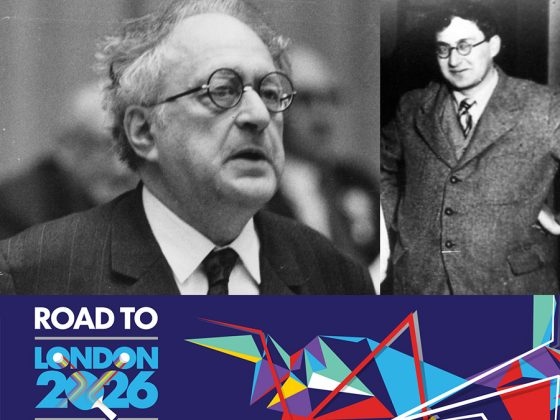
In the history of table tennis, Ivor Montagu stands as a colossus – the architect of the sport’s foundation and organisation, a leader whose global influence extended for decades.
A multi-faceted character, he was, amongst other things, a pioneering film-maker, a critic, a wildlife conservationist and a communist – there were even unfounded rumours he was a Soviet spy.
To Nicole Campbell, he was simply her great-uncle Ivor.
Keep an eye on our website and social media platforms for a host of features in our Road to London 2026 series – and click below to secure your tickets for London 2026.
Nicole was born Nicole Montagu, and Ivor’s oldest brother was her grandfather, making her Ivor’s great-niece. She says he had a profound impact on her life, and she remembers him with great affection.
However, growing up she had little awareness of him, with family lore instead revolving around another great-uncle – naval intelligence officer Ewen Montagu – Ivor’s brother, who was best known for his crucial role in Operation Mincemeat, a key Second World War operation to deceive the Nazis.
“My father wasn’t hugely family-minded, and I grew up really not that aware of either of my great-uncles and I didn’t see my grandfather that often,” says Nicole.
“I suppose growing up, I learned about my other great-uncle, Ewen Montagu, and I read (his book on Operation Mincemeat) The Man Who Never Was, and learnt about his story.
“And then I slowly heard about Ivor. But he was rarely talked about – I wouldn’t say he was the black sheep, it’s just that he was not really in a relationship with many in the family.
“So, when I turned 17 and could borrow a car, I rang up and introduced myself and said, you don’t know me, but I’m your great-niece and I would love to meet you. And that was when I started my relationship with Ivor.”

Nicole remembers their first meeting, at Ivor’s home in Watford, with great clarity and gives this first-hand account of that meeting and the man she encountered:
“We arranged to meet at 11 o’clock, which I thought was a really good time, because you could have a cup of coffee and leave politely before lunch.
“I arrived at 11 and this wonderfully warm human being invited me into his home. We sat in a small room full of books. And he sat there, and I was sitting opposite him, and we started to talk – at first a little shy, both of us, I seem to remember.
“And then we started to talk about the world and the universe. I can’t remember exactly what it was. But I do remember that around about 2 o’clock, I realised that it was way past when I should have tactfully left. We had both lost track of time.
“That was the first of many occasions where I’d drive down to Watford and we’d spend two or three hours just chatting, talking. He had a profound influence on my life. He was a gentle, gentle man – thoughtful, considered, took me seriously, which at 17, not many people did.”
Nicole says she cannot be sure when she became aware of his place in the annals of table tennis.
“Before I went to see him, I definitely did my due diligence and I knew about his interest in zoology, that he was a communist that was in relationship with both Russia and China, that he had done filming with Eisenstein, and was involved with Hitchcock as a film editor. I knew those things,” she says.
“I think people used to say he brought ping-pong to England. In the family, that’s how it was put. So, I think I knew that there was some connection to table tennis. But I didn’t really know much about that until after he died.
“You know people ask you sometimes, ‘who’s the person you’d invite to dinner, if you could have anyone, dead or alive’? Ivor would be top of my list, one of my two or three must-haves, because there are so many questions I didn’t ask him, because I didn’t know to ask him.
“We talked philosophy, or the spirit in which you lead your life, those sorts of things. A little bit intense, but interesting. We didn’t talk about things that I wish I had known to ask him about.
“He was hugely modest. He wasn’t interested in puffing himself up or making himself look or feel important. He didn’t need to do that. I think he was quite comfortable with who he was.
“He was generous with his time, with his patience, and I think he genuinely liked me.
“He was very unjudgmental, very kind, very generous – to this day one of the loveliest human beings I’ve ever met. Of all the members of the family that I went and introduced myself to, and there were a few, he was the one that I stayed in relationship with until he died, and he was the one whom I grew to love very much.”
Now almost 70, Nicole has for the last 20 or so years worked in the field of aphasia, which is when a person loses the ability to communicate through speech as a result of a brain injury or condition.
She remains profoundly grateful to have met Ivor.
“You remember those people when you’re a child and a young adult who deal with you as an equal,” she says. “You remember them because, to other people, you were this pesky child, this nuisance, too many questions or whatever.
“But there are a few that you remember, because they gave you the time of day. I’m so grateful that I met him, I’m so grateful I made that telephone call, so grateful that he didn’t turn me away. I consider it one of the greatest privileges of my life to have known him.
“I don’t think he ever knew what an impact he had on my life. You don’t remember what people say, and you often don’t remember what people do, but you certainly remember how they make you feel.
“I learned a lot from Ivor and at the I age was, this influenced me greatly.”
Who was Ivor Montagu?
Ivor Montagu table tennis career began in earnest during his time at Cambridge University, where he set up the university table tennis club, playing in the first varsity match. He joined the Ping Pong Association’s committee as a teenager in 1921/22 and was voted into the Chair for the meeting at which it became the Table Tennis Association in November 1922. When that organisation became the ETTA in 1927, he was elected Chairman.
Instrumental in formalising the rules of the sport, he was the referee at the first World Championships in 1926.
The following year, he was elected the first Chairman of the ITTF and would go on to become its President. He held high office in the sport for more than 40 years.
He was also a pioneering film-maker, who in 1929 made this silent film, Table Tennis Today.
Among his other film activities, he was a producer who worked with Hitchcock and Sergei Eisenstein, and was a critic.
He had a keen interest in wildlife conservation and was a member of the British Communist Party. In 1959, he was awarded the Lenin Peace Prize by the Soviet government for his work furthering the cause of socialism. Ivor Montagu died in 1984 at the age of 80.
Latest news
- World Championships
- World Championships
- Coaching