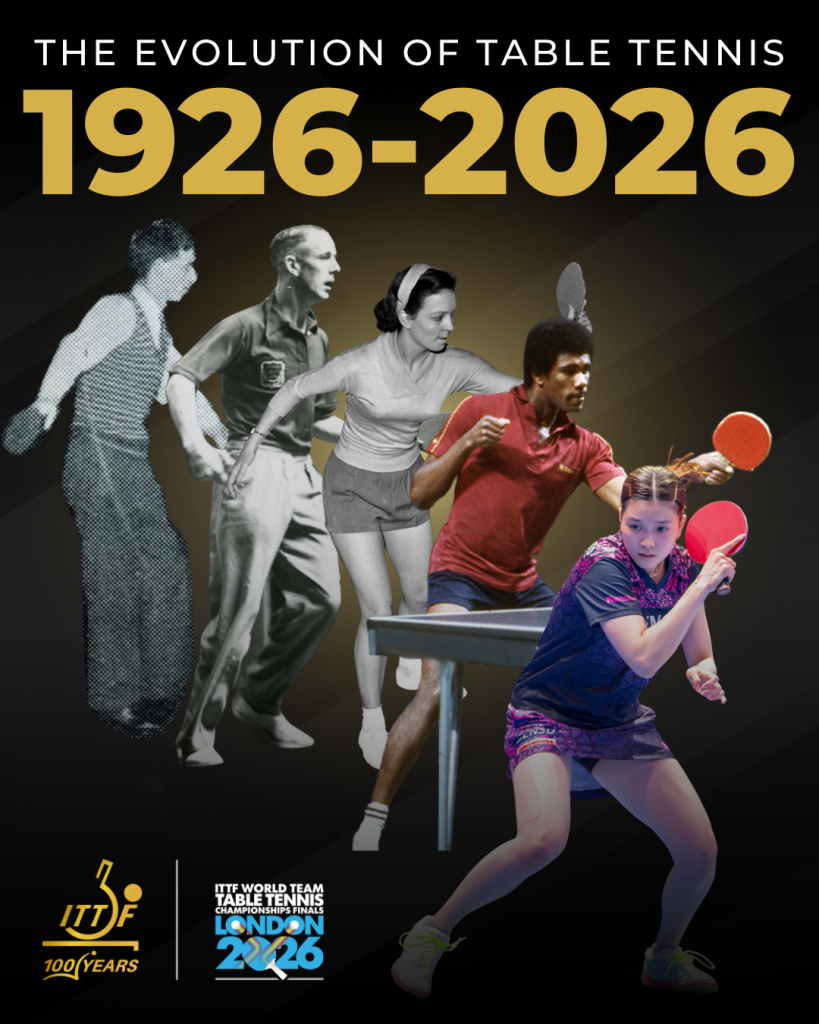
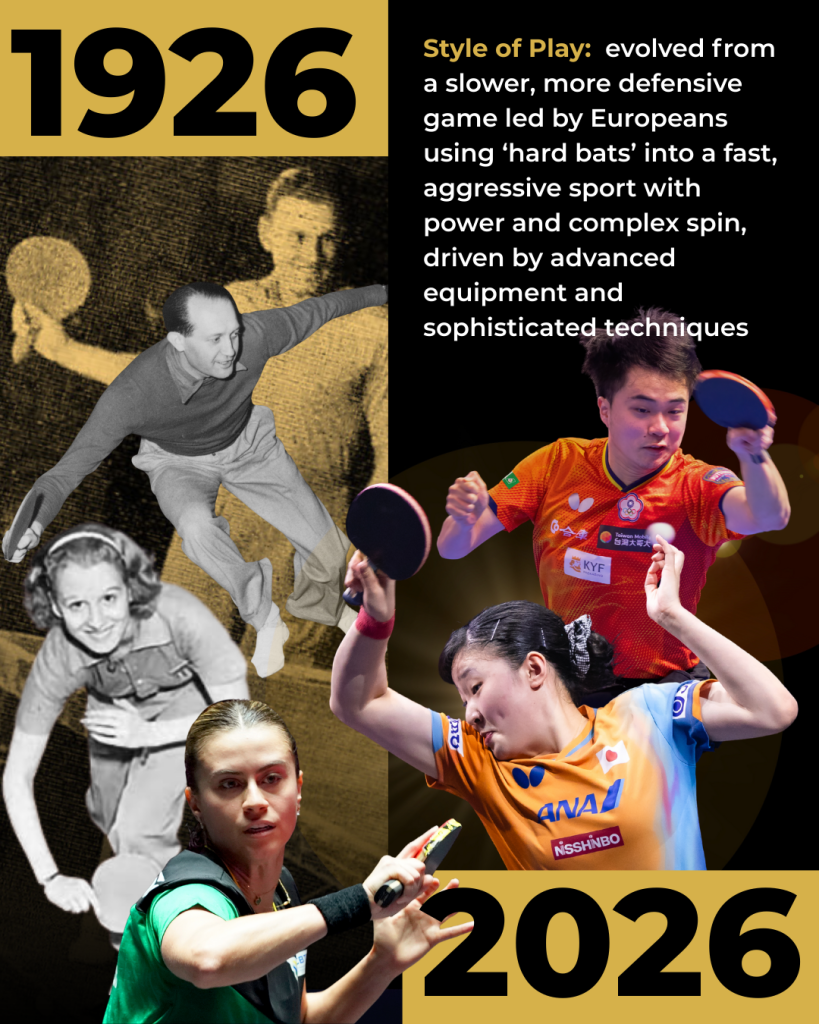
From waistcoat-clad men wielding sandpaper bats to male and female athletes in sponsored kit and armed with state-of-the-art equipment – the ITTF World Team Table Tennis Championships have come a long way since 1926.
Keep an eye on our website and social media platforms for a host of features in our Road to London 2026 series – and click below to secure your tickets for London 2026.
The event has evolved from parquet flooring to Taraflex and wood-panelled halls to massive arenas with all the razzmattaz of sport-as-entertainment.
Throw in rule changes, a shift in dominance from Europe to Asia, the number of countries competing – and even the upgrade from black-and-white to colour photos – and it’s fair to say the event is unrecognisable from a century ago.
As we prepare to come full circle back to London for the centenary edition of the Championships, let’s take a look at some of the key milestones the sport has passed on the journey.

A full set of competitions
The Championships started in 1926 with five events in total – there was no Women’s Team event and no Women’s Doubles. It was not long before the latter was introduced at the second Worlds in Stockholm in 1928, but it took until 1933 for the first Women’s Team competition to be introduced, at the eighth World Championships, in Paris.
That meant a new trophy – the addition of the Corbillon Cup for Women’s Team, to go with the Swaythling Cup, awarded to the Men’s Team champions. To this day, both cups are awarded to the champion nation.
Attacking play encouraged
At the 10th World Championships in Prague in 1936, the longest rally took place In the opening men’s team fixture between Poland and Romania, when the first point between Alojzy Ehrlich and Farkas Paneth lasted two hours and 12 minutes!
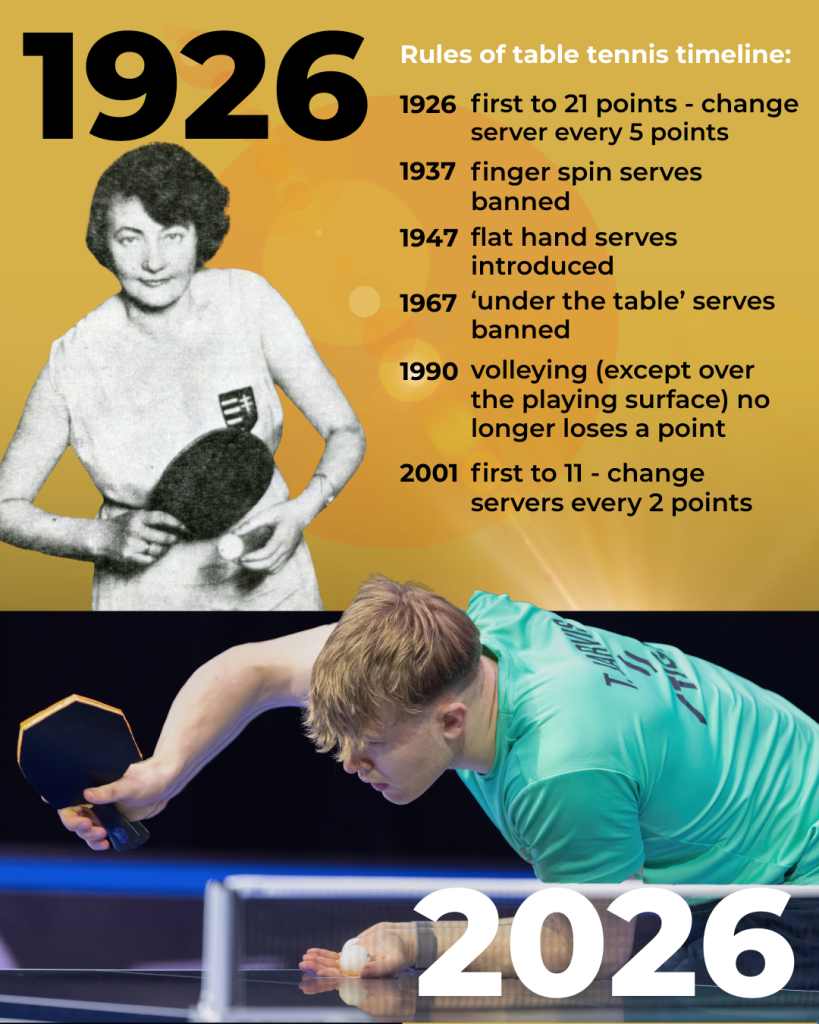
The following year, three decisions were made to promote attacking play:
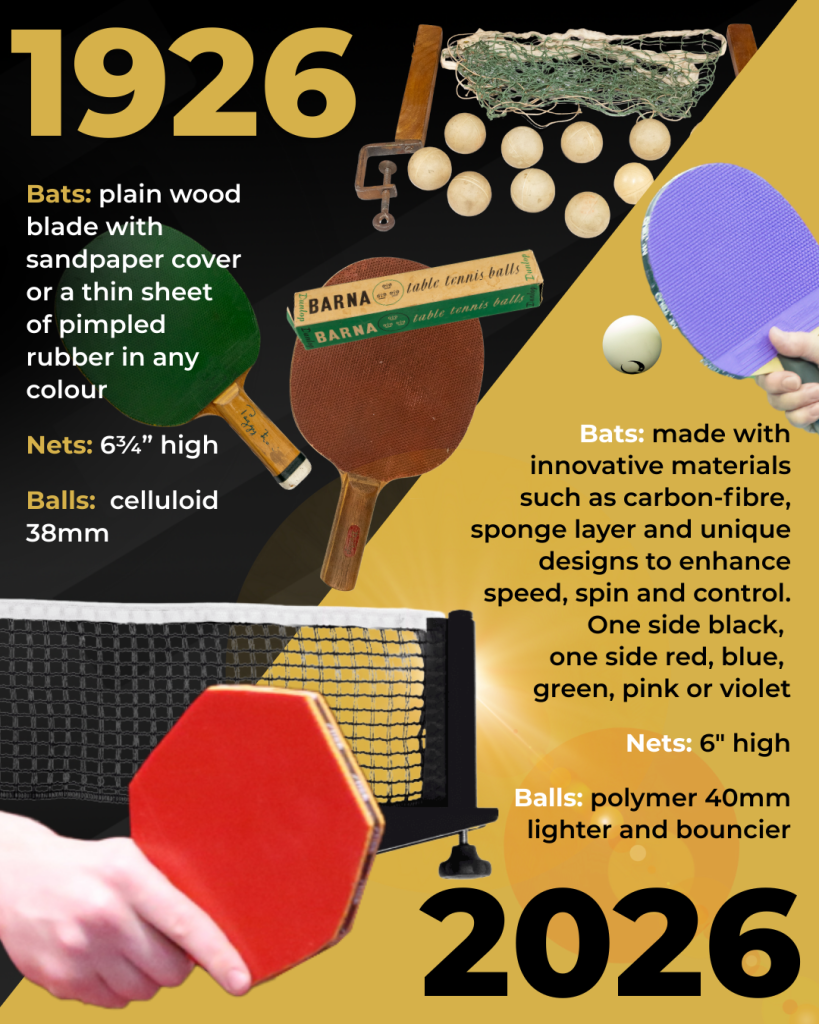
- The net was lowered from 6.75 inches to 6in
- A time limit was imposed of 20 minutes for each game
- Finger spin was prohibited
In 1947, the service law was further amended to introduce the flat-hand projection of serve.
New racket technology and Asia comes to the fore
The 19th World Championships in Mumbai in 1952 was the first to be held in Asia and only the second outside Europe (after 1939 in Cairo).
It also marked the first Asian champions, with Japan’s Hiroji Sato causing arguably the biggest sensation ever known in the men’s singles event; using a thickly covered sponge racket, he mesmerised opponents.
It’s fair to say it caught on quickly – by 1954 in London, the first all-sponge final took place between Ichiro Ogimura (Japan) and Tage Flisberg (Sweden) in the Men’s Singles – it became known as the silent final as the thwack of traditional rackets echoing around the arena was replaced.
By 1959, agreement had been reached on Racket Standardisation, with the elimination of thick sponge. And in 1961, racket colour was standardised as the same on both sides.
Serving up tweaks to the rules
Further refinements of the service action were agreed between the 1960s and 1980s, beginning with a 1967 decision requiring: “the ball shall be placed on the palm of the free hand, which must be stationary, and above the level of the playing service without imparting spin and near vertically upwards”. This ended so-called under the table serves where the ball was thrown from below the height of the table surface directly on to the racket.
Foot stamping during the service action was declared illegal in 1983 and, in the same year, further decisions barred players from serving with their back to the table, and preventing the racket from going below the table surface from the time the ball is in the hand for the purpose of serving.
Any colour, so long as it’s black (and red)
In 1983, a change was made to racket covering rules to require a racket to have distinguishably different colours on each side. It was further refined in 1985 to restrict coverings to red and black.
This remained the case until 2021, since when once side of the racket must be black, with the other side a choice of red, pink, purple or green.
A whole new ball game
A new millennium ushered in new balls, as the 38mm (1.50in) ball was officially replaced by 40mm ball in October 2000; the Sydney 2000 Olympic Games the last major event with the old ball.
From 2015, table tennis balls are made of a polymer instead of celluloid, the first World Championships to use the polymer ball was 2015 in Suzhou.
Latest news