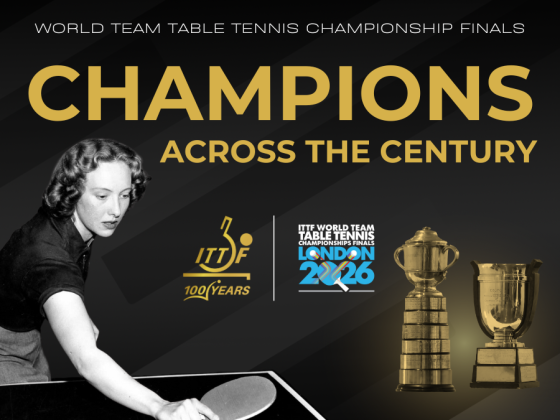
How many nations have been table tennis world champions? Which was the last nation to deny China? How many times has England ruled the world?
Read on for the answers to these and other questions as we continue our countdown to the ITTF World Team Table Tennis Championships London 2026.
Tickets

With 64 women’s and 64 men’s teams competing at London 2026, the tournament has come a long way since seven nations contended the first Championships in the same city in 1926.
Seven teams entered the inaugural Men’s Team Championships: Austria, Czechoslovakia, England, Germany, Hungary, India and Wales.
It was Hungary who came out on top, launching an early domination of the men’s Swaythling Cup, which saw them win the first five editions in 1926, 1928, 1929, 1930 and 1931. In both 1929 and 1931, they triumphed in their capital city of Budapest. 1929 was also notable as the first appearance of the immortal Viktor Barna, who went on to win a total of 41 World Championships medals, 22 of them gold, across individual and team events for Hungary and England, where he settled just before the Second World War.
Indeed, Hungary dominated the pre-war years as they also won in 1933, 1934, 1935 and 1938 – those last two also in London.
Only Czechoslovakia in 1932 and 1939, USA in 1937 and Austria in 1936 got in on the act before the war intervened – after the 1939 Championships had already been held.
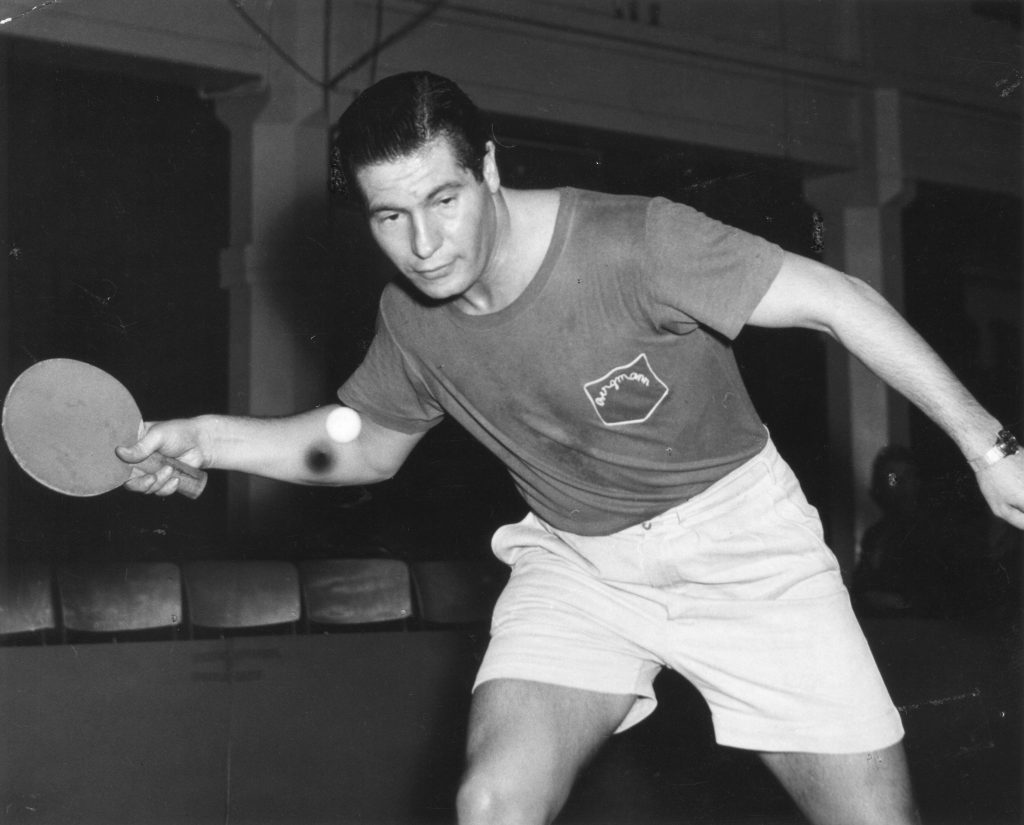
In the case of Austria and the USA, those triumphs remain their only Swaythling Cup victories. Austria’s team included the great Richard Bergmann, who would go on to represent England after coming to these shores to flee the Nazis and won 22 Championships medals in total, seven of them gold.
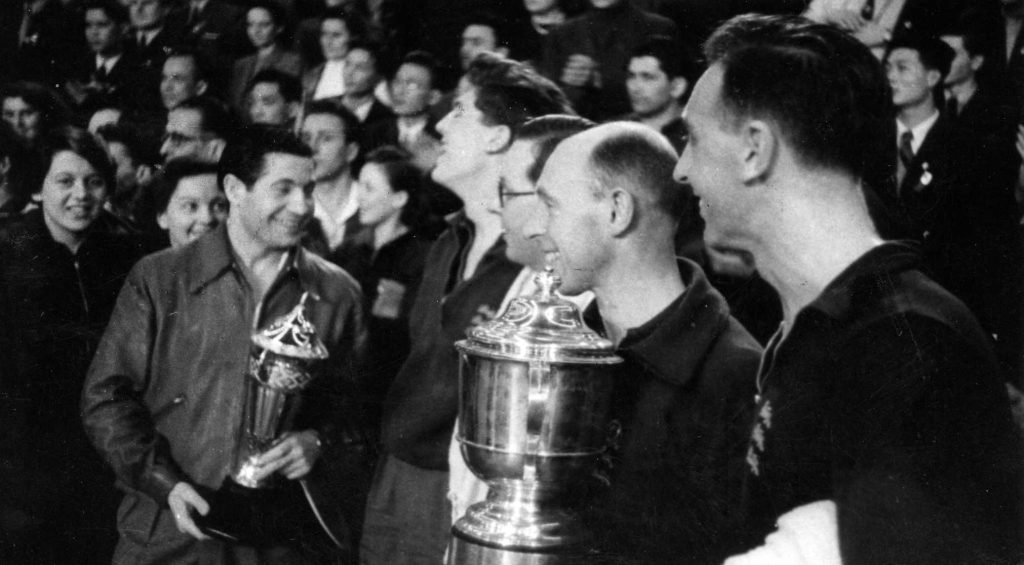
Czechoslovakia would go on to win four more – in 1947, 1948 in London, 1950 and 1951.
It took a few years to achieve gender equality, and the first ever Women’s Team champions were crowned in 1934 in Paris, when it was Germany who were the first to lift the Corbillon Cup.
Czechoslovakia were next to come out on top – they won the title in 1935, 1936 (in their capital, Prague) and 1938, while Germany notched their second victory in 1939 in Cairo.
In between the Czech victories, 1937 was notable as the USA won the Corbillon Cup, making it the first time the same nation had lifted both trophies in the same year.
USA were the only one of those three early Corbillon Cup-winning nations to taste success again, taking their second and final women’s title in 1949 in Stockholm. It is perhaps remarkable that Germany’s 1939 triumph remains their last, while their men have never won the biggest prize.
When table tennis resumed after the war, it was Paris which hosted the next World Championships, in 1947, and it saw England’s name added to the roster of Corbillon Cup winners as the squad of Elizabeth Blackbourn, Vera Dace, Peggy Franks and Non-Playing Captain Margaret Knott ascended to the top step of the podium.

The following year, in London, they defended the title on home ground as Franks and Dace (now under her married name of Thomas) returned alongside Elizabeth (Betty) Steventon, Dora Beregi and Knott as NPC once again.
Romania were the next country to join the ‘World Champions Club’ as their women won the Corbillon Cup in both 1950 and 1951 – they would go on to win it on three more occasions in the 1950s to make it five titles overall, with the legendary Angelica Rozeanu, who won 17 world titles all told, leading the way.
The following year in Bombay saw history made as Japan became the first Asian nation to win a world title – again, in the Corbillon Cup. They went on to win again in 1954 and then four times in a row from 1957-1963 as they and Romania shared 11 consecutive titles between them.
Back in the Swaythling Cup and 1953 saw England’s proudest achievement and their first and only men’s title – the winning line-up was Richard Bergmann, Brian Kennedy, Johnny Leach, Aubrey Simons and Adrian Haydon as NPC.
England were succeeded by Japan, who won both titles at Wembley in 1954 – which kicked off a run of five successive men’s titles. Japan also won both titles in 1957 in Stockholm and 1959 in Dortmund.
In 1961, the Championships was held in China for the first time, in Beijing. And although Japan held on to their women’s title, the Swaythling Cup was won for the first time by the hosts.
They retained the title in Prague in 1963 and completed a hat-trick in Ljubljana in 1965, the same year that their women’s counterparts won their first title.
That was not the herald of a dominant era, as China won only one of the next eight world titles on offer. Japan won both in Stockholm in 1967, and the men’s in Munich in 1969 – but there was a new name on the Corbillon Cup that year as the Soviet Union won for the first and only time.
China and Japan won men’s and women’s respectively in 1971 in Nagoya, before two new winners were crowned in Sarajevo in 1973, Sweden winning the first of their five men’s titles and Korea Republic (South Korea) their only women’s title.
Chinese dominance began in earnest in Calcutta in 1975 and, at the next six Worlds after that, the only time they did not take gold was when Hungary men won in 1979 in Pyongyang – the last of their 12 championship-winning squads.
Their spell was broken in the Swaythling Cup in spectacular style as Sweden claimed a hat-trick of men’s titles in 1989, 91 and 93, the last of those on home territory in Gothenburg. It was a squad whose names rolled off the tongues of all those who followed the sport – Appelgren, Karlsson, Lindh, Persson and, of course, Waldner.
Alongside the second of those triumphs, a Unified Korea team struck gold in the Corbillon Cup in Chiba City in 1991 – one of the iconic World Championships moments and later immortalised in the film As One.
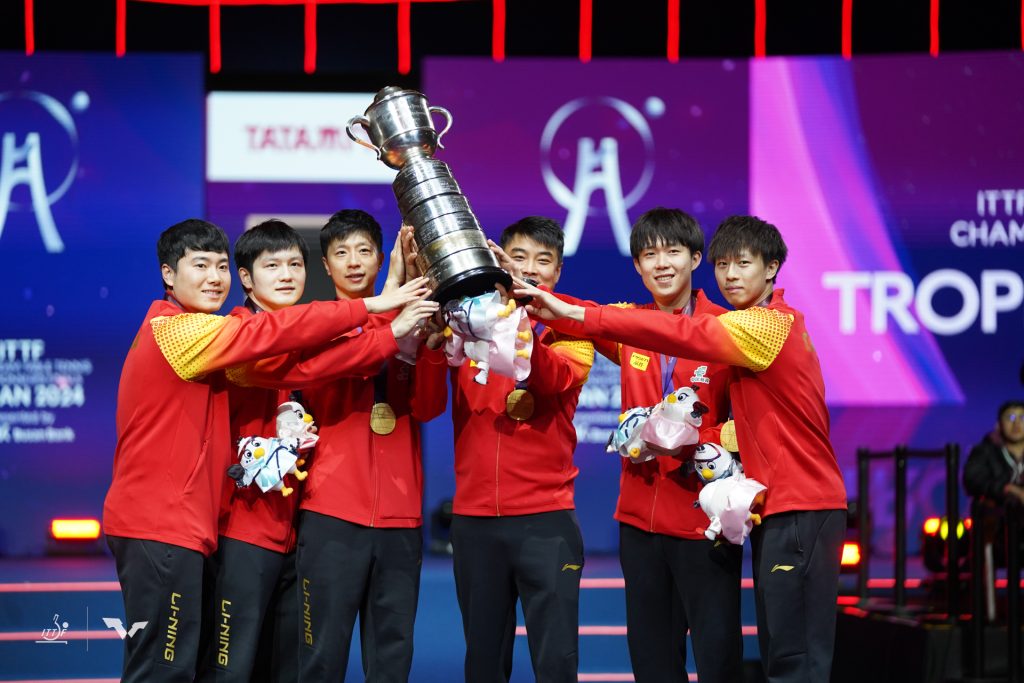
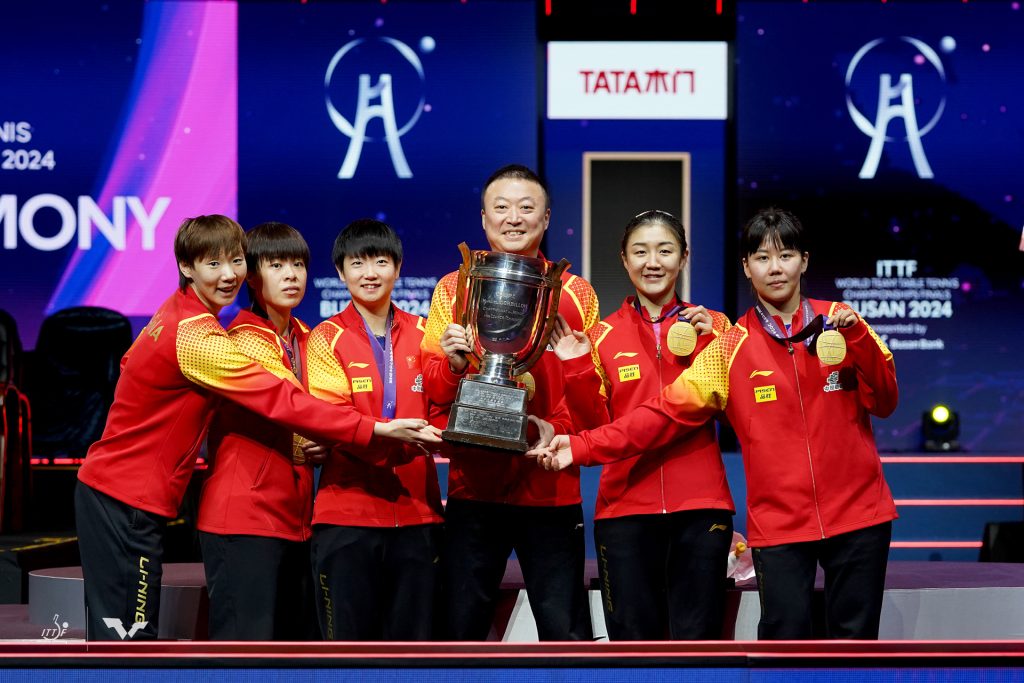
From 1995, the stranglehold of China on the Swaythling and Corbillon Cups has been total – almost. From 1995, only one men’s and one women’s team has broken the monopoly.
It was Sweden’s fifth and final men’s title in 2000 in Kuala Lumpur as Karlsson, Persson and Waldner managed one last hurrah.
And the only time this century that a country other than China has won the Corbillon Cup was in 2010 when Singapore topped the podium – also the last occasion that a ‘new’ country won either of the top trophies in world team table tennis.
In all, eight different nations have won the Swaythling Cup and 11 the Corbillon Cup, with China leading the way with 23 of each. Fourteen different nations have won one or other, and five – including England – have tasted victory in both. What does London 2026 have in store?
A century of champions
Swaythling Cup (Men’s Team)
China: 23 wins (1961, 1963, 1965, 1971, 1975, 1977, 1981, 1983, 1985, 1987, 1995, 1997, 2001, 2004, 2006, 2008, 2010, 2012, 2014, 2016, 2018, 2022, 2024)
Hungary: 12 wins (1926, 1928, 1929, 1930, 1931, 1933 (Jan), 1933 (Dec), 1935, 1938, 1949, 1952, 1979)
Japan: 7 wins (1954, 1955, 1956, 1957, 1959, 1967, 1969)
Czechoslovakia: 6 wins (1932, 1939, 1947, 1948, 1950, 1951)
Sweden: 5 wins (1973, 1989, 1991, 1993, 2000)
Austria: 1 win (1936)
England: 1 win (1953)
United States: 1 win (1937)
Corbillon Cup (Women’s Team)
China: 23 wins (1965, 1975, 1977, 1979, 1981, 1983, 1985, 1987, 1989, 1993, 1995, 1997, 2000, 2001, 2004, 2006, 2008, 2012, 2014, 2016, 2018, 2022, 2024)
Japan: 8 wins (1952, 1954, 1957, 1959, 1961, 1963, 1967, 1971)
Romania: 5 wins (1950, 1951, 1953, 1955, 1956)
Czechoslovakia: 3 wins (1935, 1936, 1938)
England: 2 wins (1947, 1948)
Germany: 2 wins (1933, 1939)
United States: 2 wins (1937, 1949)
Korea Republic: 1 win (1973)
Korea Unified: 1 win (1991)
Singapore: 1 win (2010)
Soviet Union: 1 win (1969)
Latest news
- World Championships
- World Championships
- Coaching