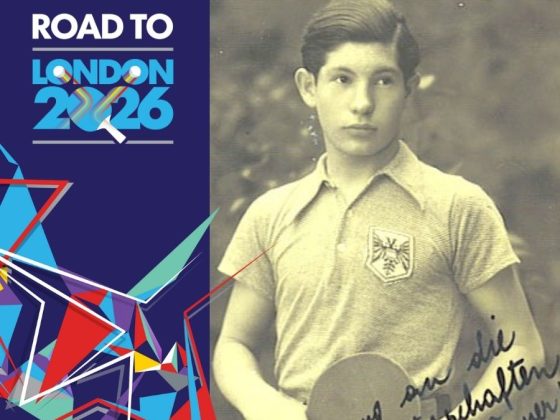
In the latest instalment of our series on England’s World Championships performances over the years, Diane Webb (Chair of Archives, Museum and Records Committee) turns to 1937.
In Baden, the USA team made history by winning both team titles – but an extraordinary decision meant there was no Women’s Singles champion and resulted in a star turning her back on the sport.
With thanks to Gunther Angenendt for photos. Keep an eye on our website and social media platforms for a host of features in our Road to London 2026 series – and click below to secure your tickets for London 2026.
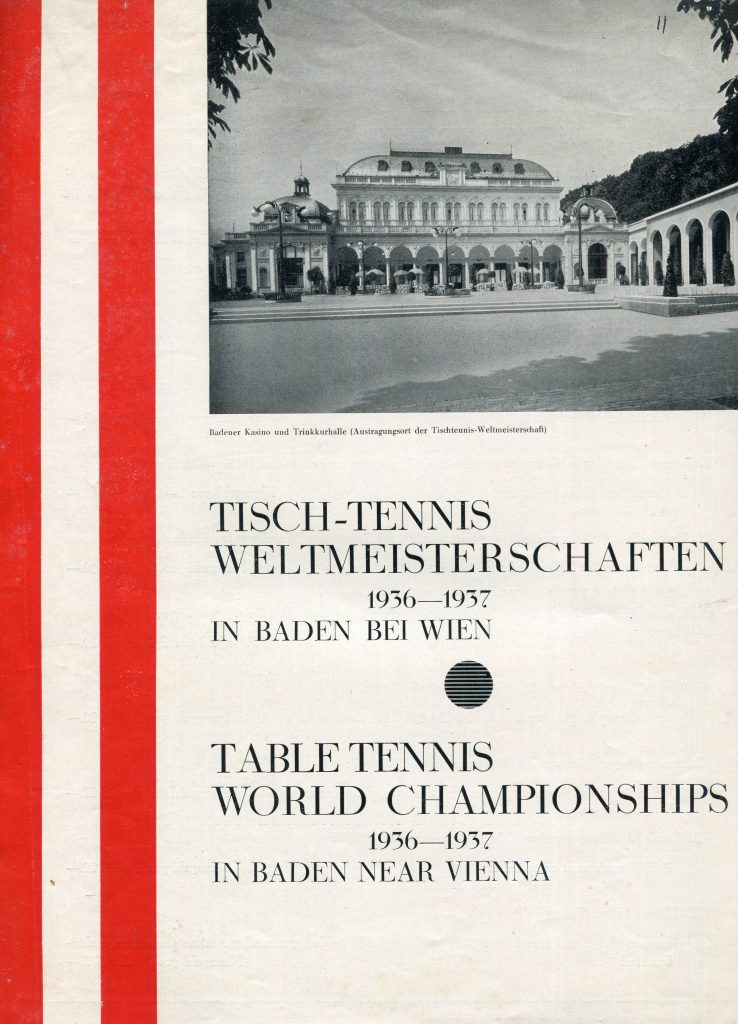
Trials took place in early January in six locations – London, Hastings, Exeter, Birmingham, Leeds and Manchester. The final trial was in London on 17 January. Leagues were asked to send their best players.
One of the considerations for selection for the women’s team was choosing a strong doubles pair and as Baden had a stone floor this was also taken into account for both teams. It cost £40 0s 1d to run the various trials with an income of £1 19s 6d.
Austrian railways reduced their fares by 50% to around £8 which helped with cost of sending the players to Baden. Visa costs and visitors’ tax were waived and with a first-class hotel costing approximately £3, the total bill of sending the players to the World Championships was £189 2s 11d.
To help prevent the debacle that was Prague, the ITTF Congress was held before the Championships commenced. It gave the Jury the authority to scratch both players if a best-of-three match lasted more than an hour and the best-of-five more than one and three-quarter hours – with immediate effect. This rule certainly helped but didn’t altogether solve the problem of excessively long matches.
It was also agreed that the net would be lowered to six inches from six and three-quarters. One further addition to the rules was the banning of finger spin or any other kind of spin apart from that imparted by the racket. All the changes certainly helped but didn’t totally cut out the negative, defensive play.
Congress also created the post of President and asked Ivor Montagu to accept the position, which he duly did.
Play each day was from 8.30am-1pm, 2pm-6.30pm and 7.30pm-midnight. The organisers had the caveat this could be extended and if the tournament wasn’t over by 7th February, play would be carried over to the next day.
Swaythling Cup
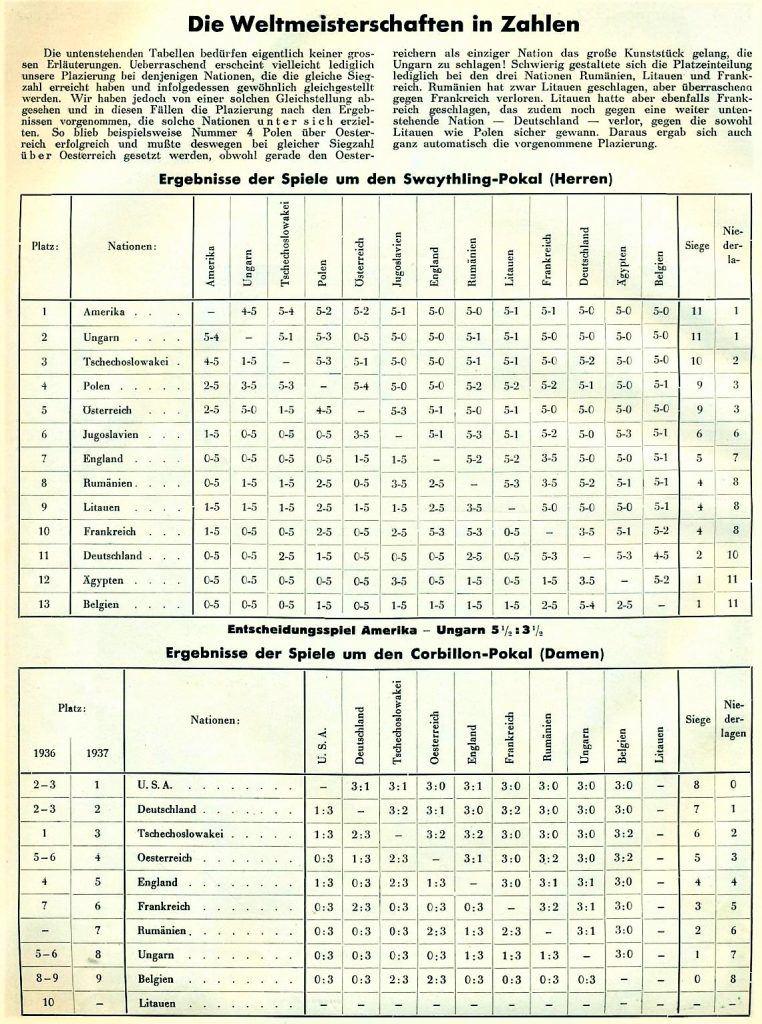
Although the number of teams was down this year to 13, Egypt entered the fray, the first African country to do so. England’s team was Maurice Bergl, Adrian Haydon – who also acted as the team captain, Ken Hyde and Stanley Proffitt, all of whom had played the year before in Prague, plus Andy Miller who had last played in the Swaythling Cup 1935. Hymie Lurie was the unlucky player not to make the team this year.
England had five wins and seven losses. Success was against Egypt and Germany, both 5-0, Belgium (5-1) and Lithuania and Romania both 5-2. The other matches did not go well and it was a 5-3 loss to France, 5-1 losses to Austria, Czechoslovakia and Yugoslavia and three 5-0 losses to Hungary, Poland and the USA.
Proffitt was the only player to win more than he lost at six to five, while the usually dependable Haydon won six and lost six, none of his wins were against the stronger teams. Bergl won nine of his 19 matches, whilst Millar won eight of his 13 and Hyde five of his 15. This resulted in a seventh-placed finish.
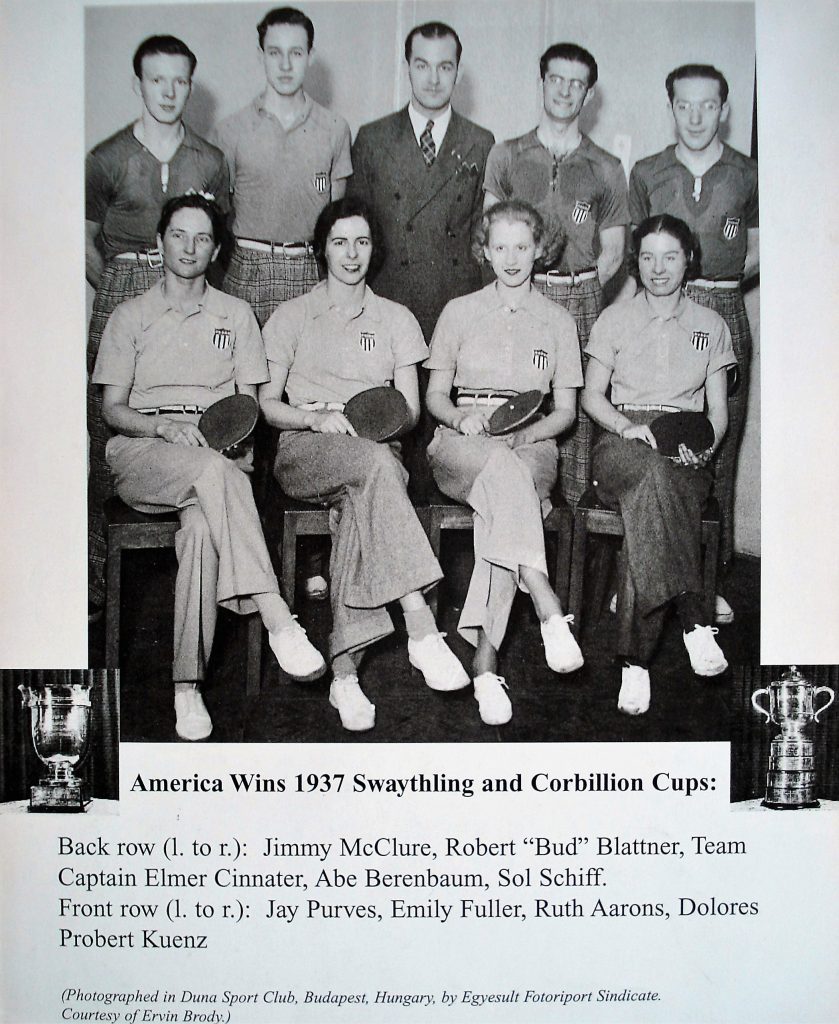
There was a play-off for the title as the USA and Hungary had both won 11 matches and lost one. The USA loss was to Hungary 5-4 and Hungary’s to Austria 5-0. In the play-off, Robert ‘Buddy’ Blattner lost his three matches against Victor Barna, Laszlo Bellak and Ferenc Soos. Jimmy McClure beat Barna and Bellak and drew with Soos. With the score at 23-21, 18-21, 11-10 in favour of McClure, the time limit was exceeded and so both players were awarded half a point. Sol Schiff beat all three Hungarians. The final score, the USA five and a half points, Hungary three and a half points. The new world champions – the USA.
Corbillon Cup
Only nine teams this year and like the men’s team the overall result was disappointing for England. Two familiar faces were part of the team, Wendy Woodhead and Margaret Osborne (the captain). Connie Wheaton and Doris Jordan made up the remainder of the team.
England won four and lost four matches and finished mid-table at fifth. Their victories were against Belgium 3-0, France, Romania and Hungary all 3-1.
Against Czechoslovakia, Osborne had some excellent results despite the team losing 3-2, she beat both Maria Kettnerova 17, -7, 17 and Vera Votrubcova -19, 19, 14. Woodhead failed to get on the scoreboard and the pair lost the doubles, so the fixture went to Czechoslovakia.
Osborne & Woodhead played most doubles matches and had a hard-fought win against USA’s Ruth Aarons & Jay Purves 22, -20, 20. There was no success in the singles and the USA won 3-1. England’s other two losses were to Austria 3-1 and Germany 3-0.
Jordan had the best statistics, winning all her three singles matches, Wheaton won four and lost two, Osborne won four and lost three. Woodhead had a poor Corbillon Cup, winning only one of her seven matches. Osborne and Woodhead won three of their five doubles matches, whilst Jordan and Wheaton were bloodied in the doubles and won one of their three matches.
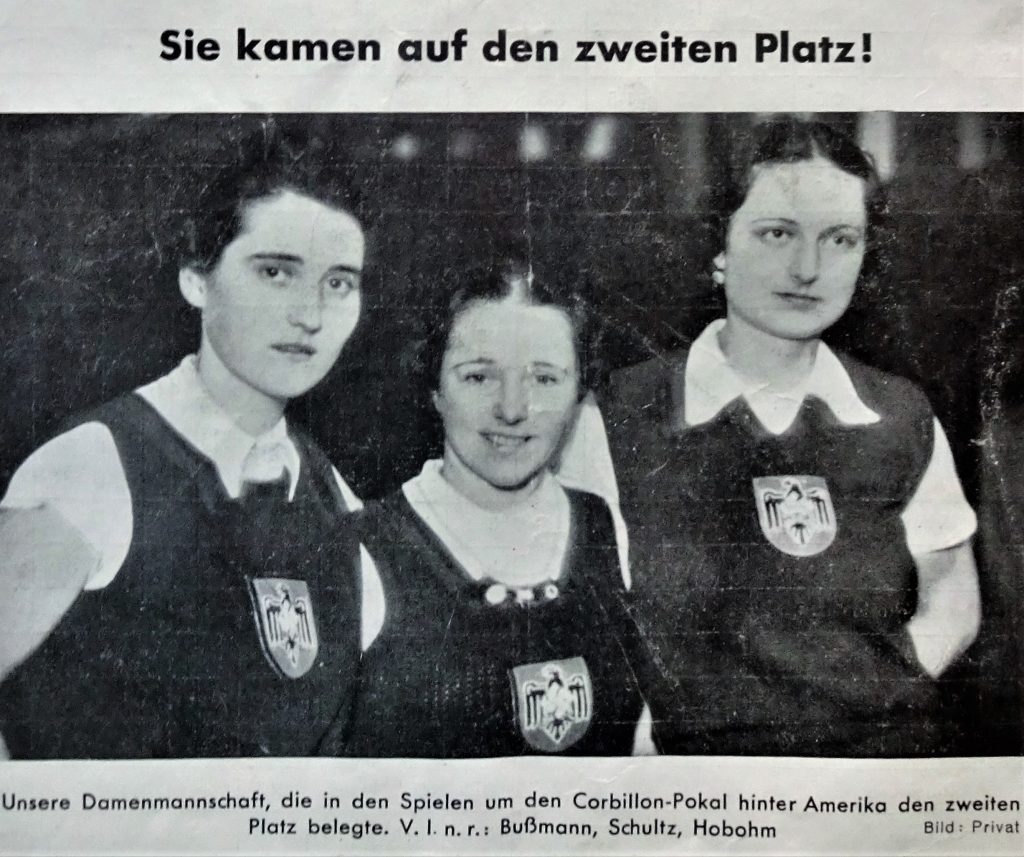
The USA won all their eight matches for a well-deserved victory and the title. Their team was Ruth Aarons, Emily Fuller, Dolores Kuenz and Jay Purves. Germany, with seven wins and one loss, were silver medallists, their team was Hilde Bussman, Astrid Hobohm (formerly Krebsbach) and Annemarie Schulz. Holders Czechoslovakia won six and lost two matches with Vlasta Depetrisova, Maria Kettnerova, Podhajecka and Vera Votrubcova to finish third.
It was the first time one country had won both team championships.
Men’s Singles
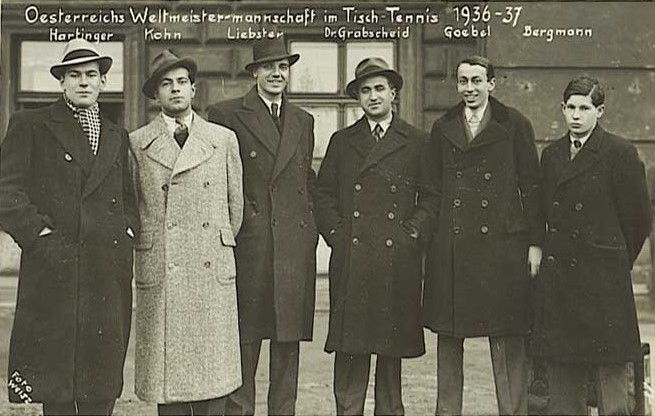
There were a number of long and close matches and the ruling on time limit didn’t always seem to be applied evenly. In the second round Helmut Goebel, Austria and Farkas Paneth, Romania, were both scratched after 105 minutes with the score 1-1 and 5-5. This put their intended next round opponent, Bohumil Vana, Czechoslovakia, through to the next round with a walkover. Here he lost to Hans Hartinger 17, -19, -14, 15, 15. Hartinger in turn lost to Richard Bergmann -15, -16, 13, 15, 18 in the semi-final.
Ferenc Soos in his quarter-final match was fortunate to go through to the semi-final. Playing against Buddy Blattner with the score 20, -15, -21, 17 and 16-19 in the fifth he didn’t have a call against his bad foul service. Soos went on to win 22-20. Aloizy ‘Alex’ Ehrlich then beat him in the semi-final 20, 9, 13. Ehrlich too, had a long match against Victor Barna in the round of 16, winning 16, -20, 15, -15, 18.
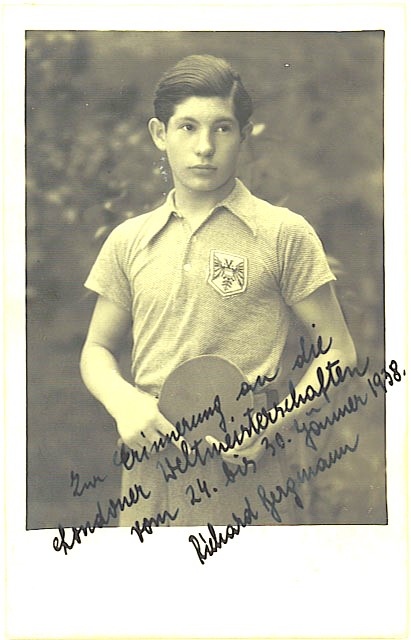
The final between the young Bergmann, now 17 years old and the more experienced Ehrlich went the distance. Bergmann won the encounter -15, -16, 13, 15, 18 to become the new world champion. Ehrlich, one of the world’s best players, yet again did not win a title.
Of the English players, Proffitt was the most successful. He lost to Blattner in the round of 16 by 17, 11, 12. Haydon and Millar both went out in the round of 32, Haydon to Miklos Szabados 9, 9, 17 and Millar to Miloslav Hamr, Czechoslovakia 6, 14, -17, 12. Bergl was a round of 64 loser and A J Wilmott, Ken Hyde, Mr Northover, Mr McNutt and Mr Robinson lost in the first round.
There was a consolation singles which Steve Boros won -15, 19, 18.
Women’s Singles
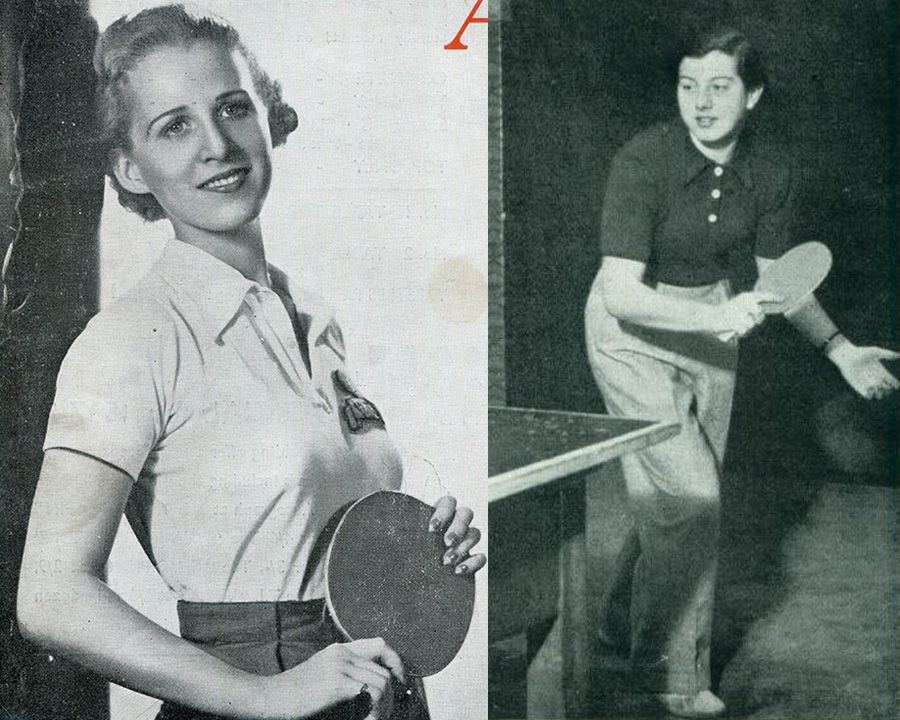
There was more controversy and more occasions where the time limit rule was applied variably. In her round of 16 match Gertrude ‘Trude’ Pritzi of Austria, had a match against Angelica Adelstein, Romania, which was reputed to be over two hours, but the players weren’t scratched. The final score -16, 20, 20, 17 to Pritzi who then beat Votrubcova in the quarter-final and won that match 20, 16, -18, 16. This set her up against Bussmann in the semis, another win 17, 15, -12, 11.
In the other half of the draw Aarons had a comfortable draw to reach the quarter-finals where she met Hobohm (Krebsbach) and with the score at 3, 14, -20, 14-5 the match was awarded to Aarons. The semi-final against Kettnerova was another lengthy affair 18, -14, -15, 13, 13 in the American’s favour.
The final was set, Aarons versus Pritzi. Pritzi was a defensive ‘chiseller’ and Aarons, a more attacking player. However, she couldn’t penetrate Pritzi’s defence and after 105 minutes with the score 1-1 and 19-16 in favour of Aarons, both players were scratched. The time limit had been exceeded. There was to be no champion and no medals for either of the players.
Aarons was so upset with the decision she vowed never to play in an official World Championships again – and didn’t.
In 2001 the ITTF decided to make the two players joint champions, too late for both as Pritzi died in 1968 and Aarons in 1980.
Lilian Hutchings, who didn’t make the Corbillon Cup team, had the best results of an English player in the individual events. She reached the quarter-finals where she lost to Kettnerova 16, 16, 17. Woodhead exited in the round of 16 with a loss to Bussman and Jordan, Osborne and Wheaton all went out in the round of 32 – Jordan to Aarons 15, 14, 15, Osborne to Anna Sipos (Hungary) 15, 20, -13, 19 and Wheaton to Adelstein 17, 6, -18, -13, 16.
Men’s Doubles
There was some redemption for Blattner in the Men’s Doubles as he & McClure retained their title in a close final against Bergmann & Goebel -19, -20, 20, 13, 11. Semi-finalists were Hamr & Frantisek Hanec Pivec and Adolf Slar & Vaclav Tereba all of Czechoslovakia.
Haydon & Millar went out to the eventual champions in the round of 16 although it was close -19, -18, -15, 13, 12. Out in the round of 32 were McNutt & Northover, Bergl with Raoul Bedoc of France and Wilmott with Lackner of Austria. Hyde & Proffitt were first-round losers.
Women’s Doubles
The Women’s Doubles title went to Czechoslovakia with Vlasta Depetrisova & Vera Votrubcova beating England’s Osborne & Woodhead 16, 18, 17 in the final. A well-earned medal for the English pair. Lilian Hutchings, playing with Austrian Stephanie Werle, won bronze losing to the eventual champions. Maria Kettnerova who played with scratch partner, Annemarie Schulz of Germany, won the other bronze in a close fought match against Osborne & Woodhead -13, -9, 15, 20, 17.
Jordan & Wheaton reached the quarter-finals where they played against Depetrisova & Votrubcova, a match they lost 12, 8, 13. They had a real tussle in the round before against former champions Maria Mednyanszky & Anna Sipos of Hungary and just won 19, -18, 18, -13, 18.
Mixed Doubles
The Mixed Doubles final was a contest between two teams from Czechoslovakia. Bohumil Vana & Votrubcova beat their opponents Stanislav Kolar & Kettnerova 18, 16, 9. Losing semi-finalists were Abe Berernbaum & Emily Fuller of the USA and Geza Eros & Angelica Adelstein of Romania. Miss Adelstein, better known as Angelica Rozeanu, went on to win an incredible 30 World Championship medals, 16 of them gold including six consecutive Women’s Singles titles. Baden was her first medal, Stockholm in 1957 was her last. Between 1939 and 1947 there were no World Championships so it can only be speculated how many more she may have won when World War II stopped play.
England’s Bergl & Hutchings went out in the quarter-finals, losing to Berenbaum & Fuller 17, 9, 19 after having beaten Istvan Kelen & Mednyanszky in the round before -19, 14, -11, 16, 18. Those who went out in the round of 16 were Haydon & Osborne and Millar & Wheaton. Hyde & Woodhead, Proffitt & Jordan and McNutt & McNutt all went out in the round of 32.
Doris Jordan: Born in London on 14 June 1911, Jordan later became Mrs Adrian Haydon and mother of Ann. She played in two World Championships, winning a silver medal in the team event in 1938 and coming fifth in 1937. Jordan also won a bronze medal in 1938 in the Women’s Doubles.
Jordan played two internationals, one against France in Le Touquet and one against Ireland. At the English Open she was runner-up in the Women’s Singles in 1938 and a semi-finalist in 1937, in the Women’s Doubles she twice won a bronze medal, with Connie Wheaton in 1937 and Miss D Emdin in 1938. She won several Open tournaments in England – the Essex Open, Home Counties Open, Hull Open, London Open, Middlesex Open, Midland Counties Open, Scarborough Open, Wembley Open and Whitby Open. Playing in the Civil Service League, she won their Women’s Singles in 1936/37. She was ranked at world number eight.
In 1948/49 season Jordan represented Warwickshire. She became a County Umpire in April 1951.
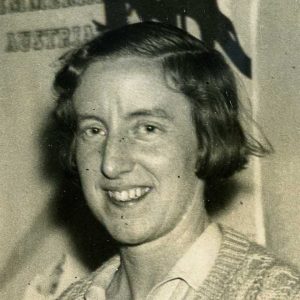
Connie Wheaton: Another player from St Albans, where she was born on 15 February 1908. Wheaton played in World Championships in 1935 and 1937. She reached two quarter-finals, both in 1935 in the Women’s Singles and Women’s Doubles with Valerie Bromfield. The women’s team in 1937 came fifth.
Wheaton played in three internationals against Wales in 1935, 1936 and 1937, all of which England won. At the English Open she was runner-up in the Women’s Singles losing to Marie Kettnerova, the following year in the Women’s Doubles she was a semi-finalist with Doris Jordan. A winner of over 30 Open titles. In Closed Championships, she won the Hertfordshire Closed three times, the Luton Closed and at least 10 titles in the St Albans Closed both before and after the war. Her highest England ranking was three.
A certified teacher, Wheaton was unable to play at times due to her position. She married Leslie Brigden in 1941.