The ITTF World Team Table Tennis Championships Finals London 2026 Presented by ACN will be the biggest Worlds ever staged.
Two iconic venues, 128 teams, hundreds of athletes, officials and volunteers – and not forgetting thousands of spectators at every session, creating an incredible atmosphere to inspire the players to produce their best!
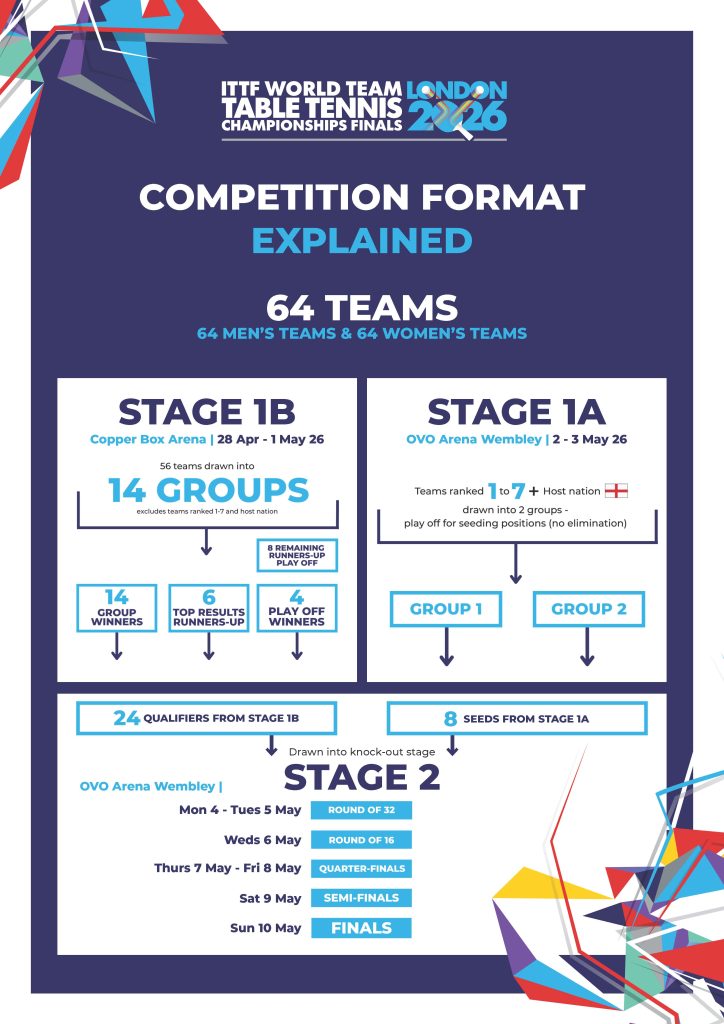
A total of 64 men’s and 64 women’s teams will compete. They have booked their places via the continental championships or the world rankings.
The men’s and women’s tournaments will run alongside each other – here’s our guide to the Championships format.
Every match in the tournament is best of five individual matches (first to three wins). The playing order is:
- Player A vs Player X
- B vs Y
- C vs Z
- A vs Y (if required)
- B vs X (if required)
Each match is best of five games to 11 points.
The tournament begins with groups of 4, played on a round-robin basis (three matches per team).
Stage 1b (Copper Box Arena, 28 April to 1 May)
The 56 teams ranked from 9-64 in each gender have been drawn into 14 groups (Groups 3-16).
Women’s groups
Group 3: Egypt, Algeria, South Africa, Syria; Group 4: Hong Kong China, Mexico, Netherlands, Macau China; Group 5: Brazil, Czechia, Kazakhstan, Mongolia; Group 6: India, Ukraine, Uganda, Rwanda; Group 7: Sweden, Canada, Tunisia, Sri Lanka; Group 8: Thailand, Serbia, Iran, Benin; Group 9: Poland, Spain, Korea DPR, Congo Democratic; Group 10: Portugal, Luxembourg, Cuba, Guatemala; Group 11: Australia, Nigeria, Uzbekistan, Wales; Group 12: USA, Malaysia, Tahiti, Dominican Republic; Group 13: Croatia, Italy, Argentina, Turkiye; Group 14: Puerto Rico, Austria, Ghana, Angola; Group 15: Singapore, Hungary, Cook Islands, Ethiopia; Group 16: Chile, Slovakia, Madagascar, Nauru.
Men’s groups
Group 3: Denmark, Madagascar, Mexico, Mongolia; Group 4: Brazil, Hungary, Puerto Rico, Uzbekistan; Group 5: Slovenia, Czechia, Spain, Bahrain; Group 6: Portugal, Algeria, New Caledonia, Greece; Group 7: India, Slovakia, Tunisia, Guatemala; Group 8: Croatia, Serbia, Cuba, Qatar; Group 9: Romania, Argentina, Benin, Peru; Group 10: Australia, New Zealand, Morocco, Korea DPR; Group 11: Egypt, Kazakhstan, Thailand, Turkiye; Group 12: Poland, Chile, Tahiti, Moldova; Group 13: Iran, Austria, Malaysia, Togo; Group 14: USA, Singapore, Cote d’Ivoire, Angola; Group 15: Hong Kong China, Nigeria, South Africa, Saudi Arabia; Group 16: Canada, Belgium, Cameroon, Fiji.
The teams finishing first in each of the 14 Groups will advance into Stage 2 at OVO Arena Wembley. Six second-placed teams will also qualify directly to Stage 2, with selection based on the best ratio of wins to losses (first in team matches, then individual matches, then games and points, as far as is necessary to resolve the order).
The remaining eight second-placed teams will play a single Preliminary Round knockout drawn at random, with the four winners progressing to Stage 2.
In total, 24 teams in each gender will qualify from Stage 1b to Stage 2.
Stage 1a (OVO Arena Wembley, 2-3 May)
The top seven ranked teams, plus England as hosts, have been drawn into two groups (Group 1 and Group 2). The purpose of this draw is to determine seedings for Stage 2 – all teams in Stage 1a will progress to Stage 2.
Women’s groups
Group 1: China, Korea Republic, Chinese Taipei, Romania; Group 2: Japan, Germany, France, England
Men’s groups
Group 1: China, Sweden, Korea Republic, England; Group 2: France, Japan, Germany, Chinese Taipei
Stage 2 (OVO Arena Wembley, 4-10 May)
The 24 qualifying teams from Stage 1b will join the seven highest-ranked teams, plus hosts England in this stage, which begins with the Round of 32 and then progresses in straight knockout format until the Finals on 10 May, when the world champions will be crowned!
Latest news