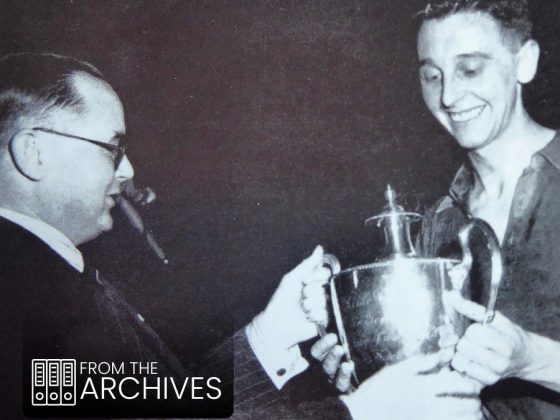
In the latest instalment of our series on England’s World Championships performances over the years, Diane Webb (Chair of Archives, Museum and Records Committee) turns to 1949 as the world travelled to Stockholm.
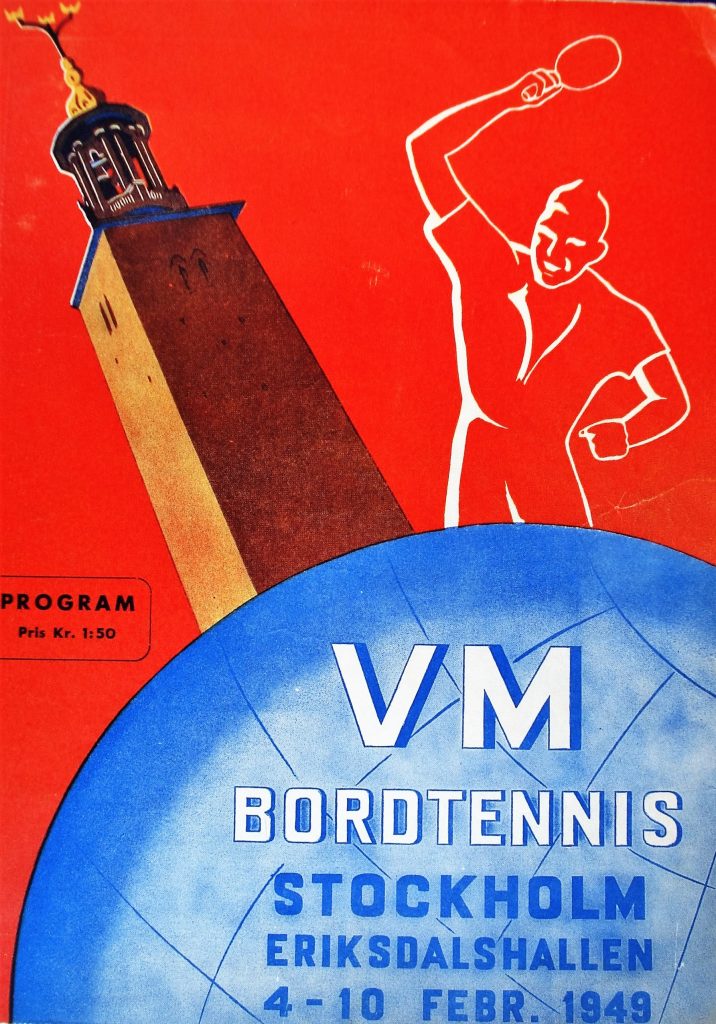
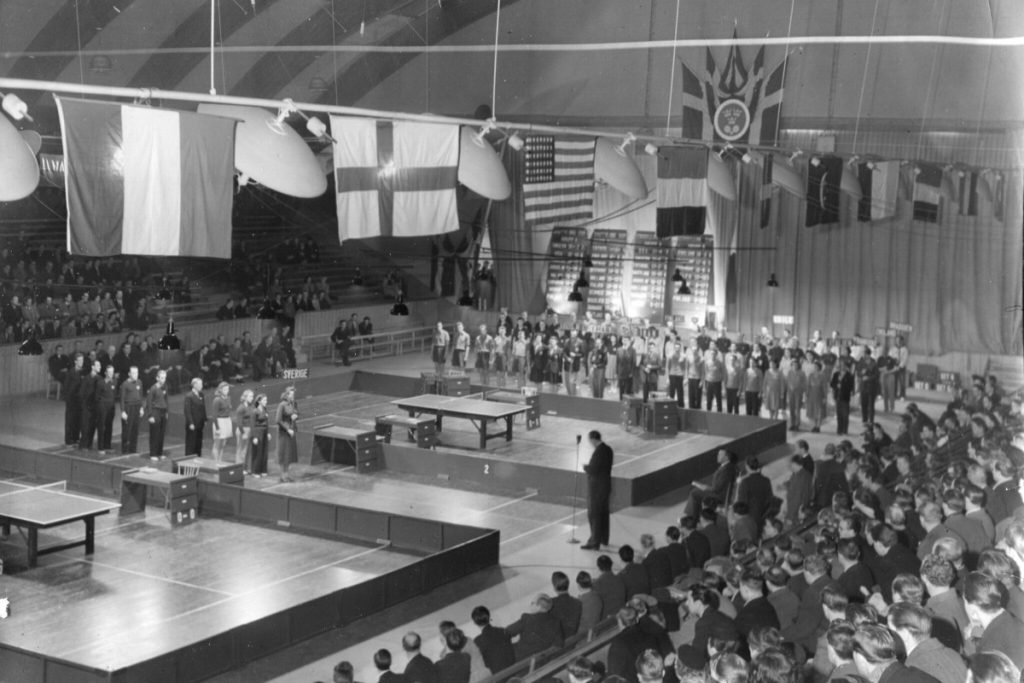
It was off to Scandinavia for the 16th World Championships in a chilly February. The Championships were held at the Eriksdalshallen, Stockholm which proved an excellent venue.
The venue was usually used for tennis which meant the wooden floors were green. This proved an advantage for the spectators who found it easier to see the ball compared to the more usual unstained wooden floors in most halls. The lighting wasn’t too good so improved visibility helped players and spectators see the ball better.
The tables were solid wood and it was estimated the ball travelled about 10% slower on them. This favoured those such as Trude Pritzi, the queen of stonewallers. In three of her games only one point was scored in respective periods of 17 minutes, 15 minutes and 19 minutes.
Sweden’s table tennis-playing Crown Prince Bertil was in attendance and before the finals of the Swaythling Cup and Corbillon Cup he addressed the parade of players and all spectators and officials in English.
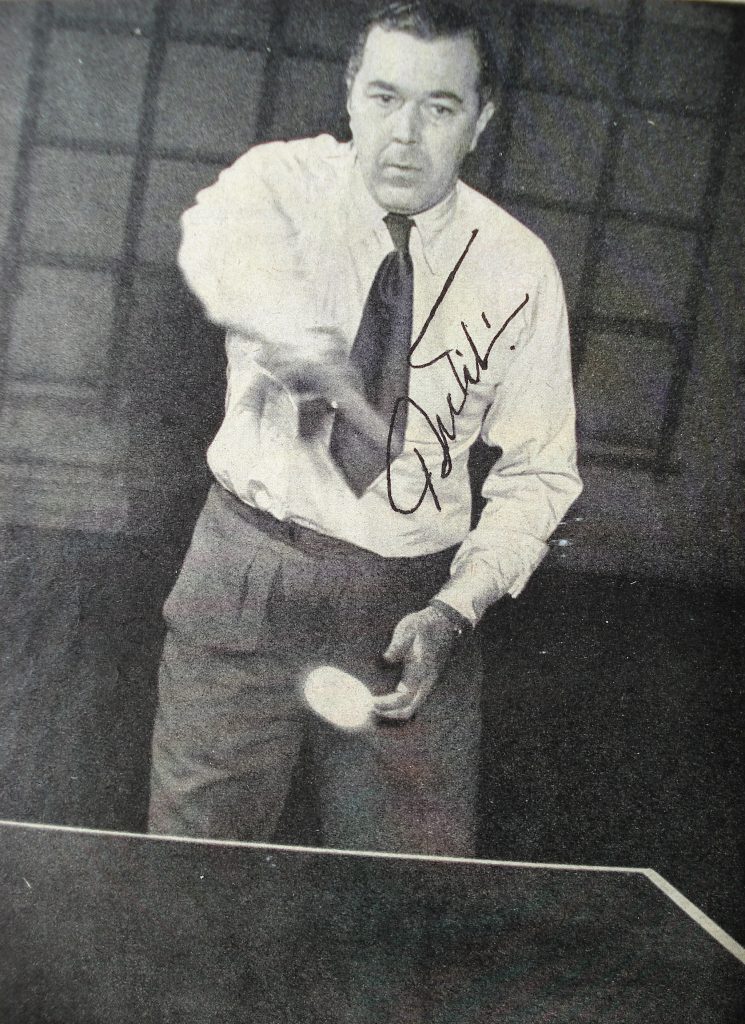
The Journey
Stockholm in February wasn’t the easiest of journeys for the intrepid few who travelled to a wintery Sweden. Three young juniors – Louis Devereux, Derek Ellison and William Pierce – were already there having taken part in a 12-town tour which started on 17 January and stayed for the Championships. A wonderful experience for the youngsters.
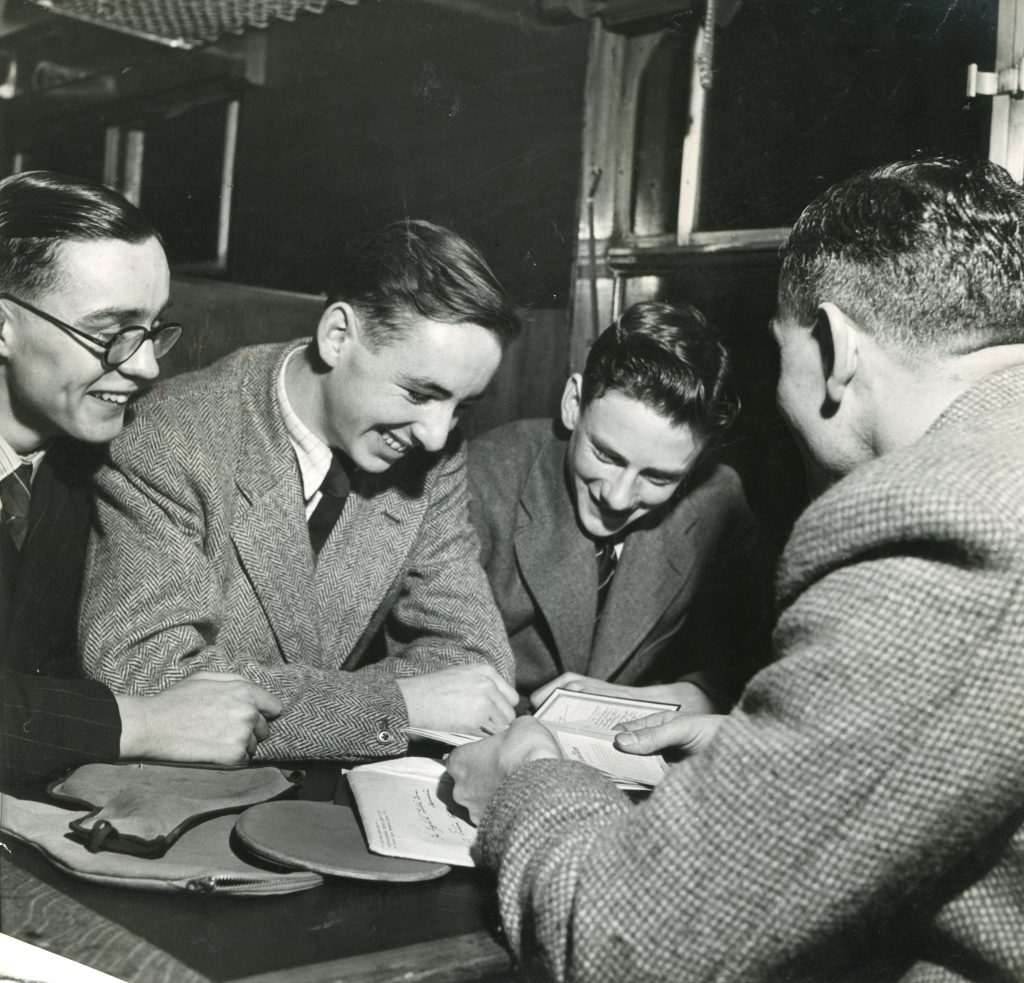
Other players travelled by air, sea, rail and road. Those who went by road included Jack and Elsie Carrington, Johnny Leach, Stan Proffitt, Ron Sharman and his wife, and Steve Boros who provided some much-needed light entertainment. The 37-seater “utility” coach was boarded in Utrecht where some players had taken part in the Dutch Open with some success.
Along with the English contingent on the coach were groups from Holland and France, plus one Irishman. It was a 1,000-mile journey through four countries. Entering Germany, the British Zone had to be crossed without a stop, 11 hours without a break was onerous. Moving into Denmark, despite an hour-and-a-half rough crossing to the main island. Copenhagen proved a welcome stop with the opportunity for a day’s rest while the Dutch team played an international against the home country.
3 February saw Copenhagen left behind as the group took the 25-minute ferry into Sweden from that well known castle of Elsinore. There were several delays along the way to Stockholm including Ron Sharman and his wife being held up at the border by Customs. The party eventually arrived in Stockholm at 2am on Thursday 4 February, the morning of the start of the team events. Not ideal preparation.
Swaythling Cup
Twenty entries were split into two groups. England’s players, captained once again by Adrian Haydon, were Victor Barna, Richard Bergmann, Johnny Leach and, for the first time Aubrey Simons and Ron Sharman.
England faced Brazil, Denmark, Holland, Italy, Switzerland, Scotland, Sweden, Czechoslovakia and Austria in Group B. The matches against Brazil, Denmark and Holland on day one led to three 5-0 wins, fortunately easy matches after that long road journey for those who travelled that way.
Day two was a 5-1 result against Italy and 5-0 against Austria. Against Sweden, even with their star player Tage Flisberg, England had a comfortable 5-0 win with Bergmann and Leach both beating Flisberg in straight games. Leach had an impressive run of 20 winning points after being 4-1 down in the second game.
One match to go against Czechoslovakia, the holders. A win would put England into the final. This time they were on the losing side 5-1. Bergmann was the only player to win a game when he beat Ladislav Stipek -12, 12, 13. Leach lost to Stipek -10, -20 and also lost to Bohumil Vana -12, -16. Barna lost to both Ivan Andreadis -16, 11, -7 and Vana -15, -13. Bergmann’s loss was to Andreadis -14, -12. So, Czechoslovakia progressed to the final leaving England in one of the two bronze medal places.
Egypt and Poland scratched from Group A, leaving eight teams. Hungary came through with 5-0 wins against Finland, France, Yugoslavia, Norway and Wales and 5-2 victories against Luxembourg and the USA.
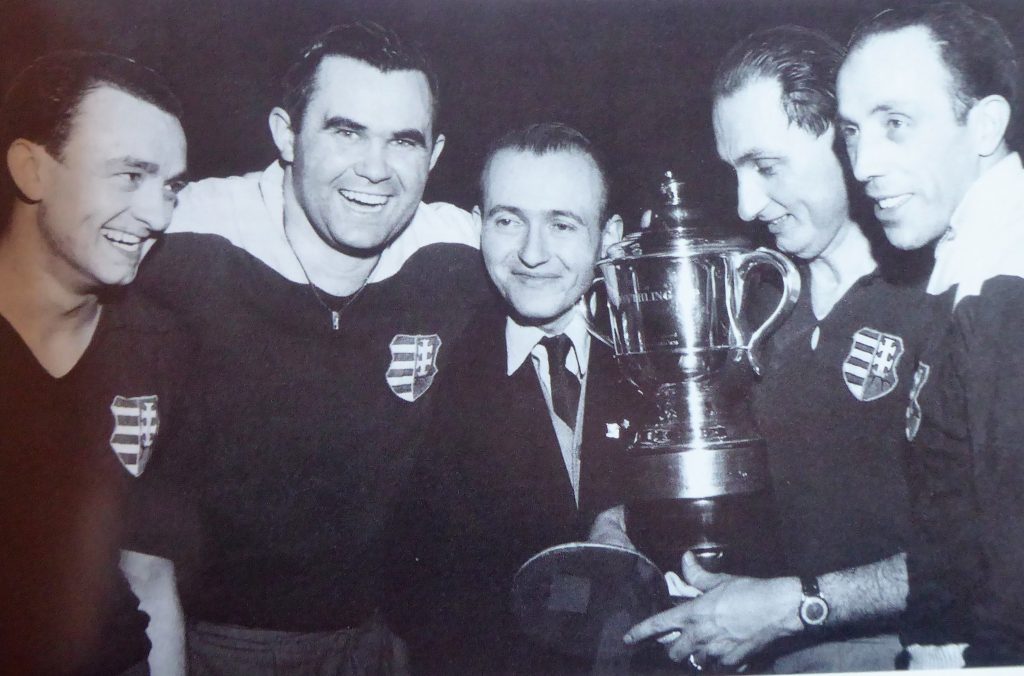
The final was contested by the two teams who topped their groups, Czechoslovakia and Hungary. It was an excellent final that went first one way and then the other. The end result, a 5-4 victory for Hungary despite Vana winning his three matches for Czechoslovakia. Jozsef Koczian beat Stipek and Andreadis but lost to Vana. Ferenc Soos lost to Andreadis and Vana but beat Stipek whilst Ferenc Sido beat Stipek and Andreadis but lost to Vana. Stipek was nearly the hero for Hungary as he led 18-12 in the third against Sido but couldn’t manage the win which would have given Hungary the victory. There were no easy matches with six of the nine games going to three. It was an excellent spectacle for the spectators.
Corbillon Cup
Eighteen teams participated in this event and for England Margaret Knott was captain again. It was a new team with Peggy Franks the only previous Corbillon Cup player. Pinkie Barnes, Joan Crosby and 17-year-old Adele Wood were the newcomers to the team.
In Group B, England played against Finland, France, Italy, Sweden, Wales and Austria. Romania and Switzerland had scratched from this group.
England’s ladies had fairly comfortable 3-0 wins against Finland, Italy and Wales and a 3-1 result against Sweden. There were harder-fought victories against France and Austria but the ladies came through, winning both 3-2 with Franks and Barnes the two English players in both matches. England were top of their group and were finalists once more. An impressive performance for the virtually new team.
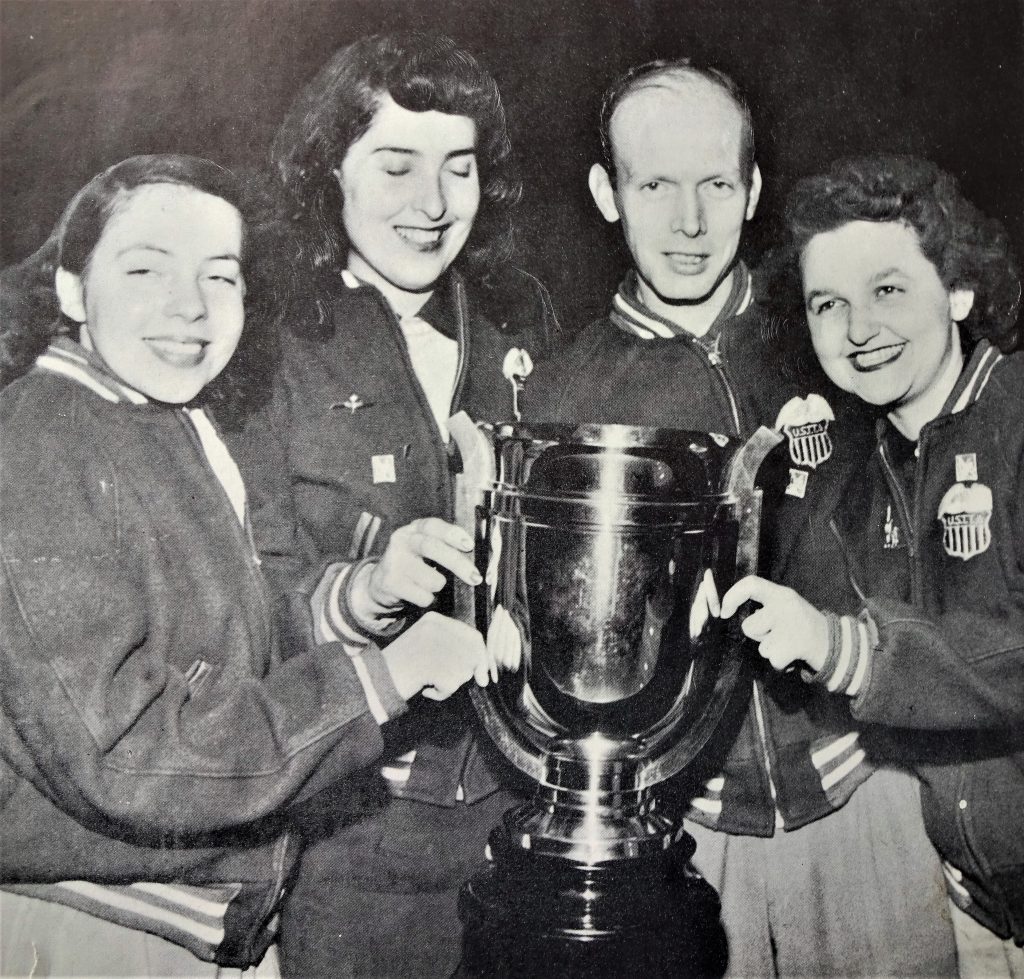
There were eight teams in Group A: Denmark, Holland, Yugoslavia, Norway, Scotland, Czechoslovakia, Hungary and the USA. Egypt was a non-starter in this group. The match to decide who went into the final was between Hungary and the USA. Hungary led 2-1 after three matches but it was the Americans who took the next two to reach the final.
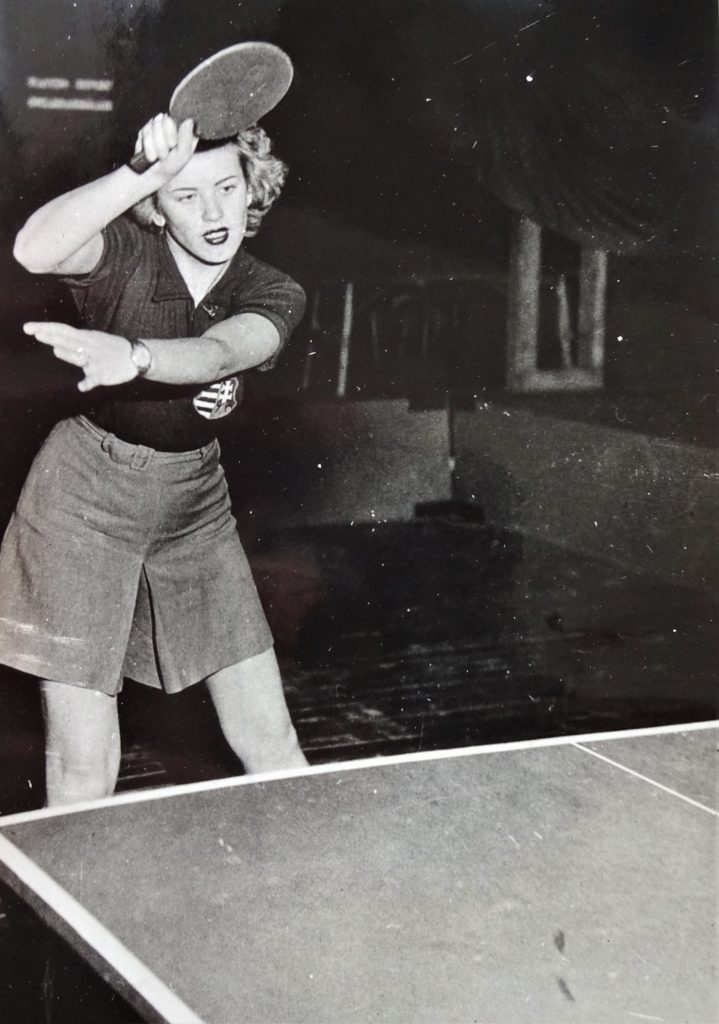
In the final, England again played Barnes and Franks, good friends and oft times doubles partnership. Although Franks beat Mildred Shahian 19, 19, the other three matches went in the USA’s favour. Peggy McLean beat Barnes 11, 14 and Franks also lost to her 16, 20. The doubles went the American way as well, McLean and Thelma Thall getting the better of Barnes and Franks 10, -12, 20. The USA were the new champions. Nonetheless, an impressive silver medal for England with a team that was nowhere near as strong as in the previous few years.
Men’s Singles
Richard Bergmann, Keith Hurlock, Johnny Leach, Adrian Haydon, Brian Kennedy, Jack Carrington, Tommy Sears, Istvan ‘Steve’ Boros (now able to play for England), Louis Devereux, J Harrison, Ron Sharman, Derek Ellison, Victor Barna, Aubrey Simons and William Pierce were all in the round of 128. Prior to that there was a qualifying competition which consisted of all Swedish players.
Haydon had the misfortune to play Leach in his first-round match, and not unsurprisingly it was Leach who won. Sears, Boros, Devereux, Sharman and Barna all went out, all others progressed to the next round.
The round of 64 saw Kennedy having to play Leach. Kennedy put up a good fight but went out 19, 15, -20, 15. Carrington lost to Richard Miles, USA, 10, 12, 12, Harrison lost to O Svensson, Sweden and Ellison lost to A Bolgar, Hungary.
Three left for the round of 16 matches, Bergmann, Leach and Simons. It was only Leach who progressed. Simons fell to Laszlo Varkonyi of Hungary in an epic match -17, 20, 18, -19, 15. Bergmann lost to Ferenc Soos, Hungary, 18-17, 21-14, 20-18. At 11-10 in the third game the ball broke and it took ten minutes before a replacement was agreed which rather disrupted the rhythm of the game. In two of the matches the time limit rule had to be applied. Leach continued his run of wins by beating Sido -18, 10, 16, 18.
Leach now the sole survivor was into the quarter-finals. Here he had to play Richard Miles of the USA. It was another long match with Miles getting three match points before Leach, holding his nerve, ended the victor 20, -13, 19, -12, 22. In the semis, Leach met Soos and the first four games saw the players level at two apiece, the score stood 13, 20, -18, -11 with Leach winning the first two and Soos the next two games. The fifth and final game went to expedite, and it was Leach who got over the line 20-18. He certainly wasn’t making it easy for himself – nor for his fans. In the other semi-final Vana was the victor, beating Marty Reisman of the USA with a more straightforward score of 21, 18, 18.
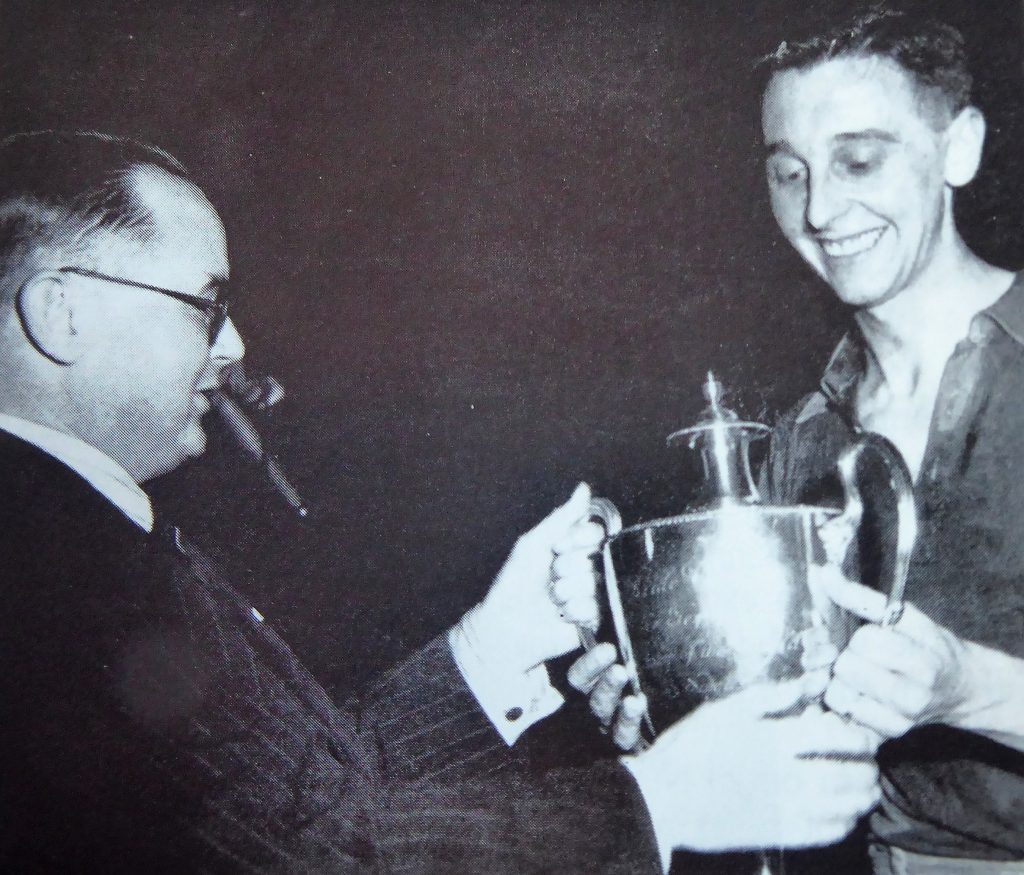
It was another final for Bohumil Vana and once again it was against an Englishman. Once again Vana was on the losing end with the score 19, -11, 17, -14, 16. Victory to Leach, the first time he had beaten Vana and what a time to do it. Leach’s defence gradually wore down Vana’s attack. In the first game the score reached 19-19 before Leach took the next two points. In the second game, Leach didn’t get into his rhythm and Vana won 21-11. In the third the score was 11-all before Leach surged ahead to make it 16-11 and never lost his lead.
The players then were allowed a five-minute rest, and this seemed to revive Vana, he took that game 21-14 to level the score, 2-2. It was 6-6 in the fifth and final game. Leach lost the next three points but fought back to make it 9-9 and then he went ahead and was leading 15-11. Vana almost pulled it back but Leach stayed ahead, 16-14, then 17-15. Leach held his nerve once again to win the game 21-15 and the championship. Huge congratulations all round, Champion of the World!
Women’s Singles
There were fewer entries in this event and only a small handful of English players – Elsie Carrington, F Stephens, Adele Wood, Joan Crosby, Margaret Knott, Pinkie Barnes and Peggy Franks. Carrington, Knott and Barnes did not proceed past the first round.
The round of 32 saw Stephens, Wood and Crosby go out, leaving Franks as the sole English survivor. She progressed to the quarter-finals where she met Gizi Farkas (Hungary) and came close to defeating her with the second game ending 25-23 to Farkas. If Franks had won that second game it may have been a different story but Franks couldn’t get past the eventual champion and went down -11, -23, 18, -15.
It was Thelma Thall, USA, against Kveta Hruskova of Czechoslovakia in one semi-final with Hruskova winning 16, 16, -13, -18, 18. In the other half of the draw it was Trude Pritzi of Austria versus Gizi Farkas and although Pritzi started better, winning the first two games 12 and 13, when the time limit rule came into force the remaining three games went in Farkas’s favour 8-1, 4-3, 3-0.
The final went to five and Farkas became the champion again, defeating Hruskova -19, -18, 8, 9, 9.
Men’s Doubles
There were several partnerships with English interest. The first round saw Barna & Leach, Montagu & Wilmott, Boros & Pierce, Hurlock with Jersey’s R Le Sueur, Bergmann with Sweden’s Flisberg, Devereux & Ellison, Sharman & Simons, Carrington & Haydon, and Kennedy & Sears take part. Only Montagu & Wilmott and Hurlock & Le Sueur did not get through to the second round.
Here, Boros & Pierce went out to the strong French pair Guy Amouretti & Michael Haguenauer. Devereux & Ellison had the misfortune to meet Bergmann & Flisberg so there was no disgrace in their loss. Sharman & Simons went out to eventual semi-finalists Doug McClure & Marty Reisman, USA, and Carrington & Haydon went down to brothers Tibor & Vilim Harangozo of Yugoslavia.
In the round of 16, Barna & Leach made it into the quarter-finals, as did Bergmann & Flisberg. Kennedy & Sears went out to Bengt Grive & Liss Larsson of Sweden.
In their quarter-final match Barna & Leach lost to Ivan Andreadis & Frantisek Tokar, Czechoslovakia15, 20, 11. However, Bergmann & Flisberg continued their progress with a win over the two Harangozo’s -13, 16, 19, 16.
The semi-finals were between Andreadis & Tokar, and Douglas Cartland & Richard Miles, USA, and Bergmann & Flisberg and Ladislav Stipek & Bohumil Vana, Czechoslovakia. Andreadis & Tokar got the better of the two Americans 13, 22, -19, 9. Bergmann & Flisberg went down to Stipek and Vana 11, -20, 14, 15.
The final saw Vana once again on the receiving end of a defeat as he and Stipek lost 18, 8, 21 to Andreadis &Tokar.
Women’s Doubles
Margaret Knott played with Vera Rowe of Wales, F Stephens & Elsie Carrington paired up, Peggy Franks & Adele Wood, and Pinkie Barnes & Joan Crosby were the other partnerships. Stephens & Carrington did not make it into the second round, all others went through. Here, Knott & Rowe exited, leaving Franks & Wood, and Barnes & Crosby as the English players in the quarter-finals.
It was at this stage that Franks & Wood went out to Eliska Furstova & Ida Kotatkova, Czechoslovakia 15, -18, -11, 16, 19. Barnes & Crosby were still flying the flag as they went through into the semi-finals courtesy of beating Eina Eriksson & Iris Persson, Sweden -17, 10, 8, -18, 12.
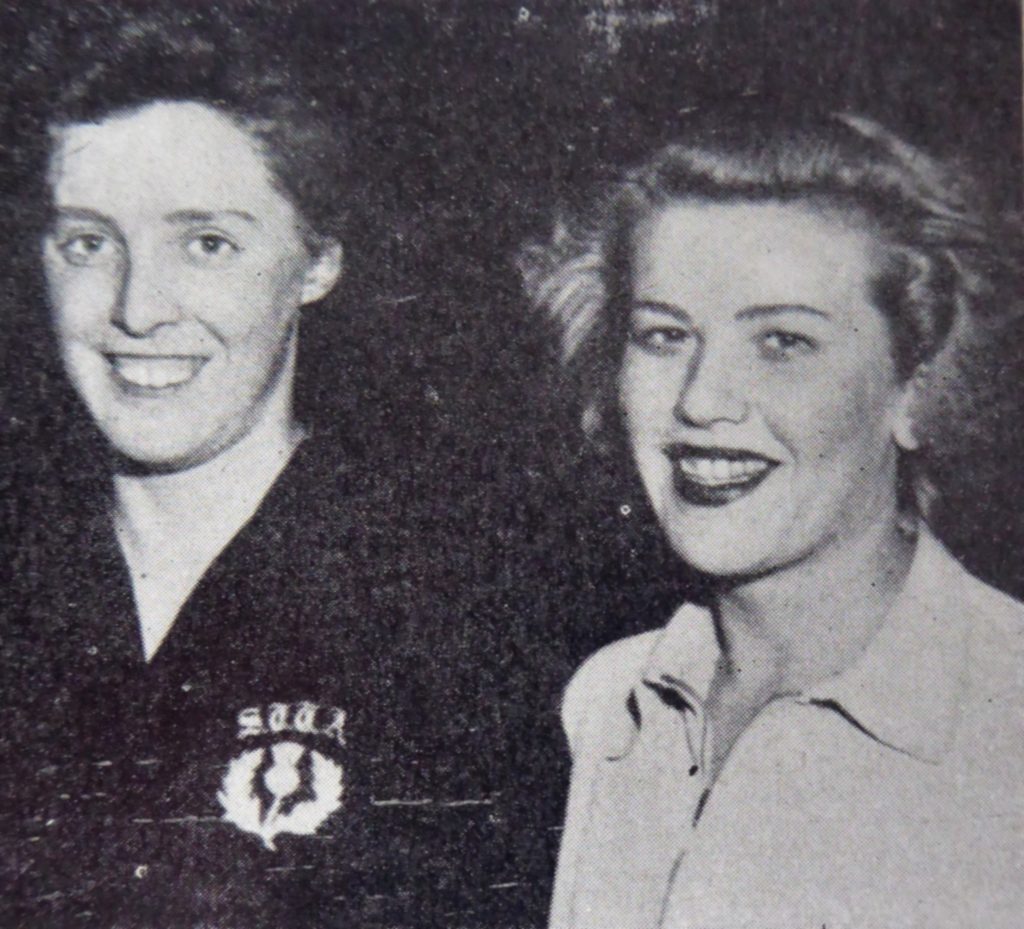
Barnes & Crosby continued their excellent run and defeated Rose Karpati & Erzsebet Mezei of Hungary 19, 16, 11 in their semi-final. Due to Dora Beregi’s absence having recently become a mother, Helen Elliott of Scotland had teamed up with Gizi Farkas and they had a resounding semi-final win 8, 5, 5 over Furstova & Kotatkova.
The final was a step too far for Barnes & Crosby who fought valiantly but it was Elliot & Farkas who took the title with the score 10, 11, 13. Barnes & Crosby had far exceeded expectations, and it was another medal for the pair to add to their Corbillon Cup silver.
Mixed Doubles
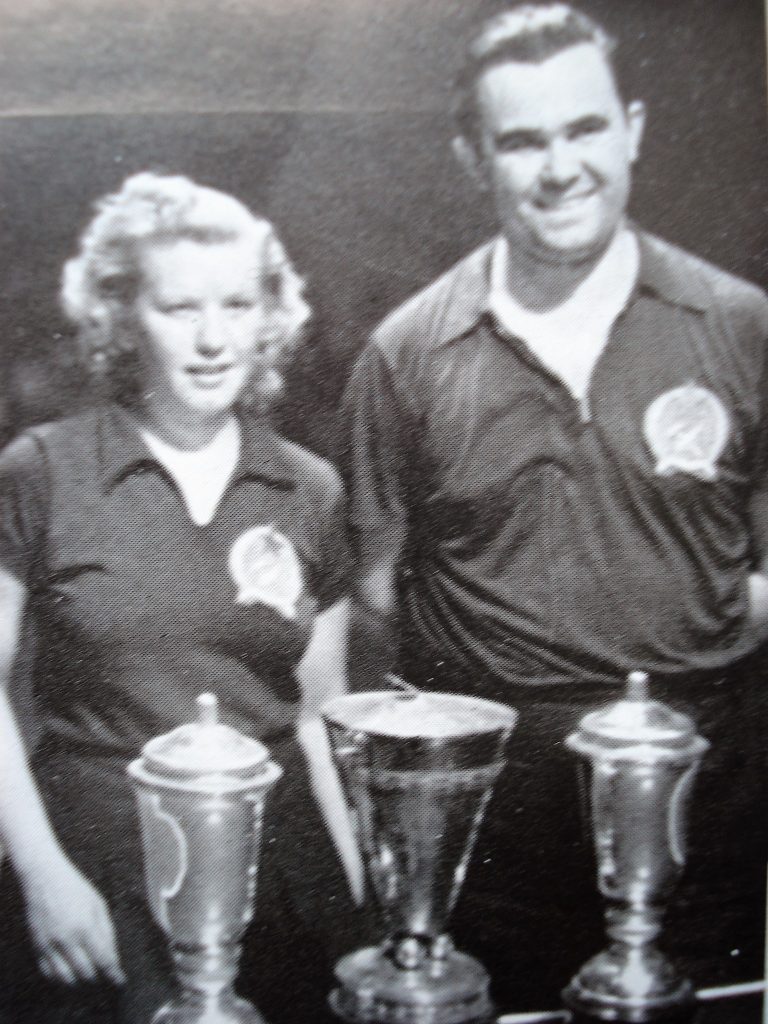
Playing well together, Johnny Leach & Peggy Franks beat the holders Richard Miles & Thelma Thall in the first round, although it was a closely run thing 21, -14, 14, -17, 15. Progressing too, were Tommy Sears & Margaret Knott with another five-game win -18, -19, 12, 19, 14, their opponents, Liss Larsson & Miss Lindquist. The Yorkshire/Lancashire pair of Brian Kennedy & Adele Wood also went through to the next round. Keith Hurlock & F Stephens had a walk over into the round of 32.
Going out in the first round were Ron Sharman & Joan Crosby to Adolf Slar & Eliska Furstova, Czechoslovakia16, 13, -17, 14, and Aubrey Simons & Pinkie Barnes, losing to Otto Eckl & Trudi Pritzi, Austria 17, 16, 1. Jack & Elsie Carrington also made a first-round exit going down to Ladislav Stipek & Marie Zelenkova, Czechoslovakia 16, 12, 13.
The round of 32 saw Sears & Knott depart, losing to Slar & Furstova 15, 11, 13. Hurlock & Stephens were on the losing side against Michel Lanskoy & Huguette Beolet, France 12, 16, 15. Leach & Franks, and Kennedy & Wood continued their run.
It was in the round of 16 that the youngsters Kennedy & Wood lost to Vilim Harangozo & E Pauk, Yugoslavia 12, 14, 13. It was a better result for Leach & Franks with a 14, 17, -19, 23 win over Slar & Furstova. They then met Vilim Harangozo & Pauk and avenged Kennedy & Wood as they defeated the pair -19, -17, 20, 16, 9. This gave them a semi-final match against Ferenc Sido & Gizi Farkas. Here their run ended as they went down 15, 12, 16. Nonetheless, it was another medal making it a very productive championships for the pair and for England.
The other semi-final was between Marty Reisman & Peggy McLean, USA, and Bohumil Vana & Kveta Hruskova, Czechoslovakia. It was the latter who went through to the final, giving Vana another shot at a gold medal. However, it wasn’t to be as a 13, 15, 17 loss to Sido & Farkas placed him and his partner in the silver medal position going down 13, 15, 17.
Consolation Events
Ladislav Stipek of Czechoslovakia won the Men’s Singles and Peggy McLean of the USA the Women’s Singles. Stipek had surprisingly lost to the Swede Sven Olsson in the second round of the Men’s Singles and McLean had lost in the first round of the Women’s Singles to Kveta Hruskova, who went on to be a finalist of the main event.
Snippets
- At the last International Congress, it was decided that seeding would be on merit basis. Seeding was to be based solely on merit not nationality, with the top two seeds in opposite halves of the draw, and so on. Previously, up to eight nominated players of each country were named and separated into different sections of the draw. This meant that the top two players in an event could meet each other in the first round if they were from different countries.
- England’s trials took place on 8 January 1949 and even world champion Richard Bergmann had to take part.
- Japan applied to join the ITTF in November 1948 but did not enter these World Championships.
- The ETTA had one-third of the world’s membership.
Thanks once again must go to Gunther Angenedt for the use of many of his photos.
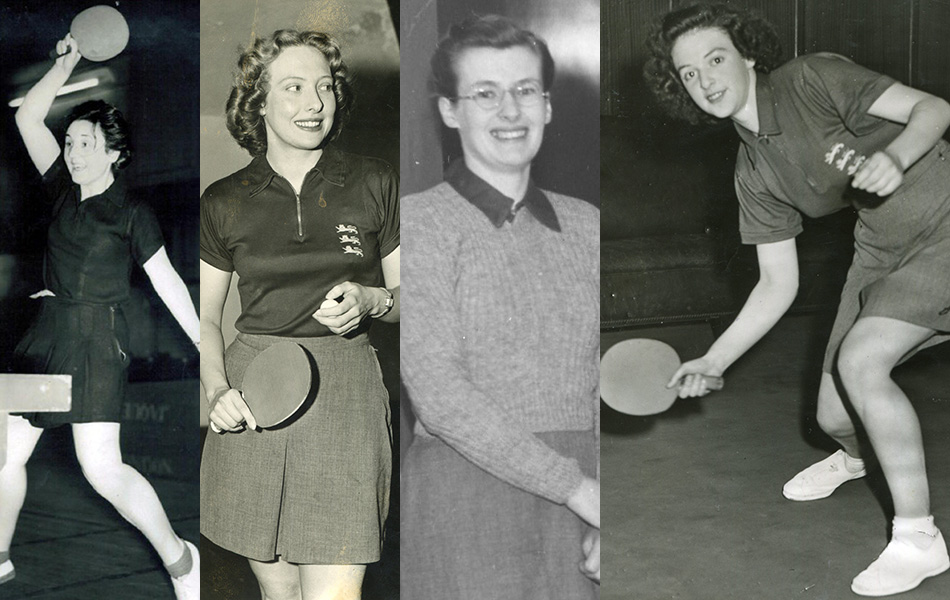
Lavender Rosamund Marguerite Barnes (known as “Pinkie”)
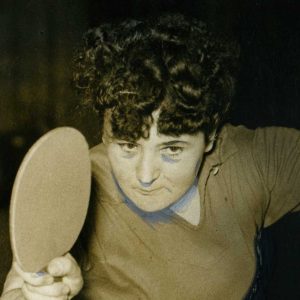
Born in Luton, Bedfordshire on 18 April 1915, Pinkie had a full and interesting life. As well as being a top international table tennis player, she had a successful career in advertising and copywriting. She married the film and television actor Sam Kydd in 1952 and with supporting her husband and working on her career, table tennis took a back seat and she stopped playing competitively. She didn’t give up her involvement though, as she had become an ETTA Approved Local Coach in 1950/51 and coached until well into her 50s.
It was interesting to learn that Sam Kydd, who was a Prisoner-of-war in Germany for five years, where he played table tennis in the camp, used to get information of players and results including those of Pinkie, little knowing that he would end up married to her.
Pinkie met Peggy Franks during the war years when they were both good but not spectacular players, they decided to work hard together and get their international badges. Work hard they certainly did and achieved their dream of becoming international players and in Peggy’s case a multiple world champion.
The pair helped raise considerable funds for the Red Cross during the war by playing in exhibition matches as well as playing for the troops and holding down war jobs. Both glamorous, they became known as “Black Beauty” and the “Blonde Bombshell”. Looking good was of great importance to the pair and Pinkie was a regular contributor to Table Tennis, writing articles with titles such as “Ladies Look Your Loveliest to Win”.
Pinkie played in three World Championships – London, Stockholm and Budapest, winning two silver medals in 1949 and the Women’s Consolation in 1948. She was a member of the England team who were runners-up in the Europe Cup in 1949.
Pinkie played in international matches against Ireland in Dublin in March 1948, winning her Women’s Singles, Women’s Doubles with Dora Beregi and Mixed Doubles with Aubrey Simons. There was another international cap against the USA in February 1949 but no win this time. Her debut had been against Wales on 9 January 1948 in Bath. A fixture England won 9-2 and again it was a triple win with the same doubles partners as against Ireland.
At the English Open in 1948, Pinkie won the Women’s Doubles with Gizi Farkas and was runner-up with Peggy Franks in 1948. In 1950 she was runner-up in the Mixed Doubles with Victor Barna. Pinkie played in Netherlands Opens, Irish Opens and Welsh Opens winning six titles. She also won over 30 domestic Open titles, playing before and after the Second World War.
Her county was Middlesex and she won their Women’s Singles Closed Championships title in 1948/49 and twice won the Women’s Doubles title. Pinkie had previously won the Surrey County Closed Women’s Singles, Women’s Doubles with Elsie Carrington and Mixed Doubles with Ron Sharman. Playing in the Central London League she twice won their Women’s Singles, twice won their Women’s Doubles and was a three-time winner in the Mixed Doubles.
Ranked at England No 4, Pinkie was also a keen administrator. She served on the ETTA Publicity Committee 1968-69 and their Publicity & Publications Committee 1969-72. She was the first Social Secretary of the International Club of England when it was formed in 1964. She was a member of the Wimbledon Table Tennis Club which played in the London League, where she was the Secretary from 1936-38. The membership at that time was around 1,800, the club also played in the South London League.
One of Pinkie’s best quotes after playing at Wembley Arena in front to 15,00 people: “Were you nervous?”, “Yes”. “Did you win?” “Yes”.
As for the name Pinkie . . . not liking the way her brothers shortened her first name of Lavender, with her pink complexion, “Pinkie” became the order of the day – and stuck.
Joan Crosby (Miss Brock)
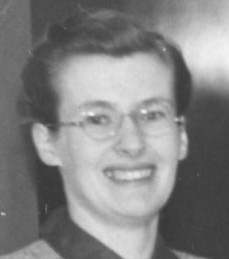
Exeter seemed to produce a number of internationals and Joan was another, she was born in the city on 4 March 1920. She played in the one World Championships, but it was certainly a successful one for her as she ended with two silver medals, one in the Corbillon Cup and one in the Women’s Doubles with Pinkie Barnes.
Joan was also a silver medallist in the Europe Cup in 1949, playing with Pinkie Barnes, Peggy Franks, Betty Steventon and Adele Wood. At the trials she finished top, beating Barnes, Franks, Molly Jones and Steventon.
Another three international caps came Joan’s way against Czechoslovakia, Ireland and Wales, all matches won by England. Joan took part in the same Czechoslovakian tour as Louis Devereux in 1949, playing in one international and six regional matches.
Playing in the English Open from 1939 to 1955, Joan’s best result was a semi-final place with Betty Blackbourn in 1940. International Opens saw success in the Netherlands Open with wins in the Women’s Doubles with Pinkie Barnes and Mixed Doubles with Ron Sharman. Joan was also a semi-finalist in the Women’s Singles in 1948/49. In domestic Opens another 20 titles were added to Joan’s record.
There were wins in the Devon County Closed x 3, Exeter & District League Closed x 6 and the Western Counties Closed x 3. Joan played for the St Stephens Club in the Exeter League and in 1938/39 their ladies ream won Division 1 with Joan having a 100% record.
Exeter played in the first ever Rose Bowl competition in 1938/39, and with Betty Blackbourn the duo of ladies won the coveted trophy.
Adele ‘Dale’ Wood
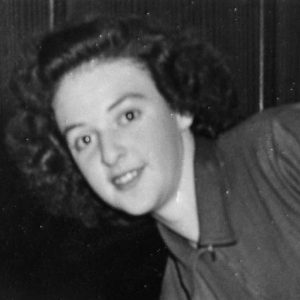
Born in Blakley, Manchester on 11 December 1931, Adele was just 17 years old when she went to Stockholm.
In the Corbillon Cup trials on 22 November 1948 in Newcastle, she played for the North against the South and although the North lost, Adele won both her matches, one against Joan Crosby – she was on her way to Sweden.
Dale had played in the World Championships the previous year at Wembley, but Stockholm was the first time she had played in the Corbillon Cup and came away with a silver medal. It was a quarter-final place in the Women’s Doubles with Peggy Franks.
Dale gained two international caps, against Scotland in 1949 and Ireland in 1951.
At the English Open, she twice won the Junior Girls’ Singles, once in November 1947 and in 1949 where she beat Diane Rowe. In 1949 she was a runner-up in the Women’s Doubles with Peggy Franks and a semi-finalist with Ronnie Allcock in 1955 in the Mixed Doubles. In the Netherlands Open, Dale was runner-up with Peggy Franks in 1949 and a winner with her at the Welsh Open in the same year. She won over 60 Senior Open titles and a number at Junior level, mainly in the north of England.
It was more wins in the Lancashire Closed, winning the Women’s Doubles in 1946/47 and the Junior Girls Singles that year. In the Lancashire & Cheshire Closed it was two titles in 1951/52 in the Women’s Singles, and Mixed Doubles with Benny Casofsky. At the Manchester Closed, Dale won the Women’s Singles in four consecutive years from 1950/51, a four times Women’s Doubles champion and the same in the Mixed Doubles. After moving to Somerset, Dale continued her remarkable record and won four more county titles.
Although Dale remained a top player, she never reached the heights the early promise showed. This was put down by many as the result of being “blooded” too early at those World Championships in Stockholm, not allowing her game to develop more naturally. She was described as “one of the most attractive players . . . both in person and performance in England . . . with a natural grace of movement”.
Adele later moved to Barrow-in-Furness and played in their league. She died in Barrow in 2024.
Keith Hurlock
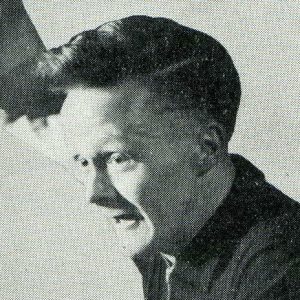
From Croydon in Surrey, Keith was born on 15th June 1927. He played in one senior international against Scotland on 13th February 1951 in Cheltenham. He won his singles match and doubles with Johnny Leach in England’s 9-0 victory. It was as a result of winning the Metropolitan Open in 1950/51 that he was awarded his England cap.
Keith was a regular on the Open tournament circuit and as well as the win at the Metropolitan Open had success at the Bournemouth Open, Buckinghamshire Open, Eastern Suburban Open, Kent Open, North East England Open and South of England Open. He was a runner-up in the Surrey County Closed in the Men’s Singles in 1953/54 and in the Men’s Doubles with Zenon Schramm in 1972/72 and a winner of the Veteran Singles in 1970/71. Keith also won titles at the Croydon Closed, Leatherhead Closed, London Closed, South London Closed and Wandsworth Closed over a period spanning more than 25 years.
Keith played in World Championships in 1947/48, 1948/49, 1950/51, 1953/54 and 1954/55 and numerous English Opens from 1947-64. He also played in three National Championships. He was on the winning side at the Worker’s Festival Tournament in Paris in July 1953 with Ivor Jones and Dennis Miller.
An ETTA Approved Local Coach qualifying in 1950/5. Keith served as Chairman of the Wandsworth League in 1975 and was Social Secretary and Executive Committee Member of the International Club of England.
Keith was a popular player and described as the perfect sportsman both on and off the table.
Ron Sharman
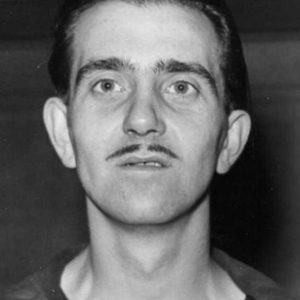
Ron was a Londoner born in Fulham on 13 September 1917. His England debut was against Wales on 15 January 1947, he played against them again in 1949 and also played international matches against Denmark, Hungary, Ireland and Sweden.
Ron was a reserve for the Swaythling Cup team in 1948 which finished fifth and then a playing member for England in Stockholm in 1949 where the team finished third, a well-deserved medal. In December 1948, just prior to the 1949 World Championships, Ron toured Sweden with Johnny Leach and Aubrey Simons, playing one international match plus regional matches in Malmo, Boros, Gravarne, Uddevalla, Karlstad, Lidkopinng, Varborg and Halmstad. Ron also played in the World Championships in 1954 at Wembley.
At the English Open, Ron’s best results were in Veteran events where he was the winner of the Veteran Men’s Singles in 1957/58, 1958/59 and 1959/60 and runner-up the following two years.
Open tournaments saw success in the Netherlands Open in the Mixed Doubles with Joan Crosby in 1948/49 and runner-up in the Men’s Doubles at the Welsh Open in 1946/47 with Peter Rumjahn. He won nearly 20 other Open titles.
Ron initially played for Surrey and later Middlesex, in the former he won the Mixed Doubles with Pinkie Barnes in 1947/48. In the latter he won the Men’s Doubles in 1949/50 with Ken Craigie and the Mixed Doubles with Rosalind Rowe. At this time, both teams were made up almost exclusively of international players. The London Closed, Staines Closed and Wandsworth Closed saw more titles come his way.
Ron represented Surrey’s first team from 1947-49 and during this time played against a Czechoslovakia international team in 1948. He also played in a Rest of England versus the Champion County (Middlesex) in 1948 and on one further occasion. He played in a North versus South fixture in 1947 and won his three matches.
With the London League, Ron was a member of the Wilmott Cup team which won the trophy in 1946/47, playing with George Goodman and Johnny Leach.
Ron qualified as an ETTA Approved County Coach in 1950/51 and an Approved Coach in 1951/52.
His style was described as “a specialist in defence with a biting chop from either wing and a stylish backhand which he used sparingly but with great effect”.
Louis Deverux, Derek Ellison, William Pierce
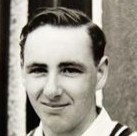
Of the three youngsters who were privileged to go on the tour of Sweden before the Championships, only Louis Devereux (pictured above) went on to become a senior international.
Louis was born in Heavitree, Exeter on 20 October 1931. His England junior debut was against Wales on 17 April 1948 in Cardiff. A 9-1 victory for England with Louis winning his two singles matches and his doubles with Ken Beamish. He played a further junior international match against the Welsh team on 18 April 1949, which was another success, this time 6-4 and again Louis won his two singles and doubles with William Pierce. The following year he gained his first senior cap when he took part in the Czechoslovakian tour in November which consisted of one international and six matches against regional sides.
It was as a junior that Louis had his best results. Two excellent results came his way in the Junior Boys’ Singles in 1948/49 in both the English and Welsh Opens, he also won the junior event at the West of England Open that year and the Men’s Doubles with Aubrey Simons at the same event.
Other victories came his way in the South Devon & Torbay League Junior Singles in 1948/49, the Junior Boys’ Singles at the Western Counties Closed, the Men’s Singles in the Exeter & District Closed in 1947/48 and 1948/49, also the Men’s Doubles in 1948/49 with J Stallibrass. In the Worcestershire County Closed he won the Men’s Doubles with J E Smith in 1954/55.
Louis was a talented sportsman and other sports pulled him in their direction. He played football for Torquay United reserves and was a first-class county cricketer. In 1949, he scored 72 for the MCC Young Professionals against the MCC and also played against Oxford and Cambridge Universities. Louis played for Worcestershire from 1950-55, playing in 79 first-class matches, scoring 2,070 runs and taking 106 wickets with his off-spin bowling. He then moved to Glamorganshire until 1960 and played 106 matches. In the winter he went to South Africa and Argentina to coach.
On retiring from cricket, he ran the Central Hotel in Aberystwyth from 1965-95 and found time to take up golf and reduce his handicap to 1. Excellence in four major sports.
Derek Ellison was from Bolton, aged 16 and a half and already working, as a clerk in The Co-operative Bank in Manchester. He had won the Birmingham, Merseyside and Bolton junior championships and earned his place to play in Sweden in the selection trials. A good wicketkeeper and chess player.
William Pierce, the second oldest of the trio, was from Liverpool, he turned 17 on 15 November 1948. This was only his second season of playing but impressed enough at the trials to be included in the tour. He played for, and was employed by, African Oil Mills.
Latest news