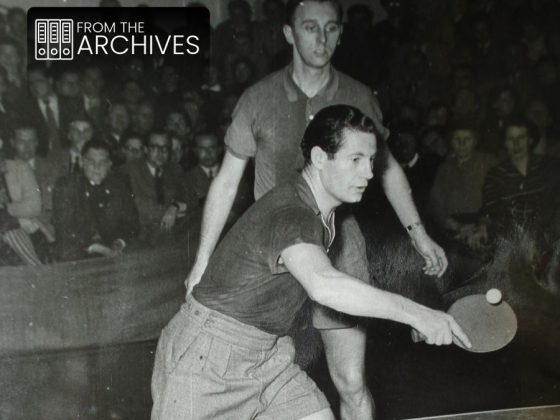
In the latest instalment of our series on England’s World Championships performances over the years, Diane Webb (Chair of Archives, Museum and Records Committee) turns to 1952 in Bombay (Mumbai).
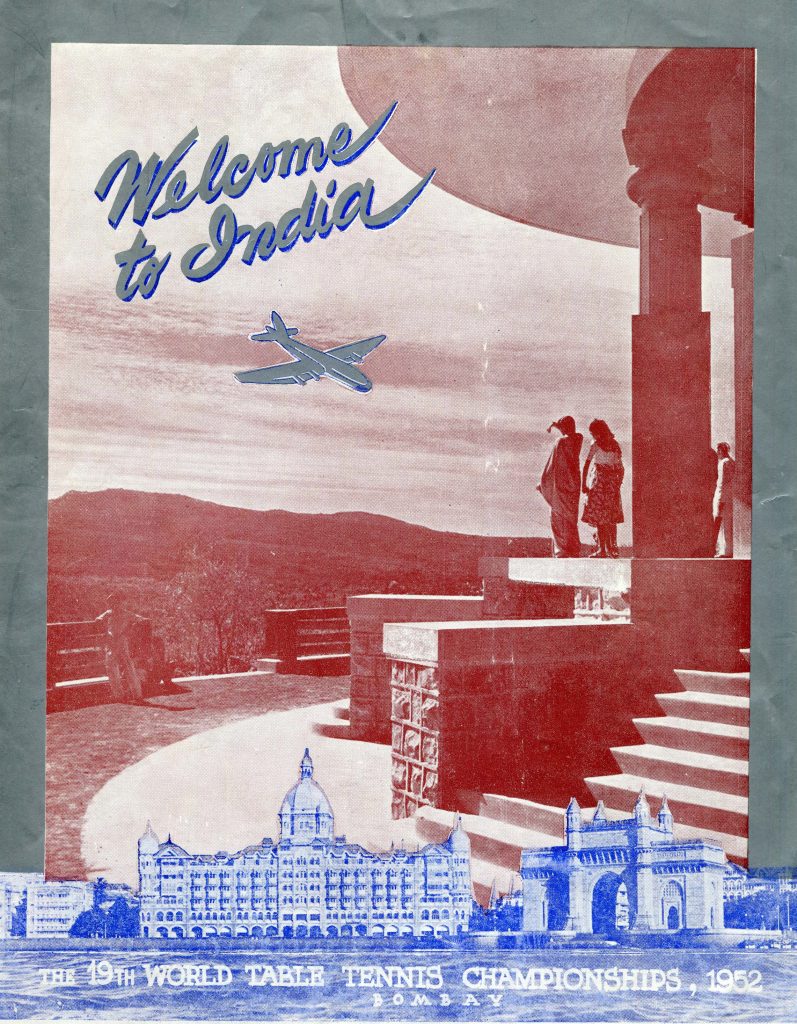
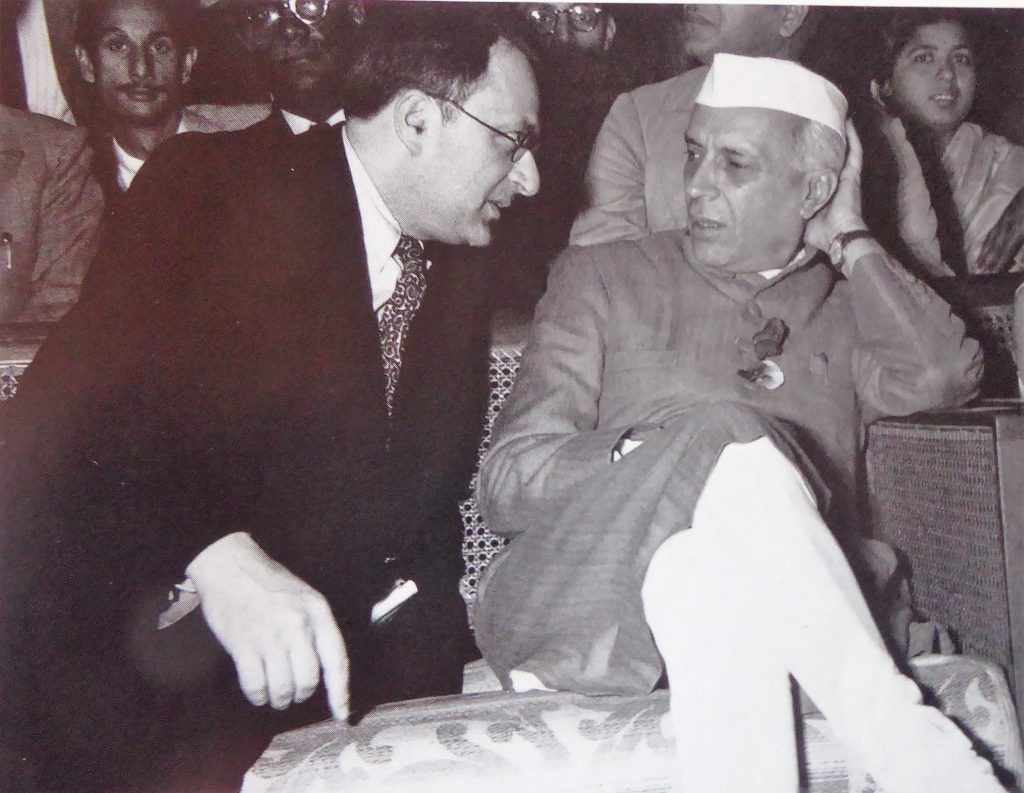
It was the first time a World Championships of any kind was held in Asia and it all started at the ITTF Congress in Budapest in 1950.
T D Ranga Ramanujan stood up and asked why the 1952 World Championships should not be held in India. To which the President, Ivor Montagu, replied: “If India were to be allowed to stage the championships for the mere asking what about Timbuctoo making a claim for the same tomorrow? Or do you expect the international body to say yes to any and every country making a request?”
To which Ramanujan replied: “If India cannot be offered a chance to stage the championships for fear of a rival claim from Timbuctoo in the year following, why call yourself the International Federation. Call yourself the European Table Tennis Federation and India will look after itself and probably form a federation for the benefit of Asiatic countries.”
That rather stopped Montagu in his tracks . . . and so, it came about. It was a Championships that changed the face of international table tennis forever.
Before the Championships
A new selection committee was set up for this season after the criticisms last year about England selection without trials, however, it was still chaired by Ivor Montagu.
Initially it was agreed that there would be no trials for seniors but that comprehensive results during the season in open tournaments, county matches, international matches, the Wilmott Cup and J M Rose Bowl etc would be taken into consideration. However, this decision was overturned and trials were held on 13 December 1951.
It wasn’t an auspicious day for Richard Bergmann as he lost to Michael Thornhill, Harry Venner and Brian Kennedy although he beat Ken Stanley. Venner was in superb form, only narrowly losing to Johnny Leach and beating Bergmann, Aubrey Simons, Stanley, Thornhill and Kennedy and so thoroughly deserved his place in the team.
Adrian Haydon was captain for both teams and keeping numbers as low as possible due to cost was a priority. The selection, after the trials, was Johnny Leach, Aubrey Simons, Harry Venner plus A N Other. Subsequently, after some superb results, Bergmann justified his eventual selection and so joined the squad, although he did have to meet part of the cost of his travel and other expenses. As he also lost considerable income from his stage shows he was well out of pocket by representing his country.
The Corbillon Cup quartet were Kathy Best, Peggy Franks, Diane Rowe and Rosalind Rowe. Thanks were expressed to the Yorkshire Association who raised £104 towards the cost of sending Kathy Best to Bombay which ensured England had a full complement for the Corbillon Cup.
The Championships started on 1 February in the Brabourne Stadium in Bombay. 250 players were expected from 34 countries although the actual number did not quite live up to what was anticipated. It was the largest number of Asian countries ever in the Championships, eight in total – Hong Kong, Iran, Japan, Pakistan, the Philippines, Singapore, Vietnam plus the home nation, India.
The stadium was in a temporary covered arena with seating for 6,000. There were three blocks of wooden stands with the square completed by a 234-foot section of the east block of the stadium. A wooden floor 40 foot by 20 foot supported 10 specially constructed tables.
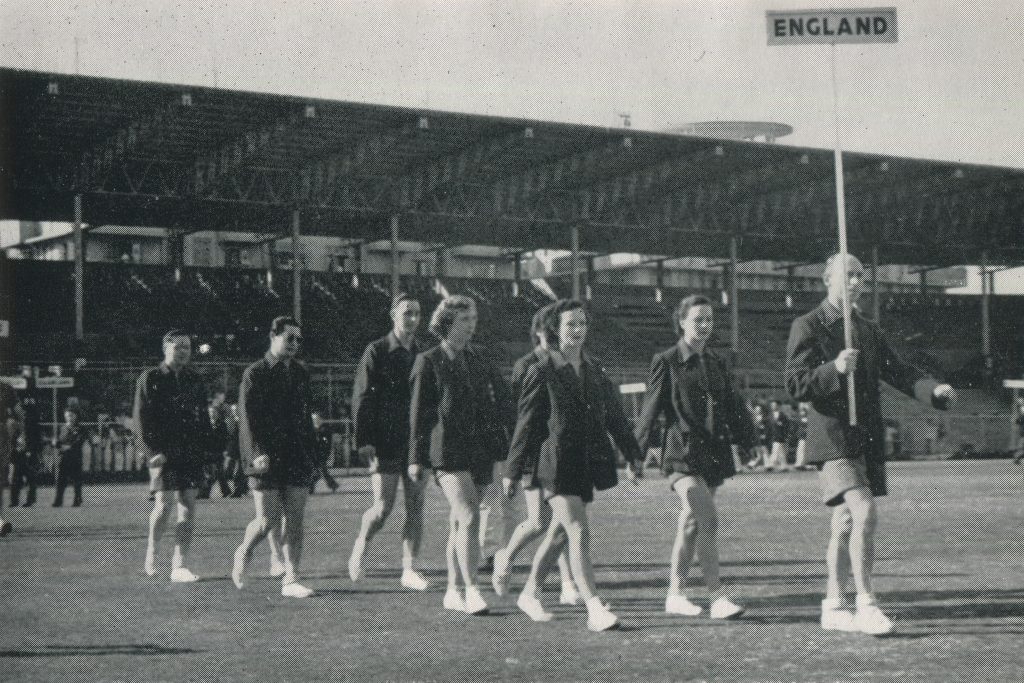
Swaythling Cup
There were two groups and England in Group A faced France, Germany, Japan, India, Pakistan, Portugal and Cambodia – several countries who had not played previously. It was success for England at the group stage as they won all their matches – 5-0 against Germany, Cambodia, Portugal and Pakistan, 5-1 against India, 5-2 against Japan and the closest match against France was 5-3 in England’s favour.
Bergmann and Simons won both their matches against India while Leach won one but lost to Thangavelu Thiruvengadam -17, -7. Japan was another win for England, this time 5-2 with Bergmann winning two but losing to Hiroji Satoh 10, -13, -15, the only match he lost in the team event. Leach won one but also lost to Satoh 18, -10, -13 while Simons at number three won his two matches.
A 5-3 win against France saw England progress to the final. In this match Leach beat Michel Haguenauer but lost to Rene Roothoft and Guy Amouretti, Bergmann beat all three players while Simons beat Haguenauer but lost to Amouretti.
Hungary in Group B were the team to go through to the finals with 5-0 wins against Vietnam, Chile, and Afghanistan, 5-1 against Brazil and Singapore and the closest against Hong Kong 5-2. None of the teams really giving them much trouble.
England versus Hungary in the final. Once again Bergmann was the star player, he beat Jozsef Koczian 12, 19, Ferenc Sido 16, 17 and Kalman Szepsi 13, 6. Leach had a win over Szepsi -8, 14, 15 but was disappointing in his other two matches. He lost to Koczian -18, -15 and Sido -19, -17, matches which he was expected to have won. In Simons’ first match against Koczian he pulled a calf muscle, he lost the first end -17 and the second -6. It was decided that he would concede against Sido, the Hungarian’s strongest player, to give his leg a chance to recover a little and to receive treatment.
With the overall match score poised at 4-4 Simons went to the table against Szepsi. Playing virtually on one leg he put up the most spirited fight but lost -21, 8, -16. If it hadn’t been for that injury it could well have been England’s name on the trophy. In the end it was 5-4 to Hungary. So close for England, captain Haydon would have to wait to achieve his dream of holding the cup.
Japan and Hong Kong were equal third after finishing second in their groups.
Bergmann won 16 of his 17 matches, a most impressive record, his one loss was to Satoh. Leach had a disappointing Swaythling Cup, losing several matches he was expected to win, he still won 10 of his 16 matches. Simons won seven of his 11 and Venner as the fourth player played four and won four.
Corbillon Cup
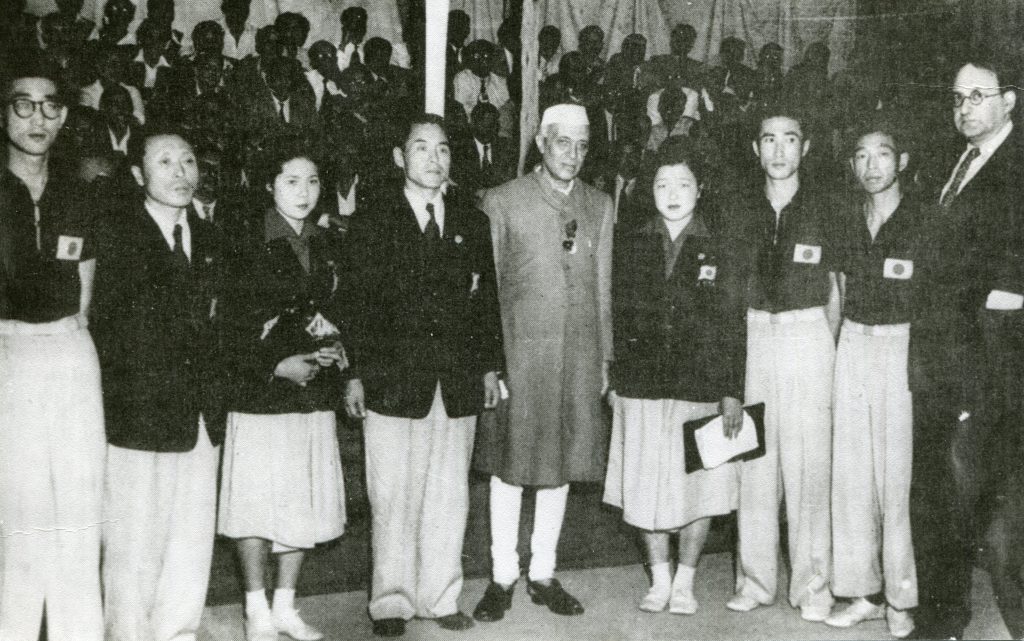
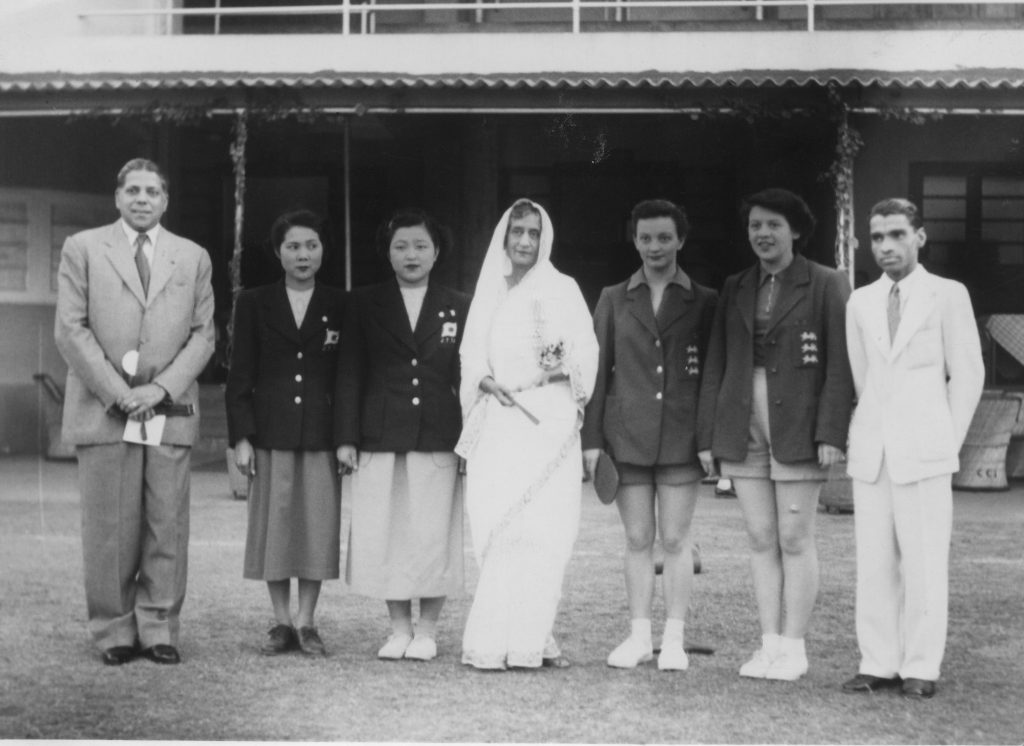
Kathy Best was the newcomer to the team and was in elevated company playing with three world champions in the form of Peggy Franks and Diane and Rosalind Rowe. They were also captained by Adrian Haydon.
Eight teams had entered but Chile were a no-show, leaving a round-robin group of seven – England, Romania, Austria, Japan, Hungary, Hong Kong and India. Japan entered the Championships for the first time and what a difference they made. In their first match their penholder players had a sensational victory over a strong Hungarian team.
England had two good 3-0 wins against Hungary and India, 3-1 against Hong Kong and an excellent win 3-2 against the holders, Romania. However, losing to Austria 1-3 and Japan 0-3 left the ladies in equal second place with Romania.
Diane and Rosalind were the English players against Japan. Rosalind lost to Sizuki Narahara 19, 17, Diane lost to Tomie Nishimura 14, 17 and the twins lost to the pair 14, 9 in the doubles, their only doubles loss. Afterwards Diane said: “We have never played anything like that.”
Japan won all their matches although they had close ties against Romania and Hungary winning both 3-2. Romania, like England also lost two matches, to Japan and England.
Kathy Best and Peggy Franks each only played in one singles match, against India and Hong Kong respectively, they both won their fixtures. Diane won two of her six singles and Rosalind won four of her eight. In the doubles the twins won five of their six matches, their one loss to Japan.
Men’s Singles
As well as the Swaythling Cup team, Ivor Montagu and Geoff Harrower also participated in this event, as did Adrian Haydon.
After his injury in the Swaythling Cup, Aubrey Simons had to withdraw from this event. Montagu had had a bye in the first round and went out in the next round, the round of 64. Harrower also went out at this stage to the good Hungarian, Elmer Gyetvai 19, 16, 18.
The round of 32 saw Richard Bergmann, Harry Venner and Adrian Haydon depart. After leading by two games Bergmann succumbed to the Japanese No 1, Norikazu Fujii, in an epic struggle -14, -18, 18, 16, 17, with Fujii’s ferocious hits getting the better of Bergmann. Michel Lanskoy of France defeated Venner -17, 12, 19, 23 and Haydon lost to Indian, Jall Godrej 16, 13, 9.
Only one Englishman left, the holder and No 1 seed, Johnny Leach. Still not playing his best, Leach made it into the round of 16 where he lost to Frenchman, Guy Amouretti 13, -10, 9, 15. Fujii too went out in this round to Rene Roothoft of France -18, 17, 20, 17, perhaps suffering the effects of his five-game battle with Bergmann.
The quarter-final matches were Amouretti versus Doug Cartland, USA; Josef Koczian, Hungary versus Lanskoy; Hiroji Satoh of Japan versus Ferenc Sido, Hungary; and Rene Roothoft, France versus Rosa Duque of Portugal. Amouretti won his match 19, 9, 13, Koczian 18, 18, 12, Satoh was the only one to lose an end beating Sido -19, 20, 4, 13 and Roothoft won 16, 12, 9.
Both Frenchmen lost their semi-final contests and finished with bronze medals. Amouretti lost to Koczian 19, 14, 18 and Roothoft, the French national champion, to Satoh 19, 15, 19.
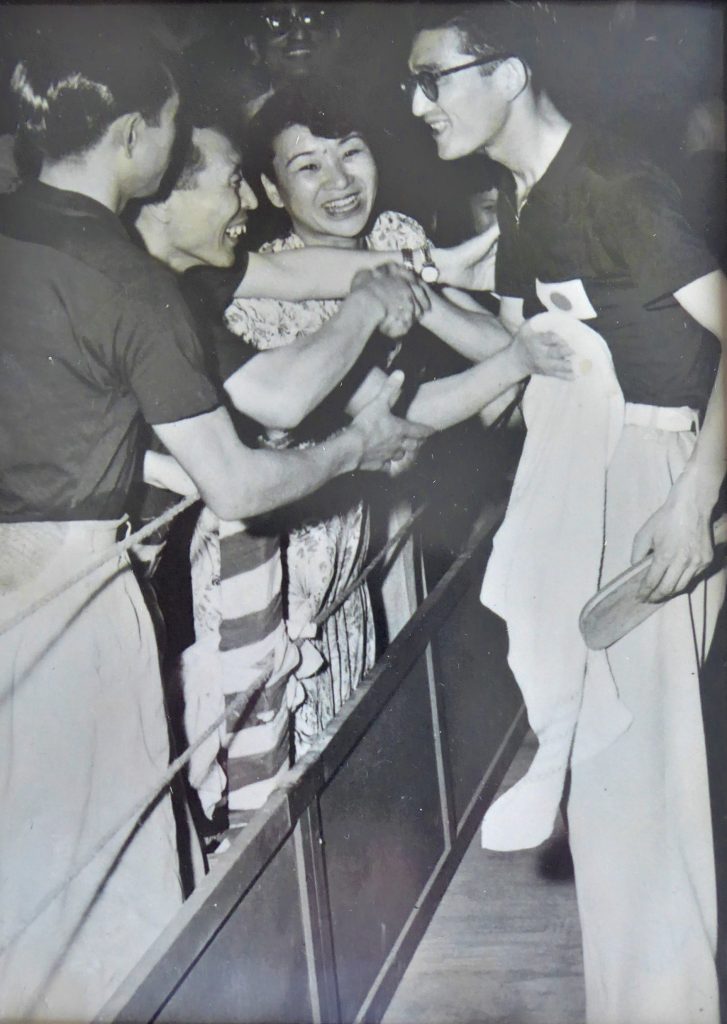
For the first time ever, an Asian player was in the Men’s Singles final and Satoh, Japan’s No 5, went on to become the Men’s Singles champion, overcoming Koczian 19, 17, 14. Apart from the inaugural Championships, this was the first time a player took the title at his first attempt, it was also the first time in the modern era that a penhold player had won and the first time a player with glasses had won.
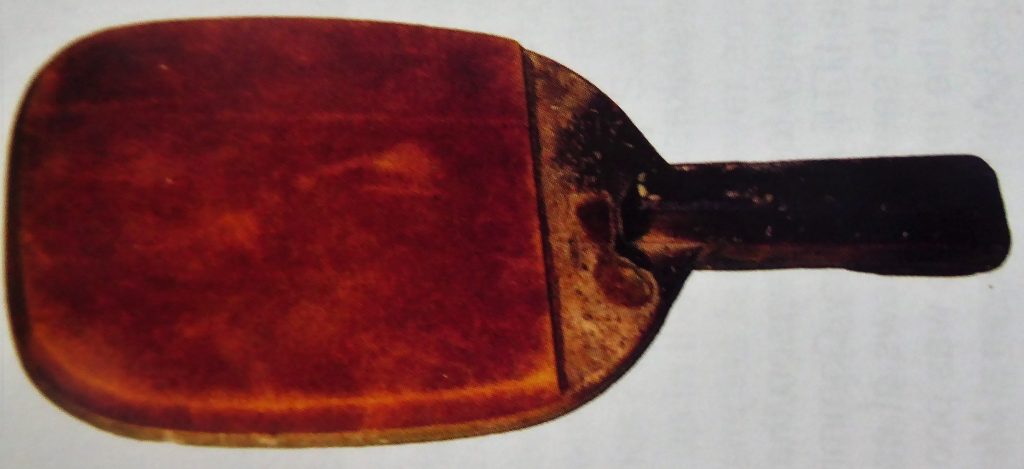
It was also the first time a player won with sponge. Satoh was one of only about 50 Japanese players amongst the quarter million who played, who used that kind of bat which was made of soft wood, barely an eighth of an inch thick, squarish in shape; on one side only (as he was a penholder player), there was aerated, soft, sponge padding half an inch thick. It was the lack of sound as the ball hit the bat that was the most significant factor in Satoh’s wins, plus the amount of spin he was able to impart. Once other players had become used to the surface there was no doubt it would not be of such significance.
However, sponge or something similar wasn’t a new concept. Ivor Montagu recalled how England international Charlie Dawes used soft rubber, as did Fritsch of Austria in the 1951 World Championships. Montagu said he and Godfrey Decker had long used cotton wool or sponge rubber padding in the past. All complied with ITTF regulations of the time.
Women’s Singles
The only English entrants were the four Corbillon Cup players and they all made it through to the third round. Here, three of them fell. Kathy Best lost to Angelica Roseanu, the holder, 9, 16, 14; Peggy Franks lost to Linde Wertl (Austria) -17, 21, 11, 10; and Diane Rowe lost to Tomie Nishimura of Japan 16, 22, -9, 16.
This left Rosalind Rowe to fly the flag for England. She had beaten Indian, Gool Nasikwalla in the third round 15, 18, 12 and had a good win against former world champion from 1937, Trude Pritzi of Austria, in the quarter-finals -20, 19, 18, 17. It was another tough opponent in the semi-finals where Rosalind faced Roseanu. It was a step too far and she lost 14, 18, 5.
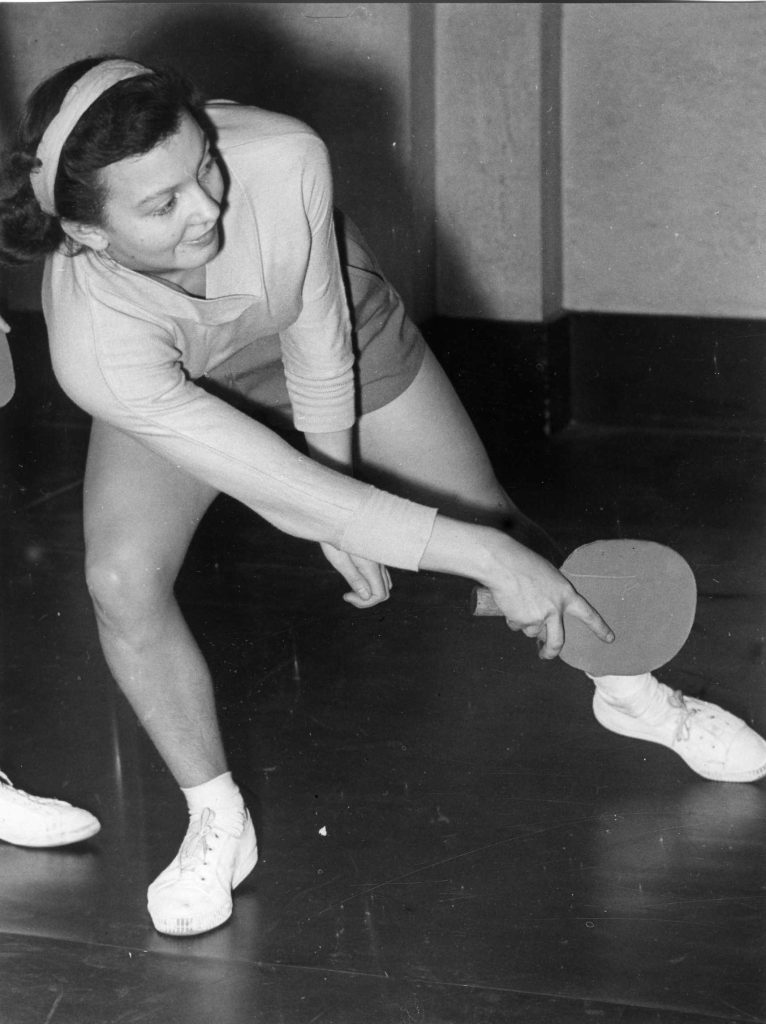
The other semi-final was between Gizi Farkas of Hungary and Wertl. It was Farkas, a three-time champion, who went into the final with an easy win 4, 9, 10. The final was a tight match with Roseanu retaining her title with a 17, -11, 18, -17, 14 win, making it three championships in a row.
Men’s Doubles
There were five pairs with English interest: Richard Bergmann & Johnny Leach, Victor Barna & Adrian Haydon, Harry Venner & Sampat, Geoff Harrower & Chang-Kwok Wing of Hong Kong, and Ivor Montagu & Laszlo Varkonyi of Hungary.
Out in the first round went Montagu & Varkonyi. The second round saw a clash as Harrower & Chang-Kwok Wing met Barna & Haydon, it was the latter pair who progressed 10, 13, 11. Venner & Sampat had the unfortunate draw in round two when they met Narikaza Fujii & Tadaki Hayashi, Japan, and went out with the score 16, 15, 11. Bergmann & Leach beat Brazilians Ivan Severo & Hugo Severo 9, 11, 12 and so progressed.
The two remaining England pairs both won their quarter-final matches. Barna & Haydon had an excellent win against Rene Roothoft & Michel Lanskoy of France 19, 16, -8, 15. Bergmann & Leach overcame Germans Rudi Piffl & Heinz Schneider 12, 11, 16.
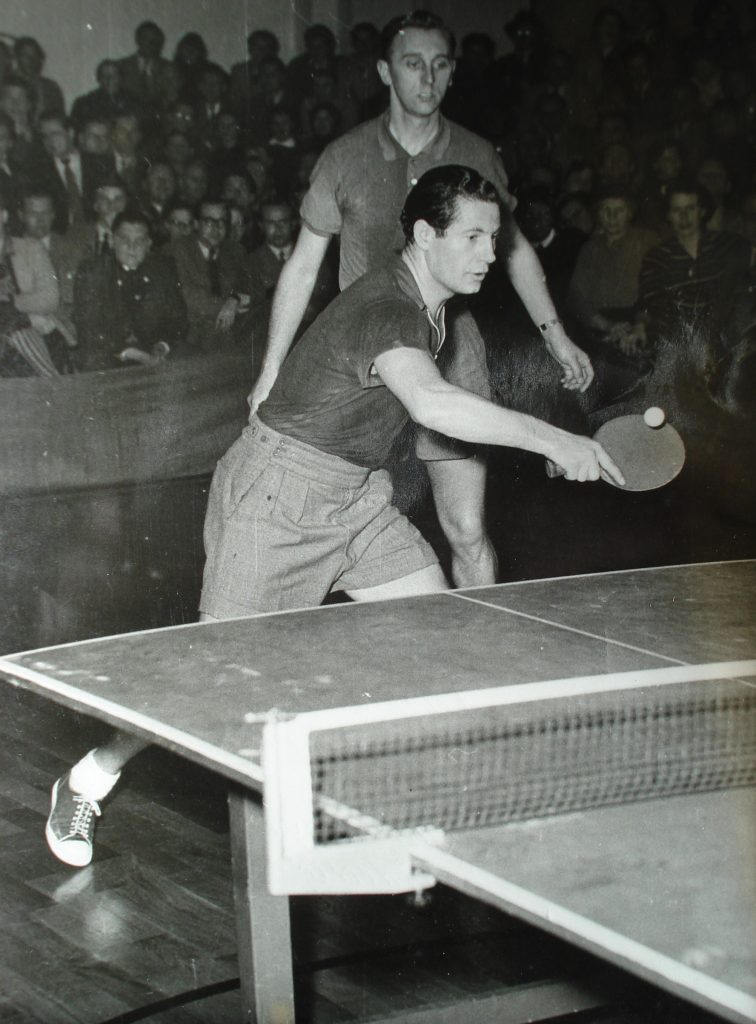
Into the semi-finals where the two English pairs met and it was, not unexpectedly, Bergmann & Leach who went on to win 5, 13, -14, 22. The other semi-final was Fujii & Hayashi versus Doug Cartland & Marty Reisman from the USA. It was a fairly comfortable win for the Japanese players 8, 14, 19.
The final was a much closer affair. Bergmann & Leach got off to a good start winning the first two games 12 and nine but the Japanese fought back to take the next three 18, 17, 12 and so take the title.
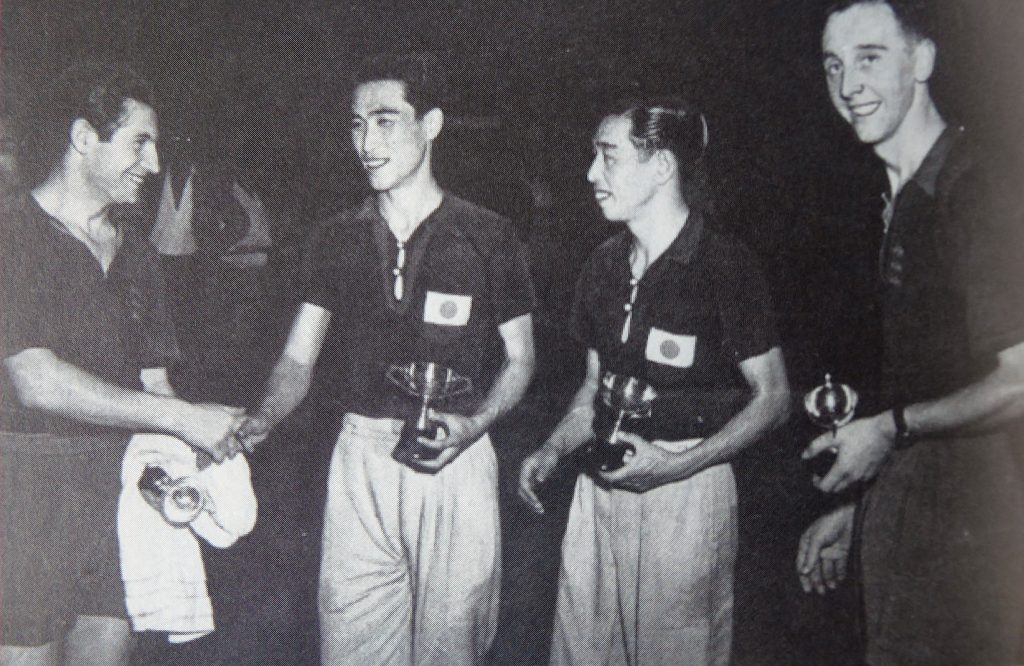
The trophy for this event, the Iran Cup, originally presented by the Shah of Iran, was not able to be handed to the new champions as it had not been returned. So, a little later, on 29 March 1952 at the English Open, the Dowager Lady Swaythling was able to pass it on to Mr K Asakia, Chief Japanese Government Representative in England.
Women’s Doubles
There were few entries in the Women’s Doubles, only 15 in total. Diane & Rosalind Rowe played together and Peggy Franks teamed up with Kathy Best.
Best & Franks had a good win in their first round against Mok Woon-King & Won Oi-Lan of Hong Kong 17, 9, 19. Diane & Rosalind Rowe, as the champions, were the No 1 seeds and started well too with a win against Mary Stafford of Australia & K John of India 20, 7, 11.
Both pairs were through to the quarter-finals. Here, Best & Franks met experienced Helen Elliot of Scotland & Linde Wertl of Austria and it was their opponents who went through into the semi-finals with the score 16, 16, -18, 8. Meanwhile, Diane & Rosalind disposed of Young Wai-Bun & Wong Bik-Yiu from Hong Kong 18, 9, 15.
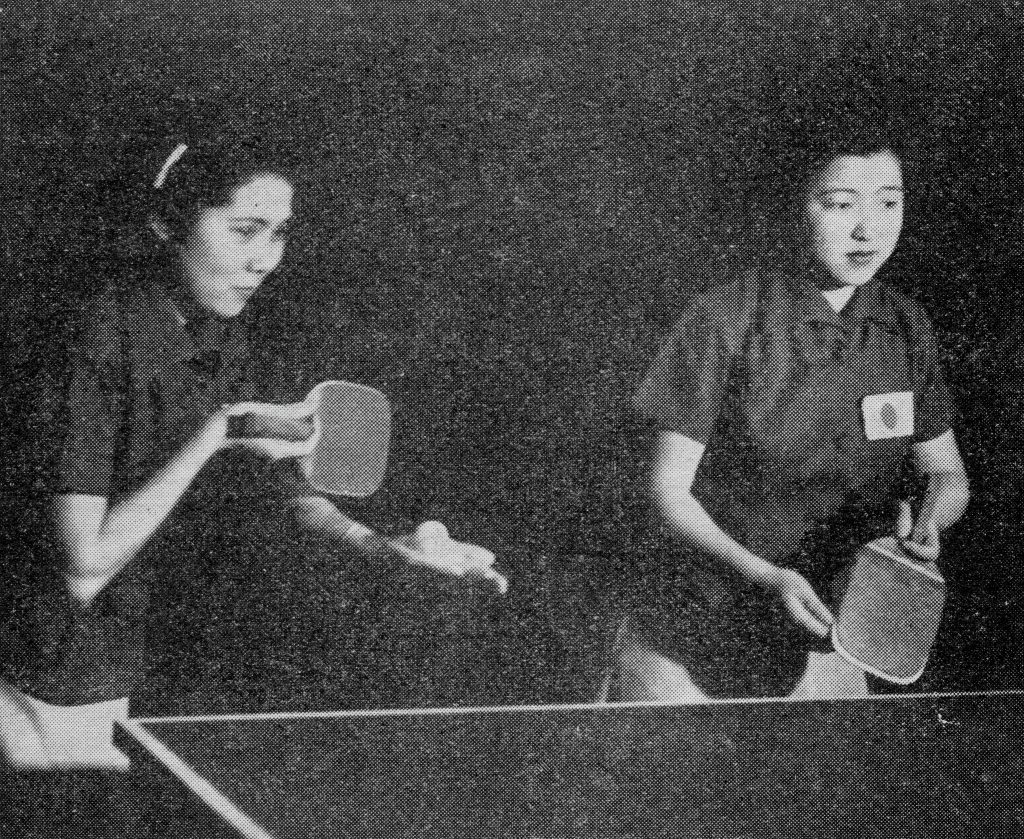
Next for the Rowe twins were Gizi Farkas & Edit Sagi from Hungary and another win -16, 18, 14, 15 put Diane & Rosalind into another doubles final. In the other half of the draw the Japanese partnership of Tomie Nishimura & Shizuka Narahara beat Elliot & Wertl 16, 16, -20, 19.
It was the same result in the Women’s Doubles final as in the Corbillon Cup match between the two pairs with Nishimura & Narahara having a fairly comfortable win 11, 7, 20 over Diane & Rosalind.
Mixed Doubles
Here, Harry Venner partnered Kathy Best, Richard Bergmann was with Peggy Franks, Victor Barna played with Rosalind Rowe, and Johnny Leach and Diane Rowe were together.
Venner & Best were the first to depart the event, in the second round, where they lost to Josef Koczian & Gizi Farkas, Hungary 14, 15, 11.
Next, it was Bergmann & Franks in the quarter-finals, who went out to eventual winners, Ferenc Sido of Hungary & Angleica Roseanu of Romania 15, 17, 19. The Hungarian/Romanian combination also took care of Victor Barna & Rosalind Rowe in the semi-finals 17, -20, 15, 14.
In the other half of the draw Johnny Leach & Diane Rowe were having an excellent run. Their first-round match was a win against Japanese No 1 pairing, Hiroji Satoh & Tomie Nishimura. Next was the Indian pair, Chandarana & Rajagopalan and they went through with the score 16, 12, 15. In the quarter-finals Leach & Rowe overcame Frenchman, Michel Haguenauer & Austrian Linde Wertl 6, 17, 20 before they defeated Koczian & Farkas in the semis 21, -20, 16, 13.
England were hoping for one gold medal from these Championships as Leach & Rowe met Sido & Roseanu. However, it was the Hungarian/Romanian pair who took the title 19, 13, 18. Diane played well, even counter-hitting Sido’s drives, but Leach once again failed to perform at his best and provided poor support for Diane. It just wasn’t his Championships.
Jubilee Cup
The Jubilee Cup was restricted, as for the last few years, for those that had played in World Championships 21 years ago or more. The final was contested, once again, between Victor Barna and Adrian Haydon and again it was Barna who took the title with the score 17, 19.
Consolation Events
The Men’s Singles winner was Marty Reisman, USA who beat Yatin Vyas of India 12, -15, 17. Reisman had lost in the main event to Hiroji Satoh in the second round, the round of 64, by -18, 12, 15, 12.
The Women’s Singles Consolation was won by young Sayeed Sultana of India who defeated Wong Bik-Yiu of Hong Kong 11, 11. Sultana had lost in the round of 16 to Romania’s Sari Szasz -16, 17, 17, -13, and 20-16 on time limit.
Closing Ball
There was a grand ball on Monday evening, 11 February, starting at 8pm and going through to midnight. Barna and Bergmann put on an exhibition of trick shots and this was followed by an Indian Dance by a Miss Vaijanthimala and then a World Costume Pageant. A fitting end to the Championships.
ITTF Congress
England’s delegates were Bill Vint and Ivor Montagu.
Despite the success by the Japanese players, Japan tabled a motion to ban crepe-faced bats as used by Satoh, saying standardisation would be better for the game. However, the proposal came too late to be considered and so was not voted on.
A sensible resolution was passed to allow referees to have the authority to accept substitute players in the team events.
England proposed that entry forms should be accompanied by a statement saying that players and teams agreed to play against all other teams and players. This was as a result of some countries/players refusing or not being allowed to play against others for political reasons. The resolution was passed.
Accepted as full ITTF members were Aden, Hong Kong, Afghanistan, Burma, Cambodia, Indonesia, Japan, Lebanon, Pakistan, The Philippines, Turkey and Nigeria.
The Table Tennis Federation of Asia was formed in Bombay with 12 countries joining the new Federation.
The ITTF’s stated ethos was that table tennis is a “Sport which admits no distinction between class, creed or colour”.
Ivor Montagu was re-elected President and Bill Vint the Treasurer. H Roy Evans as Secretary and Vice-Presidents were Elmer F Cinnater, USA, Dr Antonio Rotili, Argentina, and A S De Mello, India.
Summary
Five silver medals and three bronze plus a gold and silver in the Jubilee Cup meant England came away with a good haul of medals. However, it was the first time England had not won a gold medal in the main events since 1937.
At these Championships the world order had been turned upside down and European nations could no longer regard the rest of the world as also-rans.
As always, a big thank you to Gunther Angenendt for his help with providing photographs and information.
Kathy Best
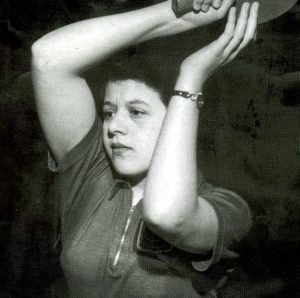
Kathy was born on 8 January 1993 in Hull, Yorkshire. She reached world and European No 9 and England No 2. She gained 27 England caps and represented Yorkshire 70 times. Her first England cap was in 1951. As an international she played against China, Czechoslovakia, France, Germany, Hungary, India, Ireland, Japan, Scotland, USA and Wales as well as in the World Championships in 1952, 1953, 1954 and 1959. She also played in the European Championships in 1960 and the Quadrangular Tournament in December 1961.
At the World Championships in the Corbillon Cup she gained a silver medal in 1953, two bronze medals in 1952 and 1954 and came fourth in 1959. In the individual events she got a silver in the Women’s Doubles in 1954 with Ann Haydon, it was an all-English final against Diane & Rosalind Rowe at Wembley. She also won a bronze with Linde Wertl, Austria in 1953 and was a quarter-finalist in the Women’s Singles in 1953 and 1954.
At the European Championships in 1960 England were runners-up in the team event where Kathy won eight of her nine singles and with Diane Rowe, also won eight out of nine Women’s Doubles.
It was a win for England in the Quadrangular in 1961 with Kathy winning her three singles and doubles with Mary Shannon.
At the English Open there were wins in the Women’s Doubles with Diane Rowe in 1960 and with Agnes Simon, France in 1961. A runners-up spot in the Mixed Doubles with Brian Kennedy in 1959 and semi-finals came her way in the Women’s Singles in April 1953, 1958 and 1961, and Women’s Doubles with Pam Mortimer in 1959.
In Open tournaments Kathy won several events at international Opens including the French Open Women’s Doubles with Diane Rowe in 1952/53, the Women’s Singles and Women’s Doubles at the Luxembourg Open in 1957/58, the Welsh Open Women’s Singles in 1957/58, the Women’s Doubles 1953/54 and 1954/55 with Ann Haydon and 1957/58 with Pam Mortimer and the West German Open Women’s Doubles with Diane Rowe in 1959/60. In domestic Opens she won over 30 titles.
In 1951 Kathy toured Germany and in October and November 1958 she toured Czechoslovakia.
Kathy belonged to the Victoria Club in Leeds where she was coached by Alan Thompson, to whom she was married for over 50 years. Kathy twice lost jobs as a result of playing for England, when asked for time off to represent her country she was told if she did so not to come back. She played and, on her return, found several new job offers waiting for her.
Kathy went on to become a teacher and also worked with children excluded from school. There was a table tennis table at the school and the pupils could not understand why they kept losing to “Miss”. In 1997/98 Kathy was Lady Mayoress of the City of Leeds.
Geoff Harrower
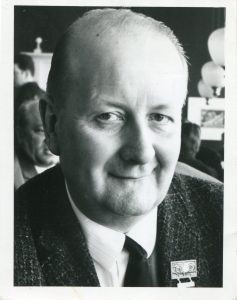
Born in Brentford, Middlesex on 5 April 1917, Geoff’s debut was against Czechoslovakia in October 1946 when on tour. He played in the Europe Cup twice, against Switzerland on 24 January 1947, Willesden where the team won 4-1 although Geoff lost his match. In November of that year he played again against France. He reached England’s No 8.
A good county-level player, Geoff did have some creditable wins to his name in Open and Closed tournaments. He won the Welsh Open (1945/46) and the Scottish Open Men’s Singles and also the first holder of the Middlesex Closed in 1946/47. He played in several Local leagues and won titles in the Barnet Closed, North Middlesex Closed and North West London Closed. Perhaps he would have gone on to greater honours if he hadn’t broken his wrist in 1937 whilst riding, he subsequently learnt to play with his left hand.
Geoff was responsible for a number of achievements including establishing the County Championships, drafting the original constitution with Bill Worsley, forming the first County Association in Middlesex and helping form the International Club of England. He was also the originator of the Master Points Scheme.
Geoff was invited to Bombay before the World Championships in 1953 and it was partly due to his influence that the Championships were run so smoothly. He was Organising Secretary for the World Championships in London in 1954.
Geoff served on many committees, at international level he was on the ITTF Equipment Committee from 1950-54, being its chairman for three of those years. He was also on the ITTF Technical Committee 1953-54.
A number of ETTA committees benefitted from Geoff’s commitment, the National Executive Committee, County Championships Committee, Disciplinary Committee, Magazine Committee, Ranking Committee, Rules Committee to name but a few. He also served on the Middlesex County and Hertfordshire County Committees and the North Middlesex League.
A qualified County Umpire in 1950, Geoff also gained his ETTA Approved Coach qualification in 1950/51, Approved Senior Coach in 1951/52 and Basic Coaching Diploma in 1953/54. These qualifications obviously served him well in coaching his daughter, Jean, who went on to play at international level.
Wanting to see more publicity for table tennis, Geoff became a regular correspondent for the Daily Telegraph and a prolific writer for the inhouse ETTA magazine Table Tennis. He was also the Press Officer for the Badminton Association from 1954-69.
As well as table tennis, Geoff was a good golfer and played cricket for Buckinghamshire and rode point to point.
Geoff was someone whose influence was significant and in recognition he became an ETTA Honorary Life Member in 1970.
Latest news
Got a story to share?
Send us news from your club, league or school and we may feature it here.