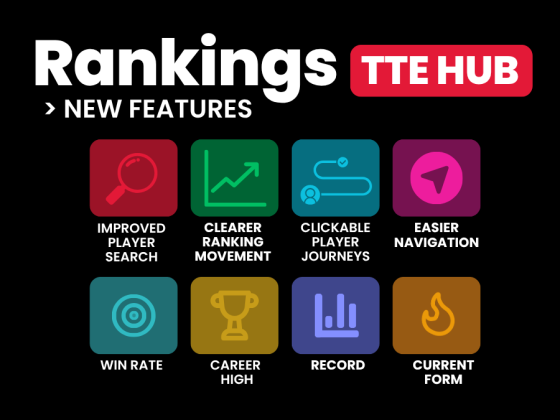
Publication of this month’s rankings have been delayed – but it will be worth the wait as we reveal a raft of improvements which will revolutionise the way the table tennis community interacts with rankings.
As we have transitioned to TTE Hub, we have become aware of a small number of historical discrepancies based on international results, which also impacted domestic rankings. Members should expect a small variance when the rankings are published – please do not contact the helpdesk to report these discrepancies. However, if you identify any incorrect reporting of results from competitions held in August, please get in touch.
In the meantime, Officials and Tournament Organisers should please continue to use the season-opening ratings to produce seedings or draws for upcoming competitions.
We apologise for any inconvenience, but are excited by the new interface on TTE Hub which will be revealed when we publish the rankings shortly.
Powered by Cloudathlete, our new interface does not just promise a better user experience – it will completely change the way you look at rankings.
Read on for all the information you need to get the most out of rankings on TTE Hub – and don’t forget to personalise your rankings page by uploading a photo of yourself!
Remember, appearing in the rankings is a benefit of Compete and Compete Plus membership of Table Tennis England. If you played last season, renew now for the 2026/27 season to ensure you remain in the rankings. If you are a returning member or a Club Play member looking to test yourself in competition, upgrade now and start your journey towards the top of the rankings!
If you have not yet renewed or joined, here’s what you need to do:
- Claim or create your account: Head to ttehub.com and claim your individual profile.
- Renew your membership: Secure your playing status, ranking eligibility and insurance coverage for the upcoming season.
Click here for more information and how-to guides
Improvements in the new rankings experience
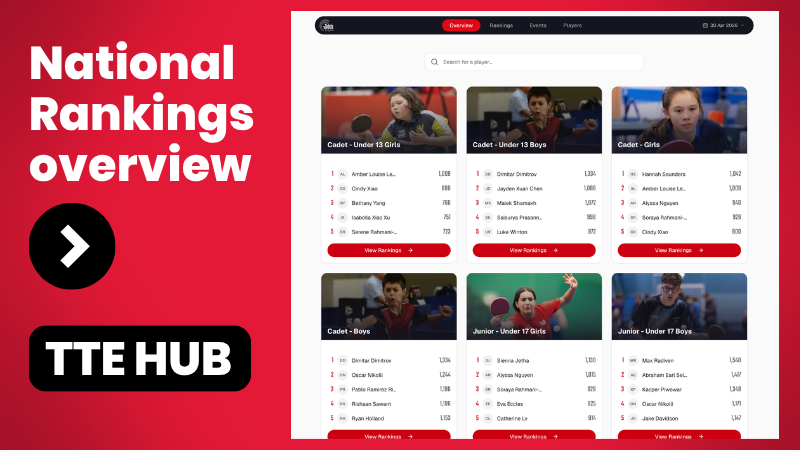
1. New visual rankings homepage
Rather than opening directly into a conventional data table, users are given an overview of the rankings landscape.
Each ranking age category is presented individually with:
- Category-specific imagery
- The top five ranked players
- Current ranking points
- Immediate access to the full ranking
- Clear distinction between the different age and gender classifications
This means a visitor can understand the leading players across the sport without having to configure filters or navigate multiple tables first.
2. Prominent player search
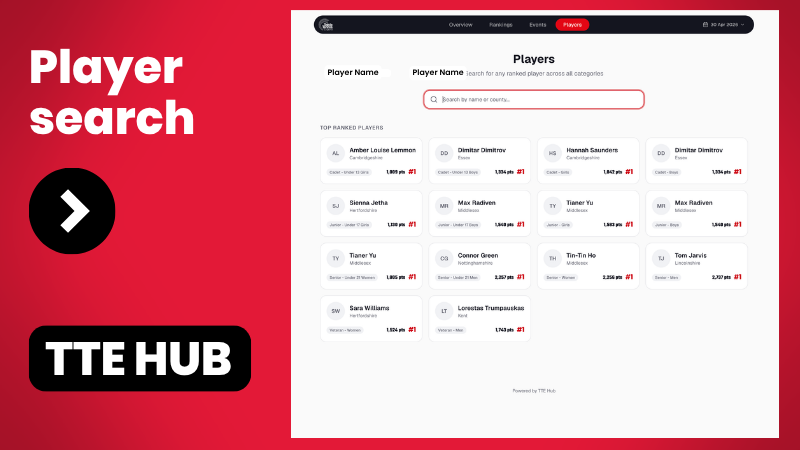
A global player search is available directly from the main rankings page.
This makes the player, rather than the database structure, one of the primary ways of navigating the service. A user looking for a particular player doesn’t first have to establish which ranking age category or filter combination they need.
3. Clearer ranking movement
The new rankings interface shows both:
- Change in ranking and/or rating position
- Change in ratings points
Movement is displayed visually using directional indicators as well as the numerical change, making improvements and declines much easier to interpret at a glance.
4. Clickable player journeys
Players are no longer simply entries in a rankings table. Their names link directly into an individual player view, allowing users to move naturally from:
Rankings → Player → Results → Opponent
This turns the rankings into an interconnected information service rather than a collection of static tables.
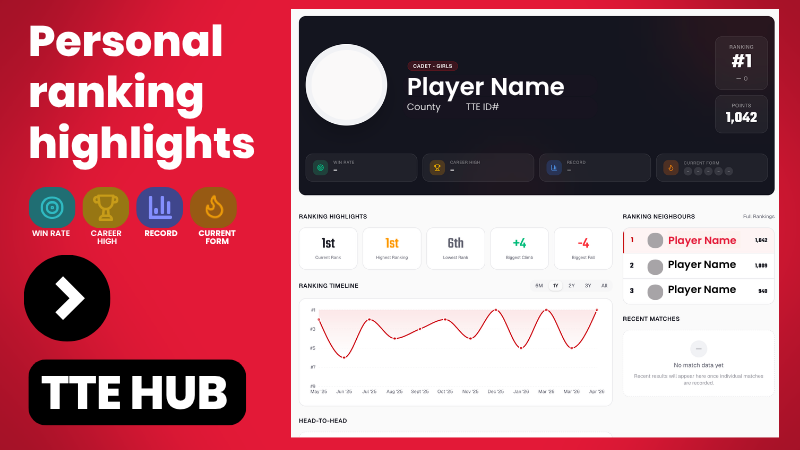
5. Individual player performance overview
The new player pages provide an immediate performance summary including:
- Current rank
- Change from the previous period
- Number of matches
- Win rate
- Win/loss/draw record
- Highest ranking/ rating position (since the start of season 25/26)
This provides significantly more context than simply showing a player’s ranking number and a list of results.
6. Player positions across multiple ranking age categories
Where a player qualifies for more than one classification, their player page can show their position within each relevant age category.
For example, a player can see their position across applicable age-group rankings from one page rather than locating themselves independently within several ranking tables.
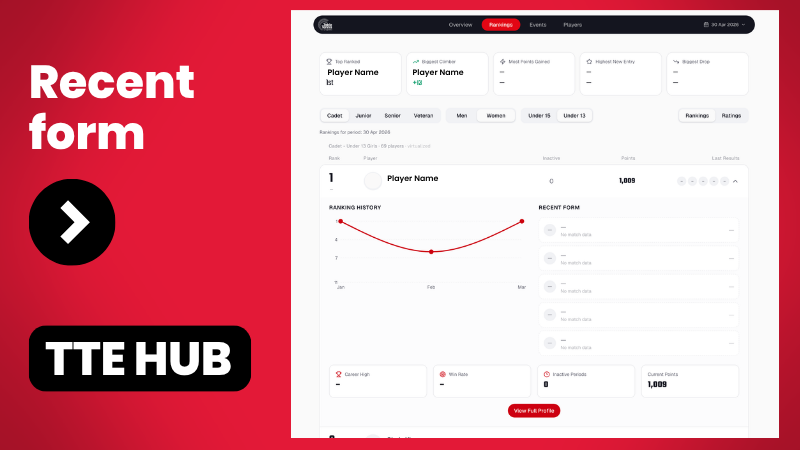
7. Richer match history
Individual match history can include:
- Date and time
- Opponent
- Win/loss result
- Competition
- Ranking age category
Opponents are themselves clickable, making it possible to move directly between player records.
8. Easier navigation between ranking categories
The platform supports direct navigation between:
- Rankings overview
- Overall standings
- Individual ranking categories
- Individual players
- Ranking periods
This reduces the dependence on repeatedly configuring a single large rankings table.
9. Improved historic rankings navigation
Ranking periods can be explicitly selected, with the relevant date range displayed.
The period selector can also become searchable where a large number of historic ranking periods exist, making historical rankings substantially easier to explore.
10. TTE-owned presentation
The rankings experience now sits within TTE’s own digital environment and visual language, providing greater consistency with the rest of the TTE Hub and allows rankings to evolve alongside TTE’s other digital services.
11. Responsive, modern interface
The new interface has been designed around modern responsive components rather than treating rankings primarily as desktop data tables.
The card-based homepage, simplified rankings tables and individual player views provide much clearer journeys on smaller screens.
12. API-driven architecture
The public interface is separated from the rankings calculation platform through APIs.
This isn’t immediately visible to a member, but it is a significant improvement because it means TTE can:
- Change or extend the public interface without changing the rankings engine
- Reuse ranking information elsewhere within TTE Hub
- Incorporate ranking information into member profiles, competitions and other services
- Develop new public experiences from the same authoritative ranking data
- Avoid tying the public user experience to the underlying ranking administration system
Summary
This is not simply a visual redesign of the rankings tables. The new approach changes rankings from a database-style listing into a player and performance experience, whilegiving us the ability to continue extending that experience without being constrained by the interface or architecture of the underlying ranking calculation system.
None of this alters the Core rankings functionality, which retains the key functionality of the previous rankings service, including:
- Public access to national rankings without requiring a login
- Rankings organised by age group and gender
- Separate ranking categories including Cadet, Junior, Senior and Veteran classifications
- Ranking position and ranking/rating points for each player
- Ranking period identification
- Movement in ranking position between ranking periods
- Access to previous ranking periods
- Individual player results history
- Match information including date, opponent, result and competition/event
- Support for rankings and ratings data
- Player eligibility and ranking-status information, including inactivity, initial ratings and ranking overrides where applicable
- Filtering by relevant classifications such as age group and county
- Search and interrogation of ranking and results data
Latest news
- Competitions
Cambridge 4* is route to Nationals - and a charity fundraiser
- Pride of Table Tennis
Why table tennis is the name of the game for super-volunteer Steve
- British Clubs Leagues
Cadet BCL entry deadline: Enter now to secure your team's place