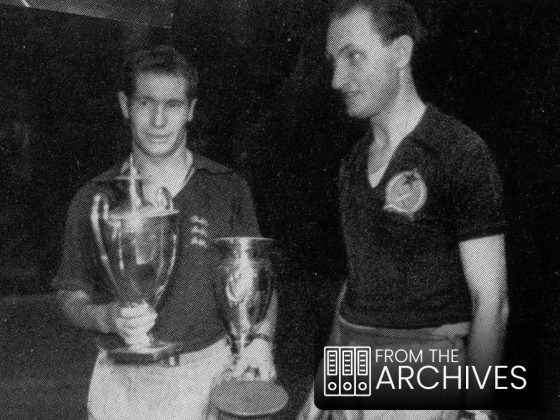
In the latest instalment of our series on England’s World Championships performances over the years, Diane Webb (Chair of Archives, Museum and Records Committee) turns to 1950 in Budapest.
The Trials
Trials in England took place on 16 and 17 December 1949. Johnny Leach, Richard Bergmann and Aubrey Simons had already been selected for the Swaythling Cup team so those attending the trials were playing for the two additional places.
Harry Venner and Bernard Crouch made the cut with Ron Crayden as reserve. Venner gave up his job for a month beforehand to enable him to be as best prepared as he could be for the trials, it paid off, only losing once.
The Corbillon Cup team had three players who were in the Wembley final two years previously – Dora Beregi, Peggy Franks and Vera Thomas (Dace) and their places were assured. All three played under their maiden names. Adele Wood was selected as the fourth player but in the end did not travel to Budapest. Diane and Rosalind Rowe put up a good show and their potential was obvious. Their time would come.
The Journey
It was another interesting journey with a specially chartered plane travelling first to Vienna and then on to Budapest. There was an unexpected overnight stay in Vienna due to bad weather conditions in Budapest on the expected arrival night. The reason became obvious the next day when they did land. The Dutch KLM converted Dakota’s landing ground was a large field covered in snow with the strip marked by sandbags. Definitely not ideal conditions to land in the dark.
Playing Conditions
There were only three lights per table, all central, slung 10 feet above the playing surface, so the defensive corners were not well lit. The tables had a high gloss finish and the ball skidded off the surface making them much quicker than those in England, both conditions advantaged attacking players. One Italian lady in the second playing hall wasn’t happy with the lights even at the height they were, saying they still weren’t high enough for her game.
The Draw
The American team were already in Europe and played in a number of Open tournaments. Regrettably, they were denied permission by their own country to enter Hungary and had to withdraw from all events.
England’s Pinkie Barnes and Betty Steventon were also in the draw but it would appear they did not attend the Championships as their first-round matches in all their events were given to their opponents.
Several other teams and players also did not turn up. In the Men’s Singles there were 20 walkovers in the first round, disappointing for the players and the organisers. It was similar in other events.
Swaythling Cup
England in Group B played eight matches. They won seven but the one loss to Czechoslovakia meant they did not go through to the final. Their wins were against Sweden, Wales and Brazil, all 5-0 and four 5-1 wins against Austria, Poland, Ireland and New Zealand.
England versus Czechoslovakia was an excellent match that went on well past midnight. After leading 4-1, England lost the next four matches and finished second in their group, so third equal overall with France.
In the match against Czechoslovakia, Leach played the first match and lost to Ivan Andreadis
-13, -19. Simons then went on the table and beat Bohumil Vana -17, 18, 17, Vana’s first loss in a Swaythling Cup match since before the war. Bergmann then put England in the lead against Vaclav Tereba, a time limit match 21-23, 21-8, 19-18. The Czechs weren’t happy with the decision to call the time limit and invaded the court but the score stood. Leach then went on to defeat Vana 17, 16 and Bergmann had a 21-16, 21-9 result against Andreadis. 4-1 to England.
It then unravelled. Bergmann lost to Vana -11, -13. Tereba overcame Simons -16, 15, 12 and also defeated Leach 18, -16, 17. Four all after four hours. In the deciding match, Andreadis, the class Czechoslovakian, had a comfortable win against Simons 15, 9.
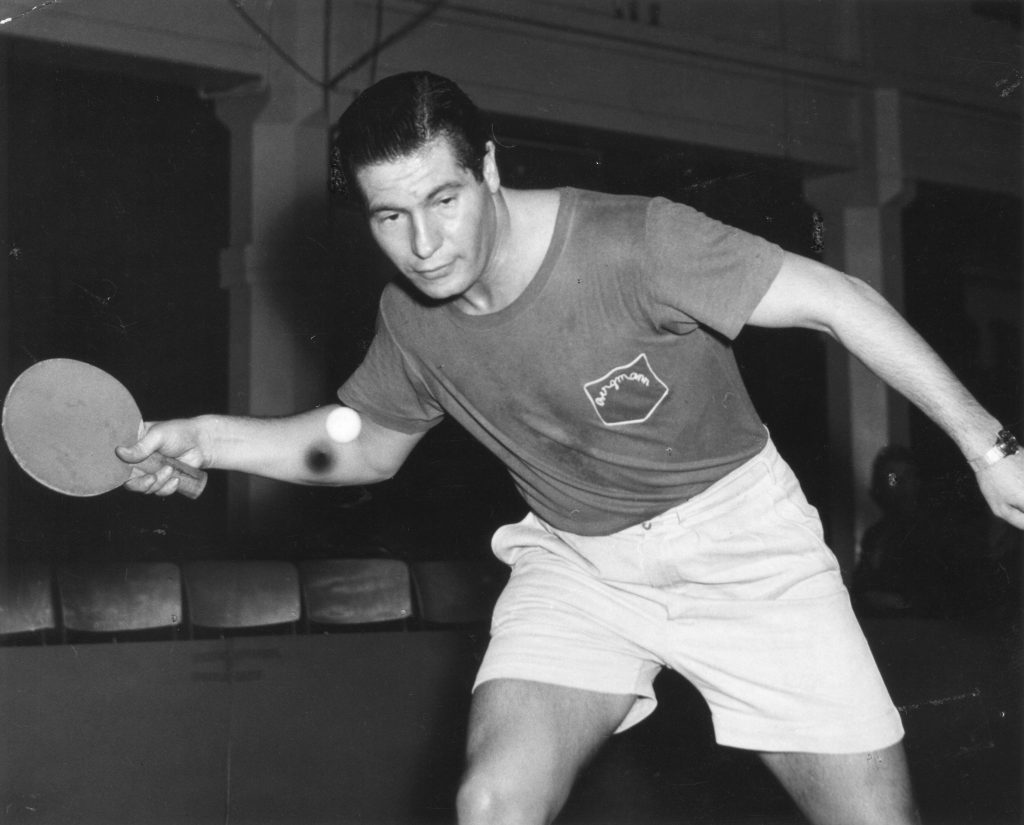
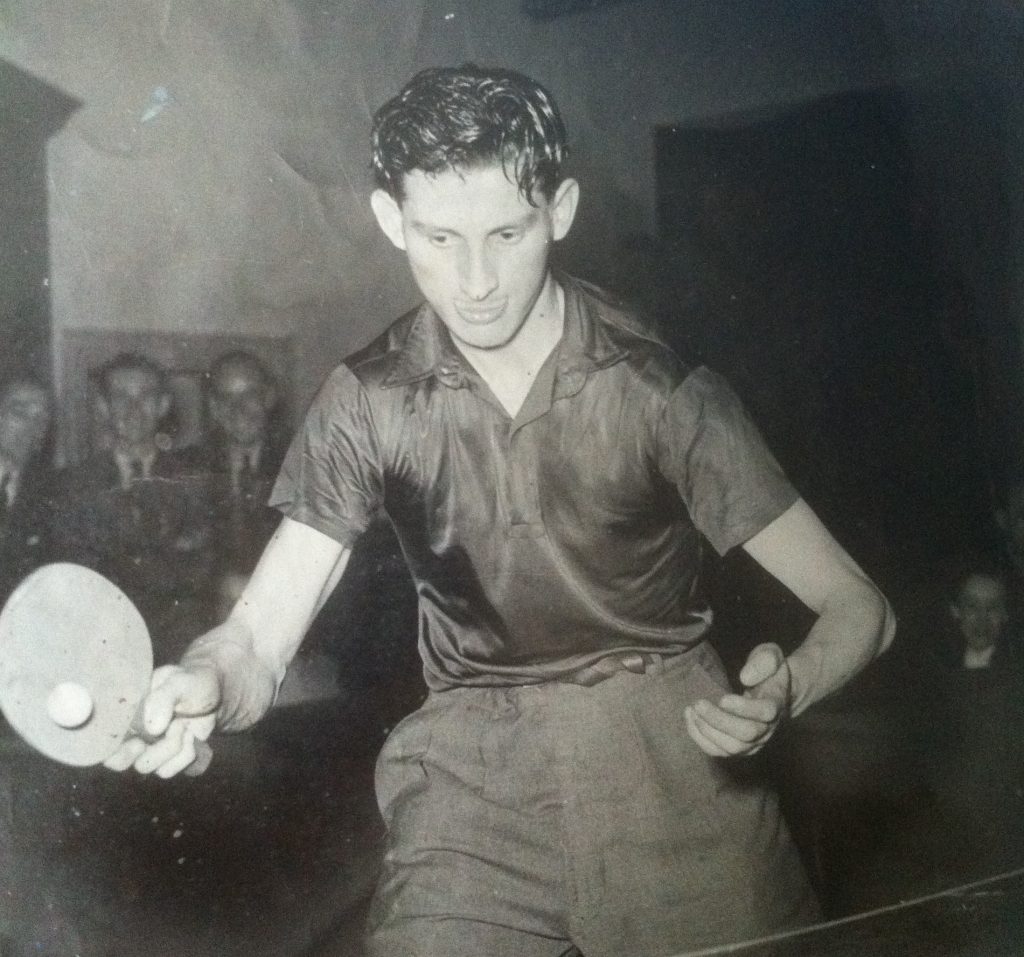
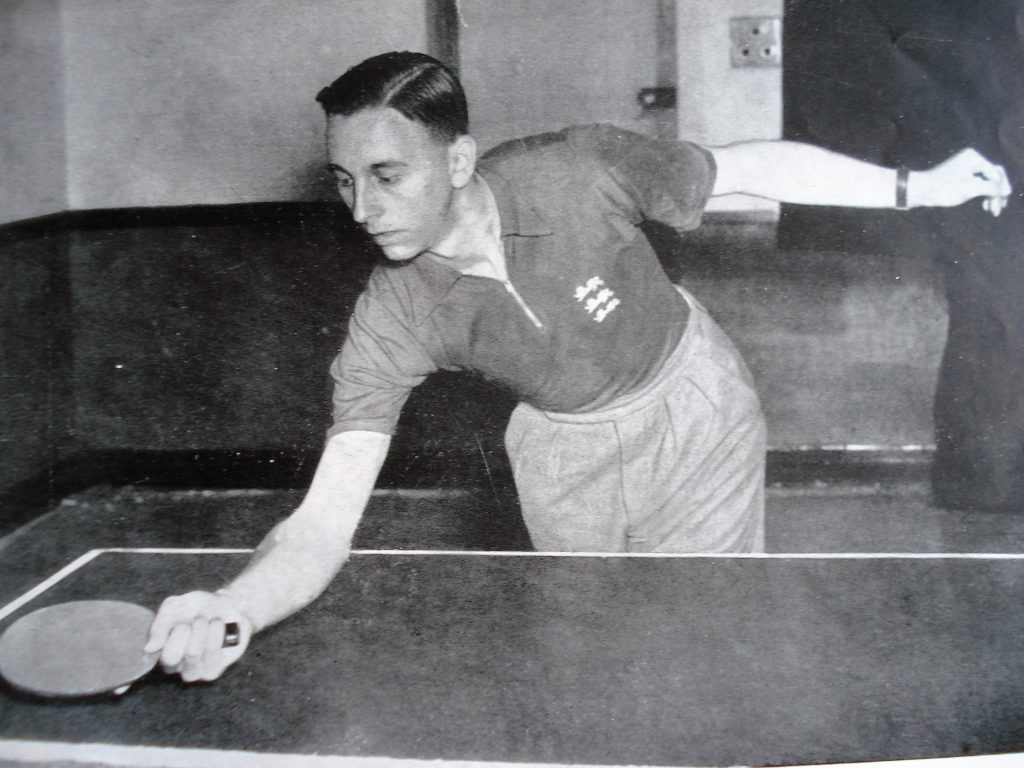
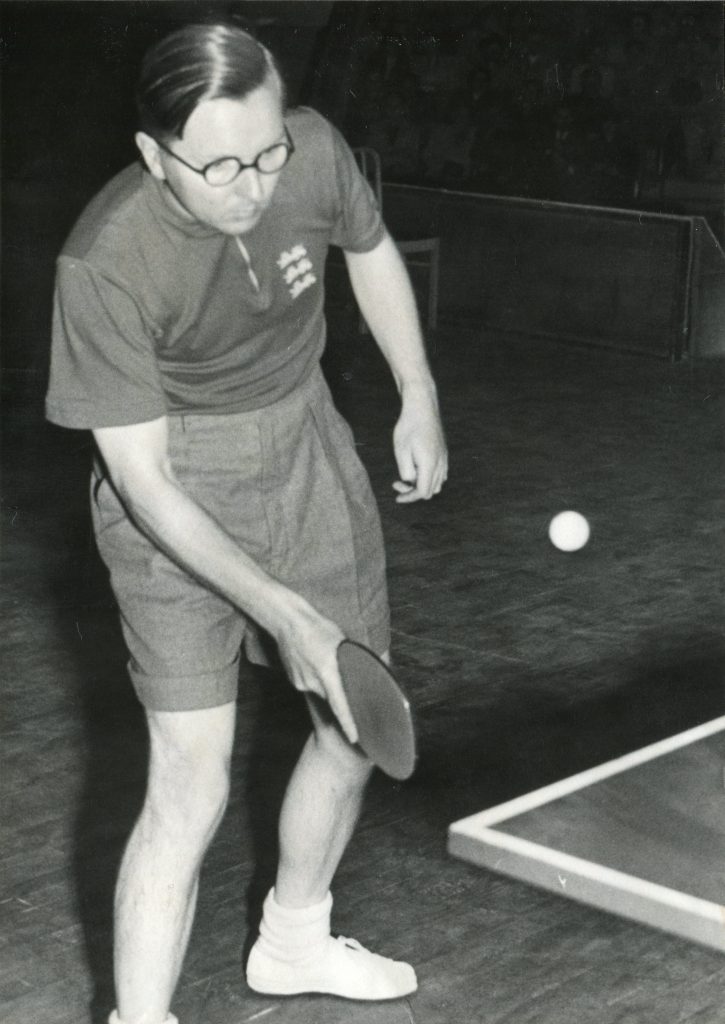
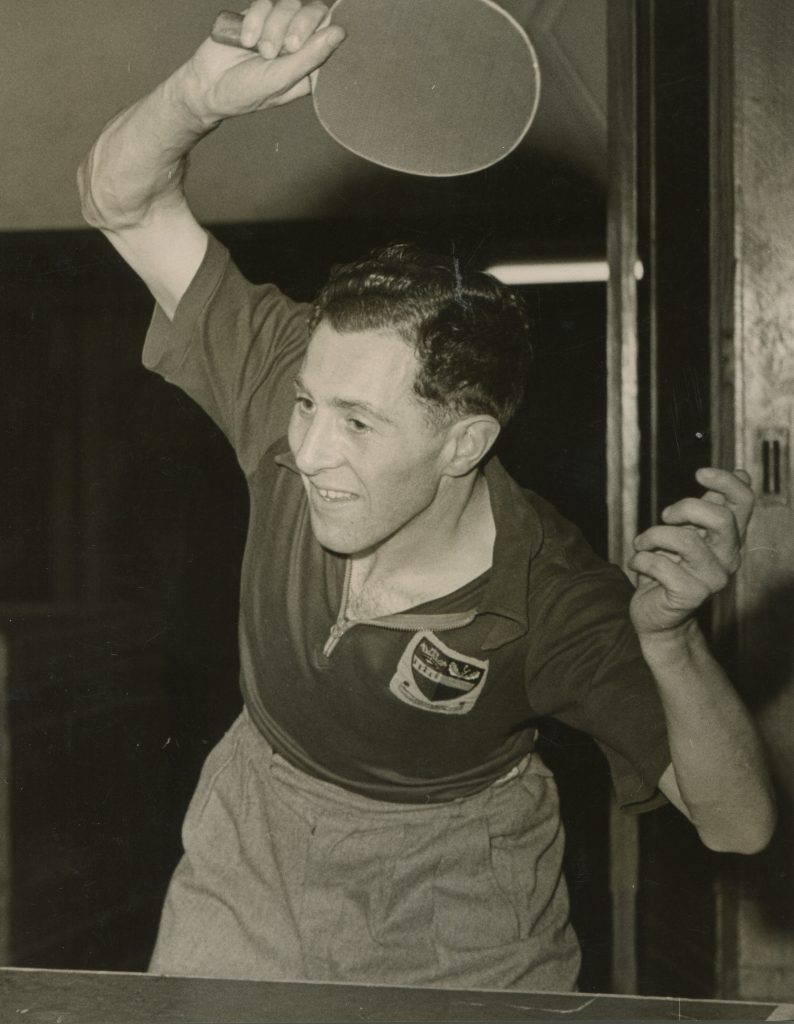
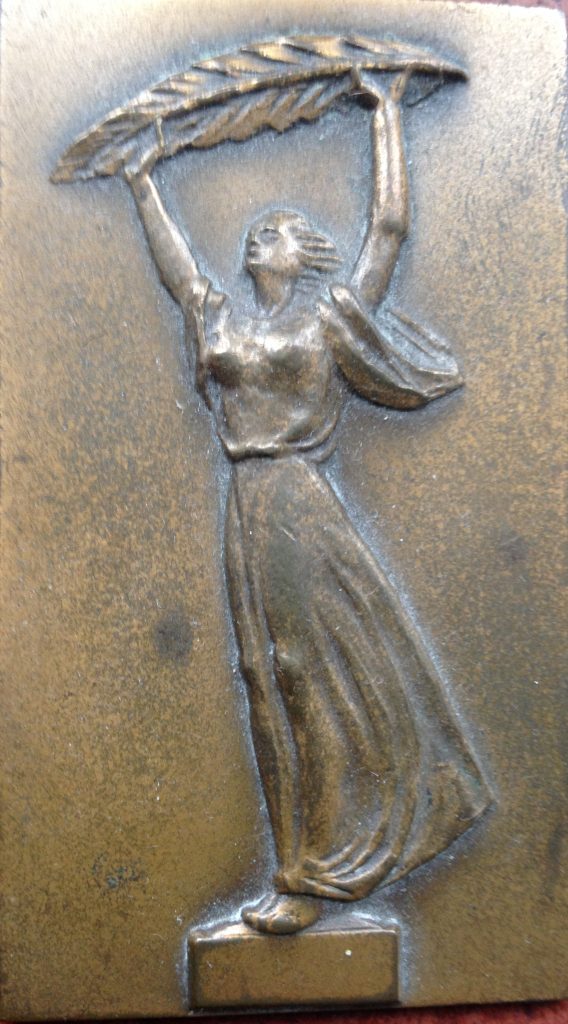
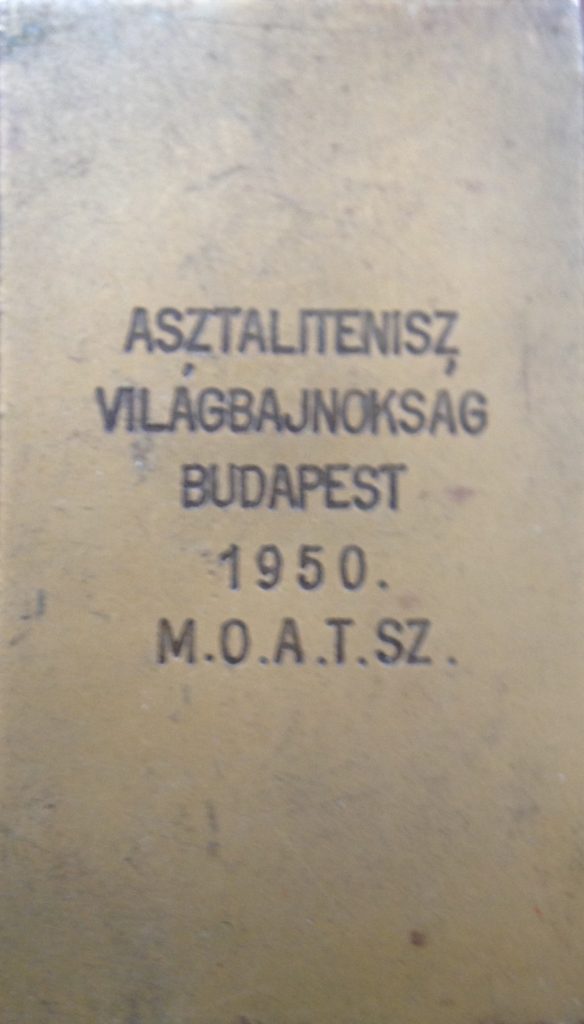
Swaythling Cup bronze medal
In Group A, Hungary finished in pole position with 5-0 wins against Switzerland, Israel, India, Italy and Denmark and a harder match against France where they finished the victors by 5-3.
Hungary versus Czechoslovakia for the final. First up was Andreadis versus Jozsef Koczian and it was a win for the Czechoslovakian 19, -17, 15, not surprising as Koczian had sustained a foot injury earlier and had badly blistered feet and despite injections was hobbling. Hungary’s Ferenc Sido was on next against Vana and unexpectedly won 17, 13.
The third match was in Hungary’s favour as Ferenc Soos beat Tereba 17, 19. Vana then beat Koczian 9, 9, Koczian was still suffering with his feet. Match score 2-2. Andreadis unexpectedly lost to Soos 18, 14 before Tereba beat Sido in the closest match yet 25, 20. The match was level at 3-3. Vana played the seventh match and beat Soos 14, 16. As Koczian was unable to carry on playing he conceded his match against Tereba and so the championship title went to Czechoslovakia.
Corbillon Cup
In the Corbillon Cup 13 teams had entered but only 10 played, USA, India and Brazil being no shows. The remaining teams were in two groups of five.
In Group A, England’s three ladies, Dora Beregi, Peggy Franks and Vera Dace met Italy, Romania, Scotland and Wales. Adrian Haydon took over the captaincy from Margaret Osborne, managing both men’s and women’s teams.
Against Italy and Wales there were 3-0 victories and a closer 3-2 win against Scotland. Romania proved the stumbling block. Angelica Roseanu, at the top of her game, beat both Dace 14, 7 and Beregi 10, 12.
Franks paired up with Dace for the doubles and pulled one back against Roseanu and Luci Slavescu 19, 18. Then Beregi levelled against Sari Kolosvary 21, -22, 17 leaving Dace to play the fifth game. It was another close one, but Kolosvary got over the line -15, 18, 15 to put Romania into the final.
In Group A, Hungary had two 3-0 wins against France and Austria and two 3-1 wins against Czechoslovakia and Sweden to put them through to the final.
Romania’s trio were the victors with Roseanu winning her two singles, Kolosvary won one and lost one and Slavescu with Roseanu won the doubles. The Hungarian’s, Gizi Farkas, and Rose Karpati, finished in silver medal position.
Men’s Singles
Ten players for England entered this event. Maurice Bergl and Bernard Crouch were the only two who did not progress from the round of 128. Victor Barna conceded his match, leaving seven to go through to the next round. It looked at one point if Bergmann was going out. Facing Czechoslovakian, Turnovsky he was down -21, 11, 14, -13 and 11-4 in the fifth before he dug in to win this encounter, with the final end 21-14 in his favour.
Three more went out in the round of 64. Adrian Haydon faced compatriot Aubrey Simons and it was Simons who won 9, 20, 17. Harry Venner went out to Czechoslovakian, Ladislav Stipek -13,
-9, 11, -14 and Ronnie Hook – on his honeymoon with Peggy Franks, having tied the knot on 12 January – lost 3-2 to Sturani of Austria.
This left Jack Carrington, Aubrey Simons, Johnny Leach and Richard Bergmann playing in the round of 32. Leach beat Max Marinko, Czechoslovakia 11, -12, 22, 11 and Bergmann beat Frenchman Phu Guoc Huy 3-0. Out went Carrington to Ferenc Soos, Hungary -17, -20, 19, -16 and Simons lost to Tereba, Czechoslovakia -14, 16, -13, -13.
Leach and Bergmann were the survivors into the round of 16 with mixed results. Defending champion, Leach, met Michel Haguenaeur and although it was close it was the Frenchman who went on to be quarter-finalist. It was a splendid match and few would begrudge Haguenauer his victory, he had suffered greatly in a concentration camp in the war and had to fight his way back to fitness – and fitness was needed to win the match with the score -16, 16, 14, -16, -16. Bergmann defeated Zoltan Farkas in his easiest match so far 6, 8, 16.
Bergmann faced old foe, Bohumil Vana in the quarter-finals and it proved yet another classic match between the two long-time rivals. Bergmann was described as being at “his brilliant best” and he had to be as once again the two giants of the game went toe to toe. Bergmann was 2-1 down but fought back, as he did so often, to win the last two games 21-19, 21-19. A medal was guaranteed.
Another familiar opponent in the form of Ferenc Sido was the semi-final challenge and it was an encounter Bergmann won in four close games 15, 18, -18, 23.
On to the final, which was Bergmann versus Ferenc Soos, a match which started at 11.13pm and lasted until nearly 1am. Once again, Bergmann had his supporters on the edge of their seats as he lost the first two ends 21-12 in the first and 18-15 in the second after the time limit rule was applied. The third was better with Bergmann winning 21-7, he pulled level in the fourth 21-14 and then clinched the fifth 21-13. An enthralling match which lasted over 90 minutes. The players were near exhaustion after four games and, although against the rules, a four-minute break was allowed.
Bergmann’s fourth Men’s Singles World Championships title and the third year in a row that England had won the event.
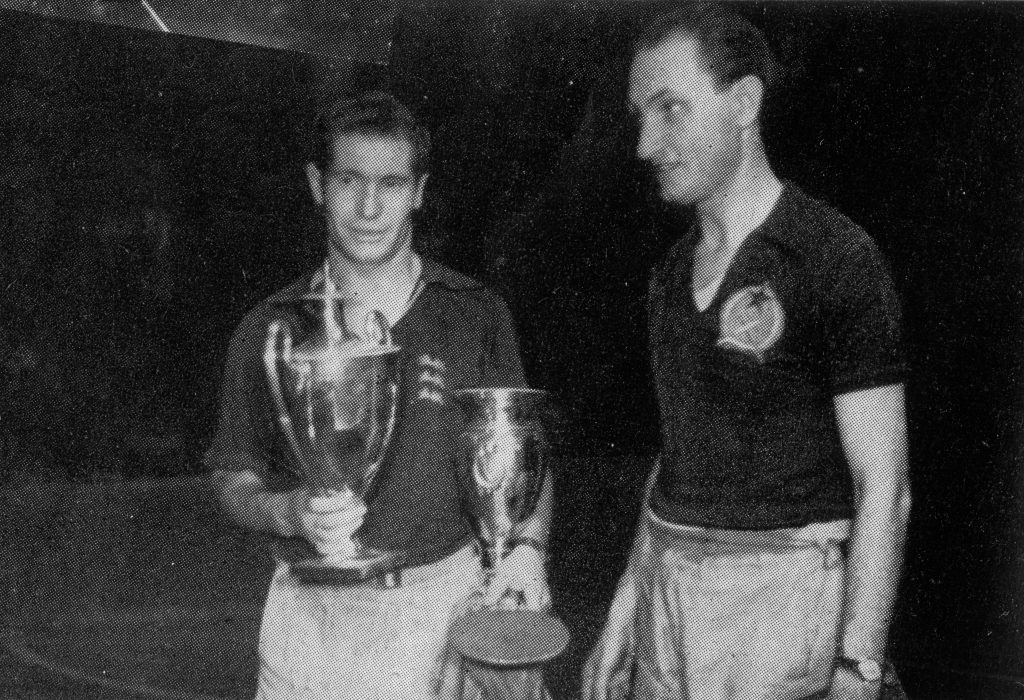
There was some criticism of the way the two finalists played their match which was a tactical defensive game. Soos, the home nation player, was cheered on by the partisan crowd who encouraged him to play steadily, to the extent his first score from an attacking stroke did not come until the 48th minute.
Bear in mind these two had met the previous year when Soos was the victor and after being two games down in this final, Bergmann decided to play it safe, he said his attacking game just wasn’t working so into defence he went. Others said the drama of the battle between the two players was enthralling. Ivor Montagu called the final “one of the most interesting and exciting ever played – though certainly not the most beautiful”.
Women’s Singles
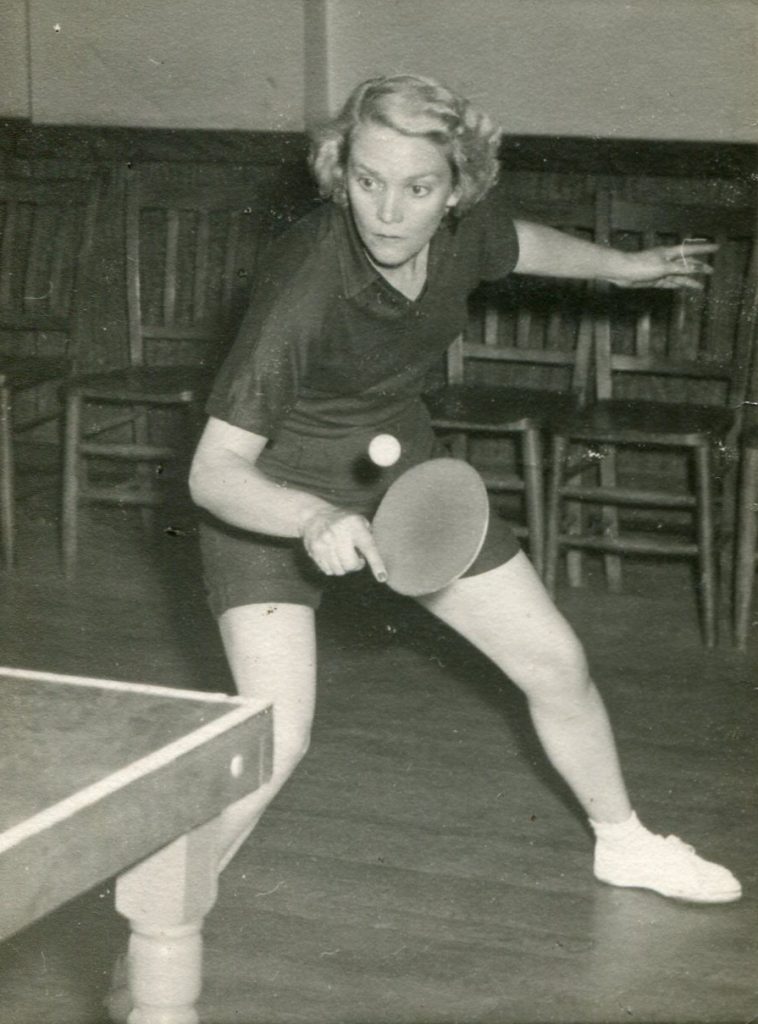
Elsie Carrington played in the singles alongside the three Corbillon Cup players and all four got past the first round. Beregi had a walkover to take her into round two, Peggy Franks won her match 3-1 against Hungarian Schonek, as did Dace against Linde Wertl of Austria and Elsie Carrington won 3-2 against Dr Simonne.
In the round of 32 Beregi lost to Rose Karpati 3-2. Carrington also did not make it past this stage, going out to Mezei of Hungary. Franks won 3-2 against Marchione and Dace had a 3-0 win over Huguette Beolet of France.
Quarter-finals was the end of the line for the England players with Franks losing 3-1 to Kolosvary and Dace to Ilona Solyom, Hungary 3-0.
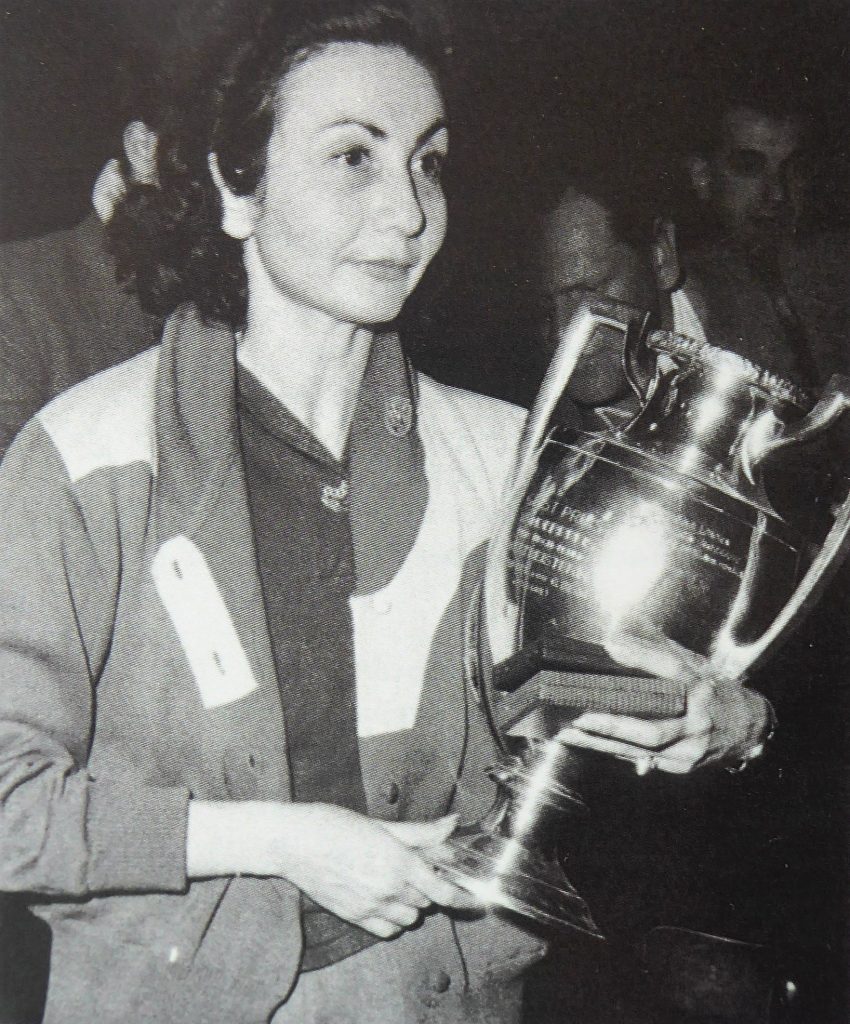
The semi-finals were between Farkas and Kolosvary, and Karpati and Roseanu, which led to the final between Farkas and Roseanu. Farkas, not at the standard she had been over the last few years went down to an on-form Roseanu 20, 15, 18. Roseanu had not dropped a single game throughout the Championships. This helped make up for the disappointment of Stockholm in 1949 where Romania did not enter a team and she was refused a visa. Roseanu had turned up at the border and was turned away.
Men’s Doubles
Six English pairs entered the Men’s Doubles although Mr Harrison & Ivor Montagu scratched. Bernard Crouch & Harry Venner went out in the first round. Adrian Haydon & Aubrey Simons lost in the next round as did Jack Carrington & Johnny Leach, the latter to Ladislav Stipek & Bohumil Vana 3-0.
This left Bergl & Hook, and Barna & Bergmann in the round of 16. Here Bergl & Hook went out to Vaclav Tereba & Josef Turnovsky of Czechoslovakia, leaving Barna & Bergmann as the sole England representatives in the quarter-finals. Here, they too were defeated by Tereba & Turnovsky 3-2. In the semi-finals this pair withdrew, giving fellow Czechoslovakians Ivan Andreadis & Frantisek Tokar, a free passage into the final. They met Hungarians, Ferenc Sido & Ferenc Soos and victory went to the Hungarians -15, 16, 13, 18.
Women’s Doubles
Vera Dace played with Peggy Franks, the champions in 1948, Dora Beregi was back playing with Scotland’s Helen Elliot. Elsie Carrington was due to play with Ella Zeller of Romania but ended playing with Hungarian, Miss Abrahams.
All pairs made it through the first round, the round of 32. Round two saw Carrington & Abrahams go out, leaving Beregi & Elliot, and Dace & Franks, in the quarter-finals. Both progressed to the semi-finals where they had to face each other. It was Beregi & Elliot who won that match 3-1. They met the two singles finalists in the doubles final, Farkas & Roseanu. Four high-quality players and it was the British pair who succeeded in overcoming the Hungarian and Romanian duo -13, 10, 19, 17.
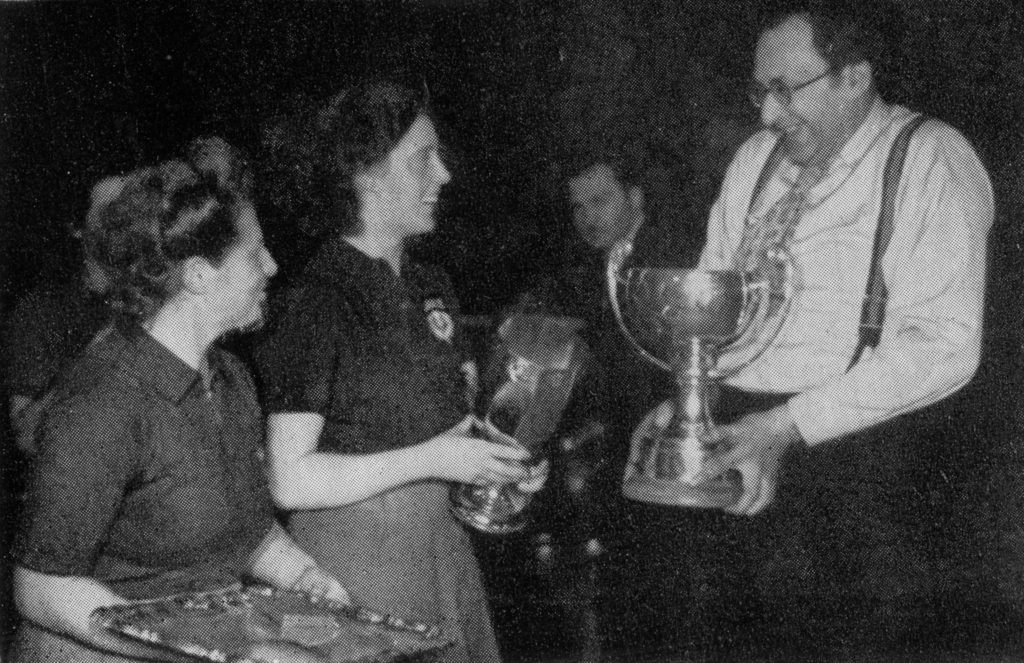
It was a fitting finale for Beregi who shortly after emigrated to Australia. As a token of appreciation, the ETTA presented her with a silver bracelet.
Mixed Doubles
Another event that was seriously disrupted with 19 of the 64 first round matches resulting in walkovers, the withdrawals included Harry Venner & Betty Steventon, and Bernard Crouch & Pinkie Barnes. Four English pairings were left, Jack & Elsie Carrington, Johnny Leach & Peggy Franks, Aubrey Simons & Dora Beregi, and Richard Bergmann & Vera Dace. Victor Barna teamed up with Scotland’s Helen Elliot. On paper, all strong combinations.
Apart from in the first round where Ferenc Soos & Rose Karpati proved too strong for husband and wife, Jack & Elsie Carrington, the others all reached the quarter-finals – and all lost. It was perhaps unfortunate that all four pairs were in different quarters of the draw.
Barna & Elliot lost to eventual winners Sido & Farkas 3-0, Leach & Franks lost to Andreadis & Furstova 3-2, Simons & Beregi lost to Stipek & Roseanu 3-1, and Bergmann & Dace to Vana & Hruskova 3-1.
In the semi-finals it was a win for Sido & Farkas against Andreadis & Furstova 16, -21, -19, 19, 11. Vana & Hruskova got the better of Stipek & Roseanu 15, 15, -18, 13. The final went the way of Sido & Farkas 17, 18, 12.
Jubilee Cup
This was now for players who had taken part in World Championships 20 years ago or more, rather than only in the first Championships.
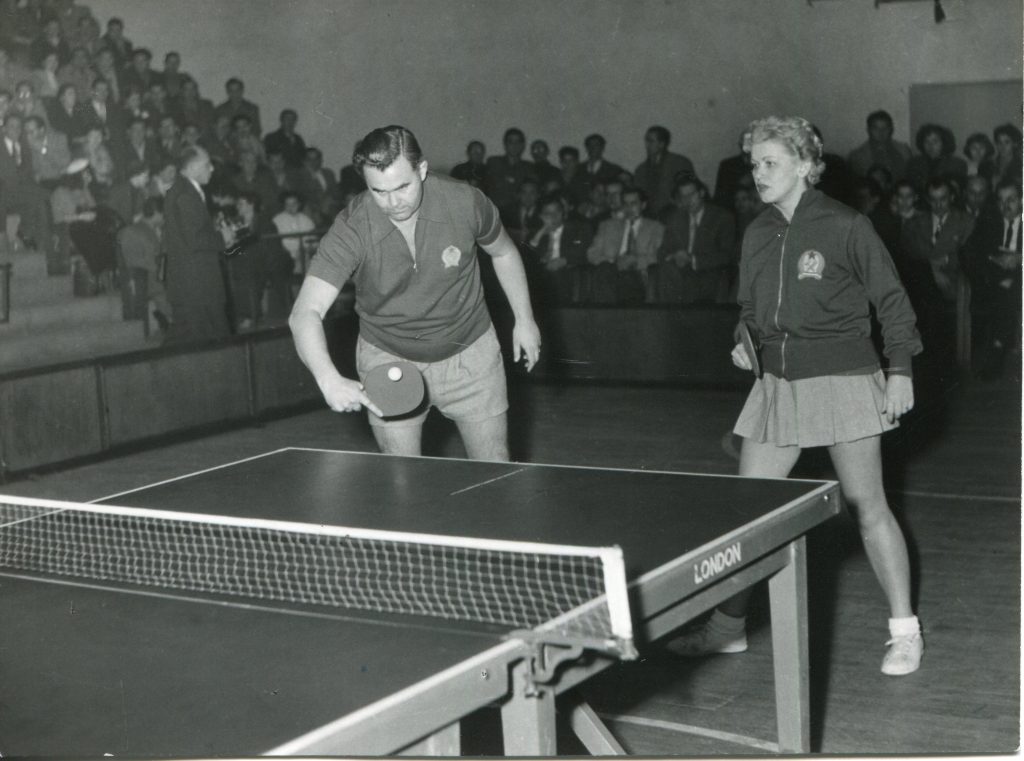
England had both the finalists. They had played against each other at the top-level numerous times and once again it was Victor Barna who got the better of Adrian Haydon with the score 14, 20, 18.
Snippets
- It was the first time that semi-finalists received a bronze medal.
- Due to the devaluation of the pound, the exchange rate was very poor and items expensive. A cup of coffee cost 2/- and a penny bus ride worked out at the new rate of exchange at ninepence. Some players were compromised when they found their baths were costing 10/-.
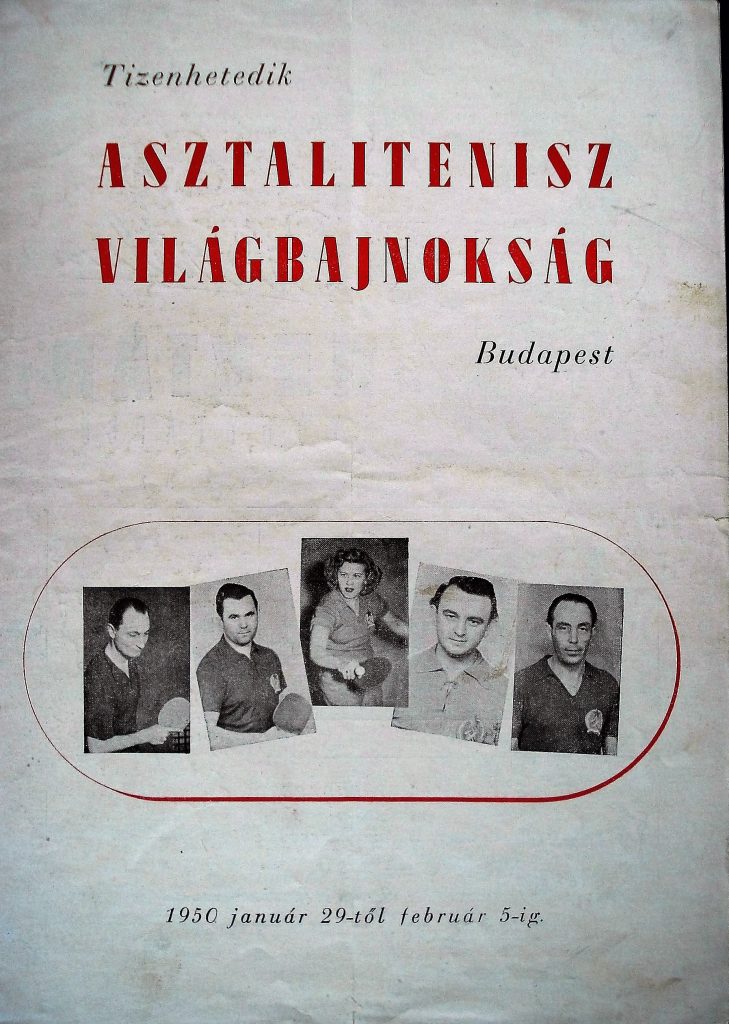
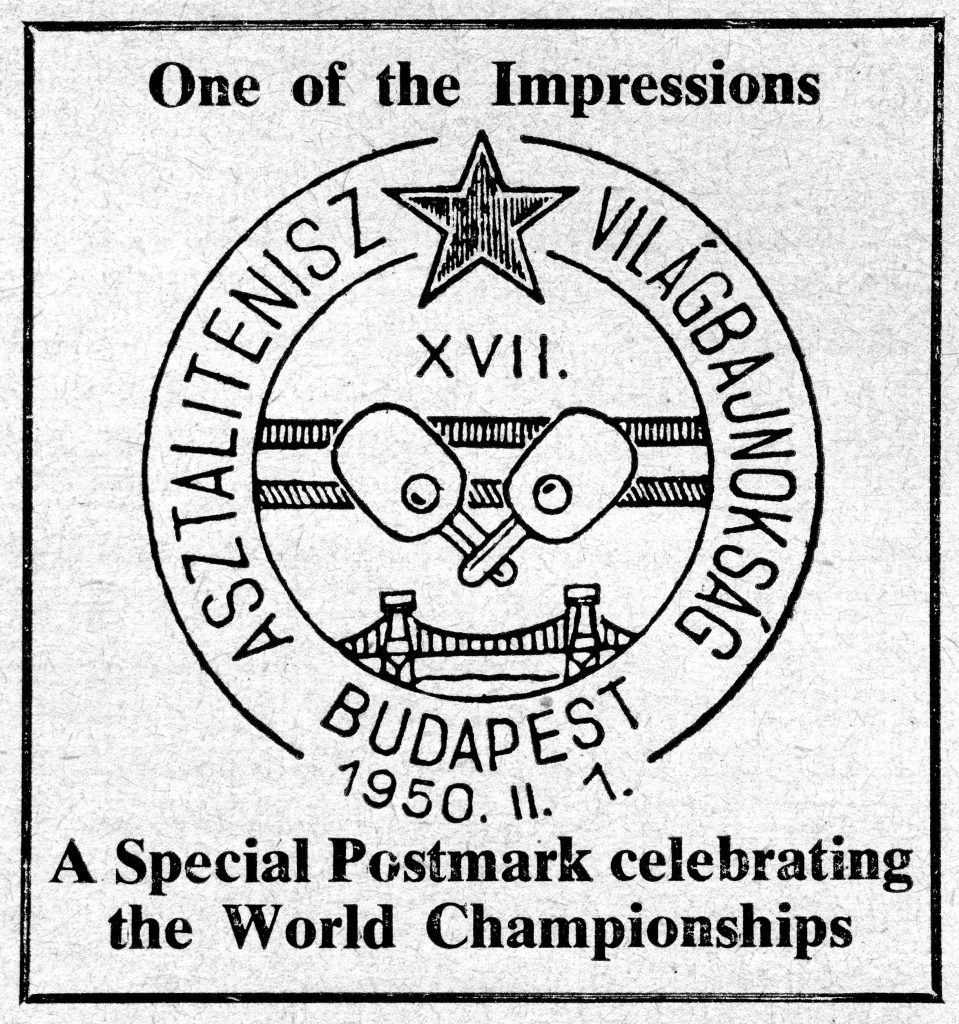
- Letters could be posted from the playing hall with a special postmark (shown right).
- Richard Bergmann suggested that from the quarter-finals instead of a straight knockout the players should all play each other with the winner the one with the best results.
- On returning home, the champion Czechoslovakian team were all presented with a motor car by the government.
- What an excuse for losingL “Ah, it was so unfortunate. My opponent was a good player, but when I was losing 0-2, a so-beautiful lady came to sit by the table and so – I have no chance anymore”.
- The three players making up the New Zealand team worked their passage to England in January. They left New Zealand on 20 November 1949 and arrived in England on 2 January, 44 days at sea, carrying out jobs such as peeling potatoes and acting as officers’ stewards. They were captained by former ETTA Chairman, Corti Woodcock.
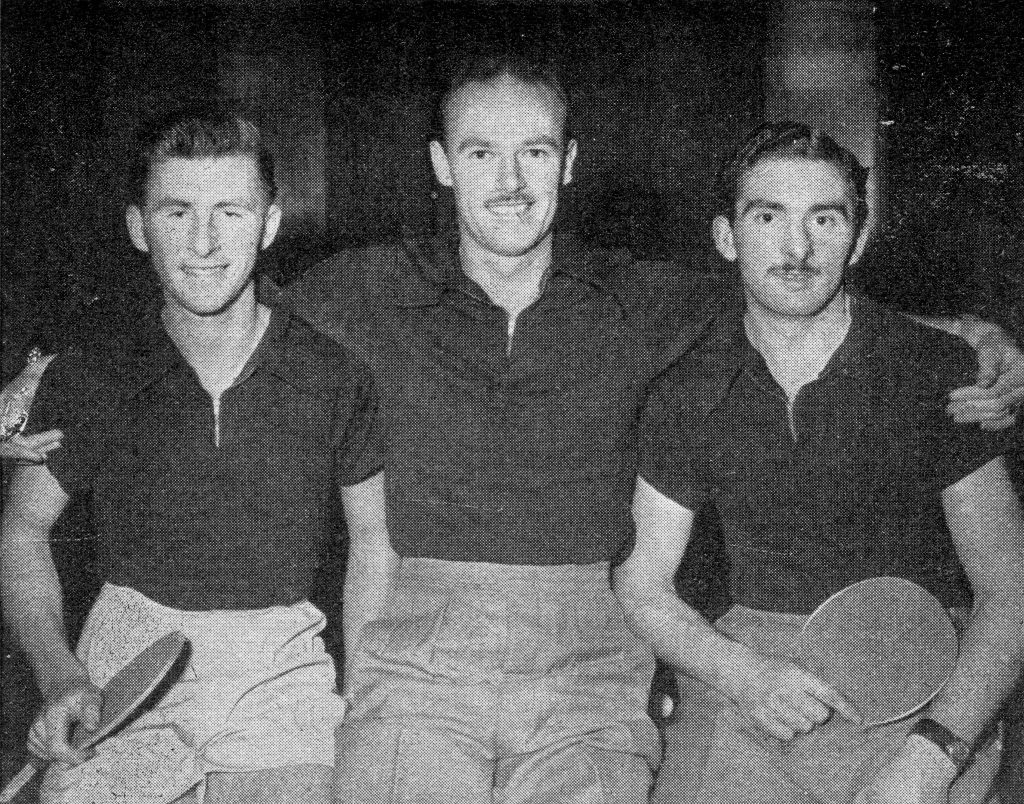
Thanks once again must go to Gunther Angenedt for the use of many of his photos.
Elsie Carrington
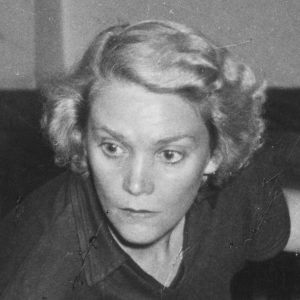
Born in Walthamstow on 29 September 1919 and surviving the war years despite being bombed out of several office buildings, Elsie did not take up table tennis until she was 28 years of age when she met the outstanding coach and player, Jack Carrington, at a tea dance.
Despite the late start in playing table tennis Elsie went on to play in nine World Championships, the first being in 1948, as well as one European Championships and 11 English Opens.
Elsie’s playing career was extensive and successful – she reached the quarter-finals of the World Championships in 1950 in Budapest with Miss Abraham in the Women’s Doubles and reached the last 32 in the Women’s Singles that year.
Eleven English Open appearances between 1949-1968 again saw impressive performances in the doubles with four quarter-final appearances (Doreen Spooner, Barbara Milbank x 2, Claude Rougagnou (France) in the Women’s Doubles and one in the Mixed Doubles with Jaroslav Stanek of Czechoslovakia.
Twice national champion, (Elsie always said she was a better doubles player than a singles player), in the Women’s Doubles with Jean McCree in September 1960 and with Jackie Billington (Canham) in 1968. Several semi-finals and quarter-finals were reached too.
Elsie told a lovely story about her first Open Tournament in Birmingham. Feeling very nervous, she registered when she arrived, and waited and waited to be called. However, when she heard the semi-finals being announced and she still hadn’t been called she went up to the desk and with some trepidation informed the officials that she was still waiting to play.
They looked through their list and realised that they hadn’t called Elsie for her first match so they started the tournament again – Elsie reported it didn’t make any difference to the final result!
The crowning achievement for Elsie in her playing career was becoming World Over-70s Veterans Champion in Baltimore, USA in 1990. Despite Elsie’s late start she made up for it by playing well into her 70s in the Bournemouth League. Always competitive, if you played against Elsie you could be 20-2 up and still not be sure that you would win. After her world title Elsie decided she needed another challenge and took up lawn bowls and before long she was appointed club captain.
Elsie’s playing career was prodigious but many will know her best for her tremendous coaching input. Elsie was taught by Jack to play perfect strokes and so became the ideal demonstration and training partner on his many coaching courses and camps, setting up not only the English Coaching scheme but introduced good practices in many other countries, including Canada, Australia and Sweden.
In recognition of Elsie’s contribution to table tennis, she was honoured with becoming a Vice-President of the English Table Tennis Association in 1979. Elsie was also an Honorary Life Member of Hampshire Table Tennis Association and Life Vice-President of the Bournemouth Table Tennis League.
A regular contributor to the magazine Table Tennis, Elsie always emphasised the importance of appearance and was a stickler for clean white shoes and neat dress, her standards continued throughout her life and Elsie was always immaculately turned out. Her faculties were as sharp as her dress and it was a real pleasure to listen to Elsie talking about past times. It was only when she reached 90 that Elsie gave up driving, not because she was not capable but because the insurance premiums became rather high!
Bernard Crouch
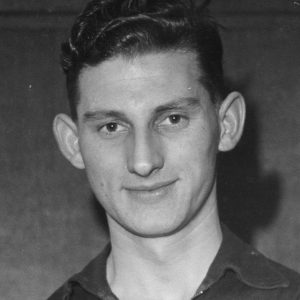
Bernard was born in Bishopstoke, Hampshire on 27 May 1925. He gained his first England cap at the World Championships in 1950 against Brazil and came away with a bronze medal. Not a bad start to an international career. Bernard also played in the World Championships in 1948 and 1954 when they were held in Wembley. Sadly, the year after his last appearance his life was tragically cut short in the Barnes railway accident.
Bernard played before the National Championships came into being but did play several times at the English Open. He was runner-up with Vera Dace in December 1950, a Men’s Singles quarter-finalist in 1949 and twice a quarter-finalist in the Men’s Doubles with Peter Skerratt in December 1950 and with Ivor Jones in 1952.
Playing in the National Team Championship’s Wilmott Cup, Bernard was winner with the Staines League in 1954/55, with Jimmy Lowe and Michael Thornhill, and runner-up in 1951/52.
Bernard played in a number of Open tournaments and had success at the Bournemouth Open, Central London Open, Eastern Suburban Open, East of England Open, Metropolitan Open and West Middlesex Open. He also won the Middlesex Closed men’s Singles in 1949/50, Men’s Doubles in 1949/50, 1950/51 and 1951/52 with Michael Thornhall and the Mixed Doubles with Doreen Spooner in 1951/52. In the Staines League he took titles in the Men’s Doubles with H Archer in 1947/48 and the Mixed Doubles with Mrs Bennett in the same year.
Bernard became an ETTA Approved Local Coach in 1951/52. His highest England ranking was at 7.
Harry Venner
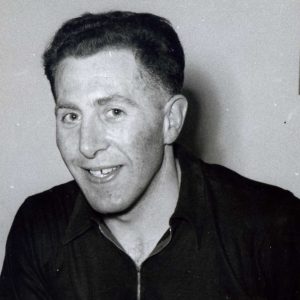
Harry was born in Battersea, London, on 16 October 1922. He played in five World Championships and was in the Swaythling Cup team for three of them, coming second in 1951/52 and third twice in 1949/50 and 1953/54. His best result in an individual event was a quarter-final place with Ann Haydon in 1953/54.
He played in 13 internationals in total, against Belgium, France, East Germany, Ireland, New Zealand, Romania, Scotland, USA and Wales. Harry’s debut was in 1949, and he continued playing internationally until 1957. He played in 19 English Opens and was runner-up in the Men’s Singles in 1955/56 and winner in the Veteran Men’s Singles in 1963/64 and 1966/67.
Harry was a semi-finalist in the Men’s Singles in the National Championships in 1964 and a men’s Dobles semi-finalist with Ken Craigie in January 1960. In the Wilmott Cup playing for the South London League, he won the coveted trophy five consecutive years with Jackie Head and Ron Crayden.
There were impressive results in Open tournaments. Winner of the Men’s Singles at the Welsh Open in 1953/54 and nearly 80 domestic Open titles. Harry won the Surrey County Closed Men’s Singles in 1952/53, 1960/61 and 1962/63. He also won titles at the Croydon Closed, London Closed, South London Closed and Wandsworth Closed. Harry played over 50 appearances for his county and was part of the team that won the County Championships Premier Division in 1955/56 and 1958/59.
As well as a top player, Harry was also one of England’s best ever coaches and coached a number of players to international and world championships success, including Mary Shannon/Wright and Chester Barnes. He became an ETTA Approved County Coach in 1950/51, and Approved Coach in 1952/53 and gained his Basic Coaching Diploma in 1953/54, the first year of the awards.
Harry coached at Butlins Holiday Camps for three years in the 1950s, set up Wimbledon Table Tennis School with Jackie Head in March 1952 and later took over the famous Putney Club in 1959 and later opened a new centre in Becontree. Harry stood in as National Coach when Jack Carrington went on a six-month coaching tour of Australia in 1961 and in 1967 until 1971 became Australia’s National Coach, moving with his family to Melbourne. His family, of course, included son, Ritchie.
As far back as 1952, arry wrote a detailed article about the ideal bat. He carried out a lot of research into the best type of wood, birch or beech plywood, the best shape and handle type and the best rubber – large pimples of reasonable depth. His research served him well.
A useful footballer and cricketer, Harry gave up those sports to concentrate on his table tennis.
Latest news
- British Clubs Leagues
BATTS' BCL Premier delight: A dream season-opener for Kingham and Carder
- From the Archives
- Team England