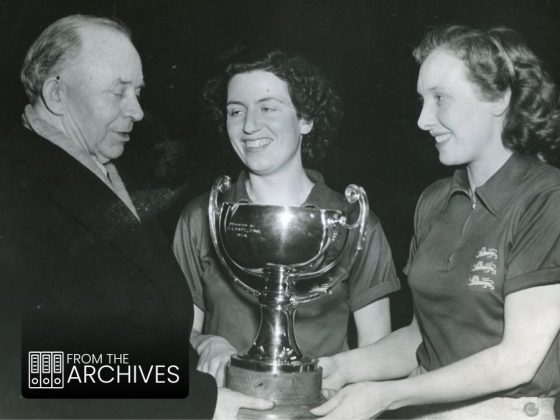
In the latest instalment of our series on England’s World Championships performances over the years, Diane Webb (Chair of Archives, Museum and Records Committee) turns to London 1948 – with high hopes for the host nation.
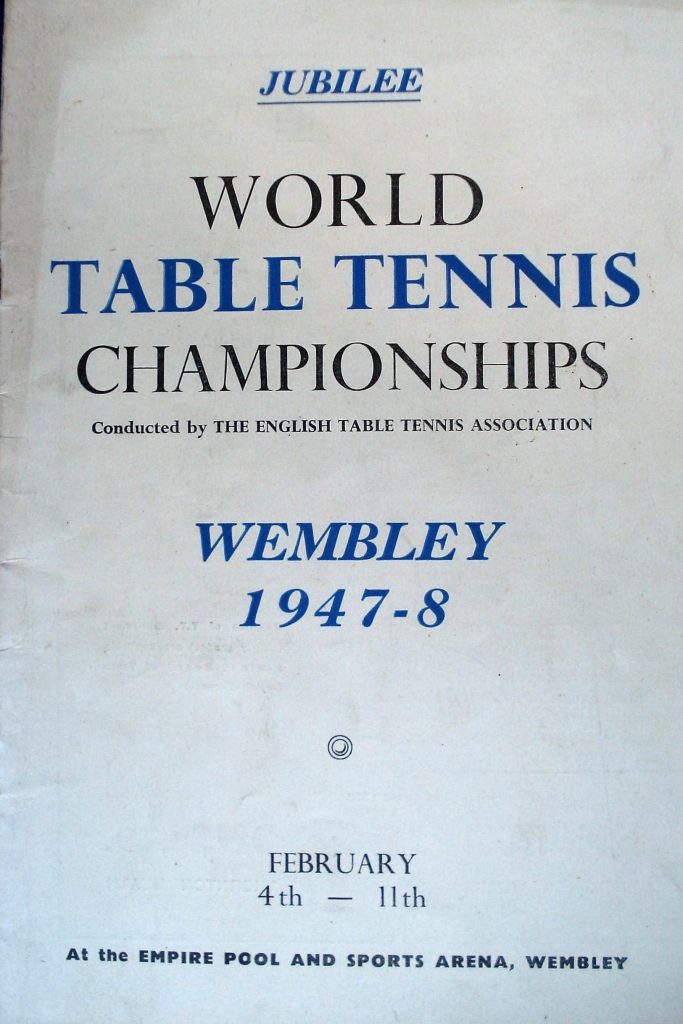
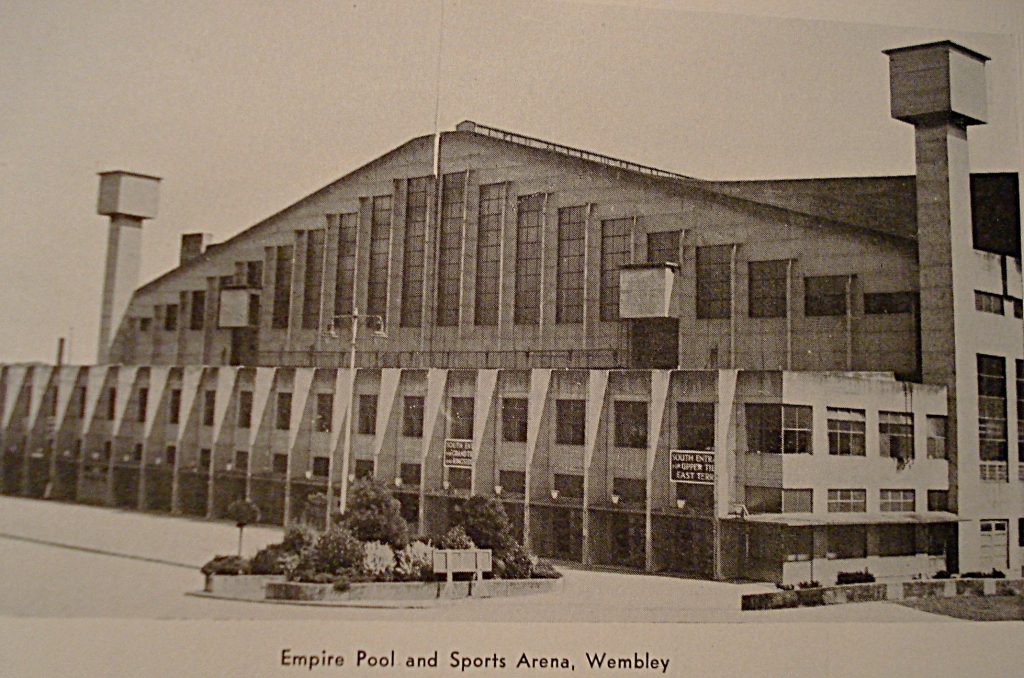
The World Championships returned to London, the fourth time they were held in the city. They were played at the Empire Pool and Sports Arena, Wembley from 4-11 February 1948 and titled the Jubilee Championships to reflect 21 years since the first.
It was a very experienced team which ran the Championships, with the most senior positions on the Organising Management Committee going to Ivor Montagu as the Chairman, Bill Pope the Organising Secretary, Bill Vint the Treasurer and J Morris Rose the Referee.
For the first time a country from South America entered in the form of Argentina, it was also a first for a Caribbean country as Trinidad & Tobago took to the floor. Their team was made up of players who were students in England. The longest journey was from the New Zealand team who travelled halfway around the world to play.
The draw took place on 13 January 1948 at the Orchid Suite, Dorchester Hotel in Park Lane, London. Two months prior to that on 13 November 1947, a Reception and Press Conference was held at the “Falstaff” Inn in Fleet Street.
Stats and facts
- 28 countries entered
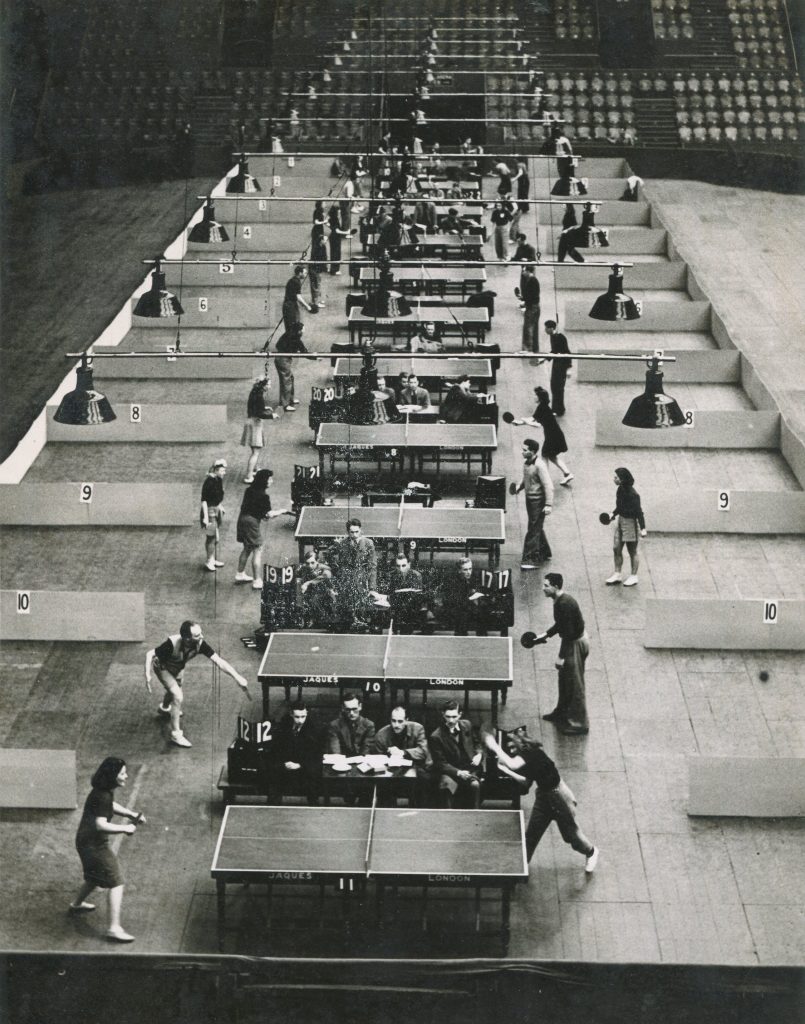
- 11 tables were used, going down to one for the finals
- Nearly 500 volunteers gave their time
- The entry fees were £2 per team, 10 shillings for singles, £1 for each pair of doubles
- 85,000 watts of power were used to light the finals with lights suspended from the 85ft high roof
- A book of season tickets was available to purchase for 25/- which gave a reserved seat for each evening session and access to all daytime sessions, 14 tickets in all. The cheapest ticket cost 3/6d
- 20,000 programmes were printed with daily supplements
- Team finals were held on Wednesday 7 February, individual event finals on Saturday 11 February
The initial budget was for an income of £4,250 and expenditure £3,800. The final figures were an income of £6,433 16s 8d, with ticket sales making up £4,574 10s 7d, although Wembley Arena took just over half. Programme sales made up £1,056 5s 3d with an additional £215 for advertisements. Expenditure totalled £6,688 17s 2d with hospitality the next highest cost of £1,960 18s 7d, after the Wembley Arena payment, followed by the printing of programmes costing £1,282 10s 0d.
Swaythling Cup
Entry numbers had increased considerably with three groups of six and one of seven. Regrettably, Palestine withdrew from Group C and the anticipated Argentinians from Group D as well as Portugal from this group. India were in Group A but withdrew following Mahatma Gandhi’s death on 30 January as a sign of respect.
The top team from each group went through to the semi-finals which resulted in Czechoslovakia versus USA and France versus Austria. Czechoslovakia had won all their five group matches 5-0, the USA had one 5-0 result, one 5-1 success and two at 5-2. France in Group D had only three matches and won them all 5-0 whilst Austria won three matches 5-0, one 5-2 and a tussle with Yugoslavia which they just managed to win 5-4.
The two winning semi-final teams were Czechoslovakia after a 5-2 win against the USA and France with a 5-1 success over Austria.
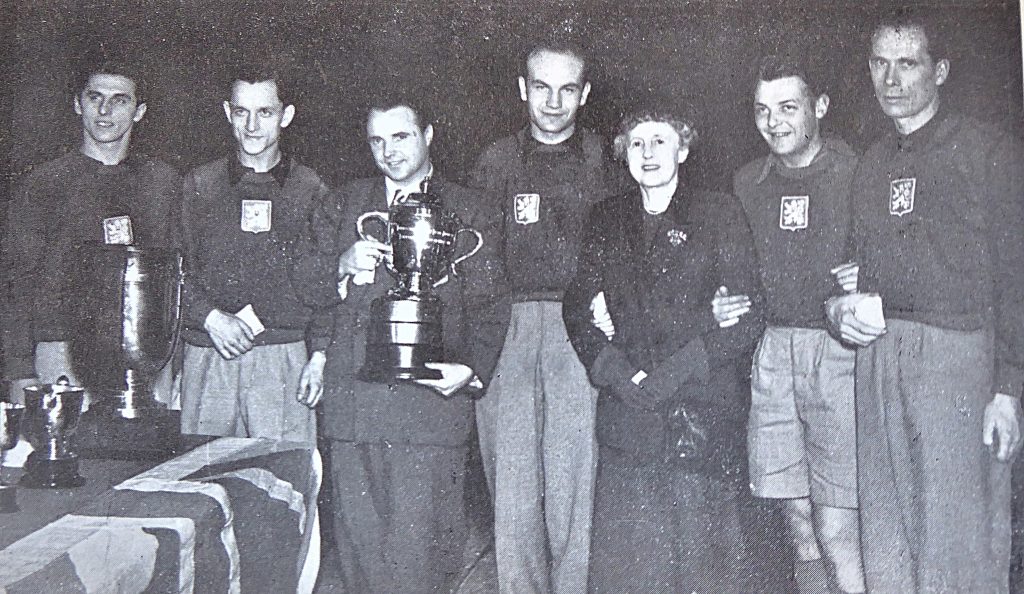
The final saw a very entertaining match as Czechoslovakians Ivan Andreadis, Ladislav Stipek and Bohumil Vana faced the Frenchmen Guy Amouretti, Michel Haguenaeur and Maurice Bordrez. Vana continued to show what a world-class player he was by winning his three matches, Andreadis won both his matches, Stipek was on the losing end in his two encounters against Bordrez and Haguenauer. The title belonged to Czechoslovakia.
England, in Group A, had a strong team with Victor Barna, Richard Bergmann, Ernie Bubley, Johnny Leach and Ron Sharman, captained by Adrian Haydon. It was the first time Barna and Bergmann had donned an England shirt for a Swaythling Cup match after their naturalisation. Aubrey Simons and Ken Stanley were the two reserves. The first match against Hungary was very tight with England winning 5-4 (Barna won 1, lost 2, Bergmann won 2, lost 1, Leach won 2, lost 1). It was more comfortable against Jersey with a straightforward 5-0 result (Barna won 2, Bergmann won 1, Leach won 2).
Sweden didn’t give the England players much to worry about and it was a 5-1 win (Barna won 1, lost 1, Bergmann won 2, Leach won 2). The USA proved a different proposition. England went down 5-2 (Barna beat Garrett Nash but lost to Richard Miles, Bergmann lost to both Miles and Nash but beat Marty Reisman, Leach lost to Miles and Reisman, all matches were won in two ends. As second in the group England did not progress any further in this event.
Corbillon Cup
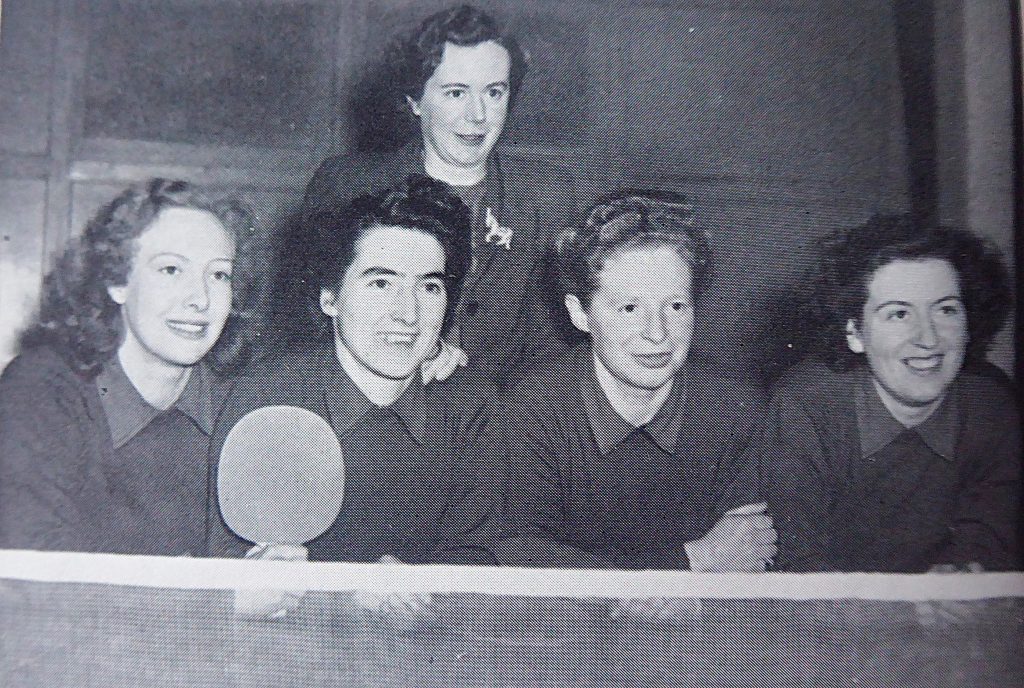
There were two groups of eight in the Corbillon Cup vying for the title. All 16 teams were present and England in Group A faced Austria, Belgium, Jersey, Romania (then spelt as Rumania), Scotland, the USA and Wales. The team was once again captained by Margaret Knott with Peggy Franks and Vera Thomas (Dace), two established stars and holders of the title. Dora Beregi, like Barna and Bergmann, was able to play for England and was part of the team along with other newcomer Elizabeth ‘Betty’ Steventon. Pinkie Barnes and Jean Mackay were reserves.
It was straight through to the final for the winners of both groups with the ladies’ format the best of five with potentially four singles and one doubles match. England had an impressive run with 3-0 wins over Austria, Jersey and Wales and 3-1 wins against Belgium, Romania, Scotland, and the USA. All four from England played their part in the group matches.
The final against Hungary saw Beregi win her two matches, giving her a perfect eight played, eight won. She beat her former compatriots Gizi Farkas 19, 15 and Rose Karpati 10, 13. Dace wasn’t at her best in the final and lost her only singles match in the event to Farkas -16, -14. Captain Knott took a big gamble in the doubles, putting the two left-handers Beregi and Thomas together, not usually a good combination, but they came up trumps after a slow start to win the match against Farkas and Karpati -18, 14, 13 to retain the trophy.
What a result on home soil. England’s ladies were definitely on top of the world, winning not only the World Championships but also the Europe Cup.
Men’s Singles
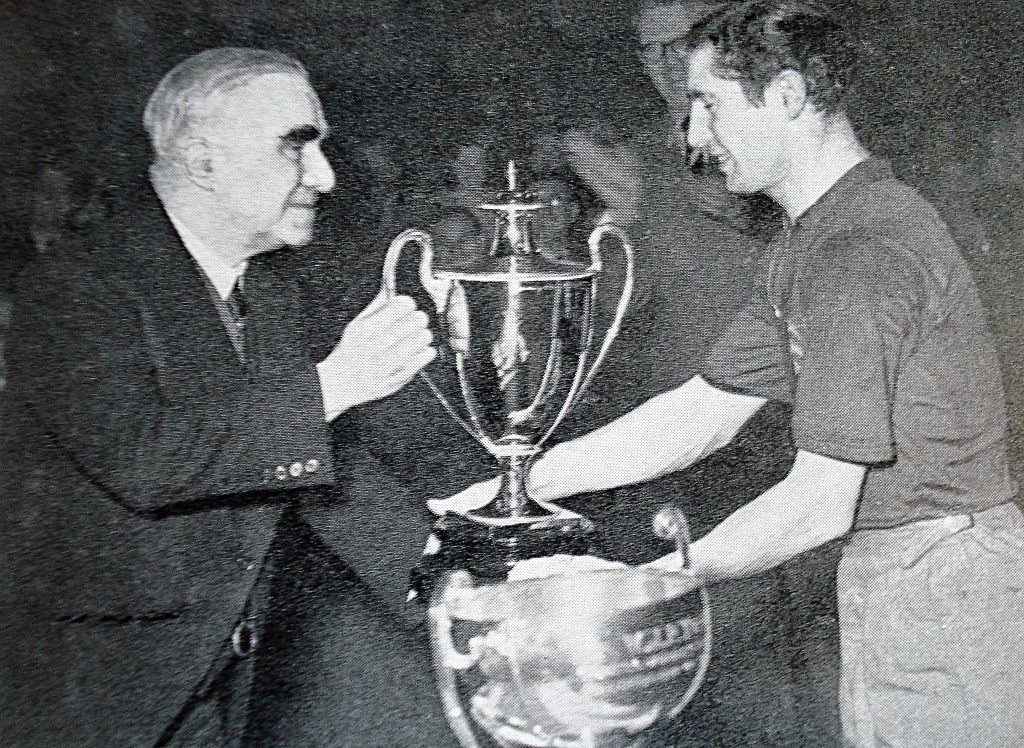
There was an impressive entry of 212 men for the St Bride Vase. 120 were placed in the main draw plus eight qualifiers from qualification matches. Bergmann, back in the Championships, had an outstanding event and after beating M F Mohtadi of India 13, 14, -19, 7, had a long match against Marty Reisman, USA 20, -18, 14, -19, 12 before another victory in the round of 16 against Ferenc Soos of Hungary 15, 12, -18, 12. Austrian Heribert Just was his next opponent and an easier match 20, 13, 14 before facing Ivan Andreadis of Czechoslovakia in the semi-finals. Another fine win for Bergmann keeping his supporters on the edge of their seats -17, -18, 7, 23, 16. Andreadis at 2-1 and 9-4 up looked well in control but it was Bergmann’s steady play which won through.
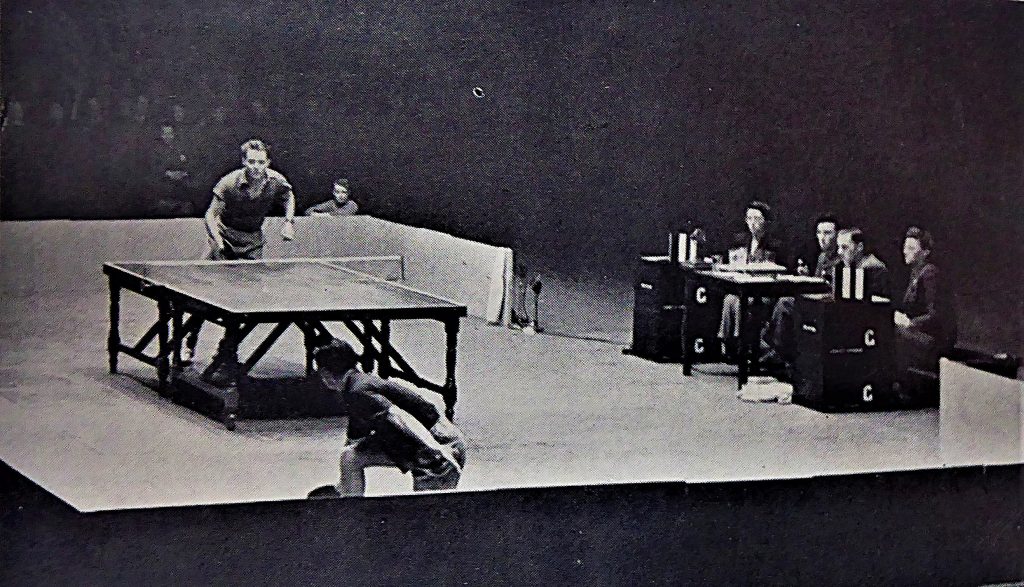
On to the final against Czechoslovakian holder, Bohumil Vana. The first went to Bergmann 21-12, the next was in favour of Vana 21-18. The third saw Bergmann retake the lead with a 21-19 win, Vana levelled 21-14 in the fourth. Two hours had now passed and the two warriors were still locked. Bergmann started the fifth with uncharacteristic hits which seemed to unsettle Vana and it was Bergmann who went on to win the game 21-10. The second time he had beaten him in a final, the first in pre-war Cairo in 1939.
As for the other English players, Johnny Leach went out in the round of 16 to Frenchman Guy Amouretti in a close match which see-sawed first one way and then the other (13, -20, 15, -13, 12), Victor Barna lost in the quarters to Andreadis 9, 17, -19, 13, two giants of the game. Aubrey Simons was the only other player to get as far as the round of 16 when he lost to Frantisek Tokar 13, -11, 17, 15.
Women’s Singles
England were hoping to make it a double gold in the singles events and after their women’s success in the team event it looked promising. It was a good entry of 73 with 60 going straight through to the main draw plus four from the qualifying rounds. The winner would be taking home the Geist Trophy.
16 English players were in the main draw and nine made it through to the round of 32 where Margaret Knott, Jean Mackay, Gwen Mace, Molly Jones, Violet Patterson and Irene Lentl went out at this stage. The round of 16 saw the exit of Peggy Franks and Betty Steventon, leaving Vera Thomas to fly the flag for England which she did in style with a 10, 12, 9 win over former World Champion Trude Pritzi of Austria. She then had another comfortable win against Vera Pokorna, better known as Miss Depetrisova, of Czechoslovakia 11, 8, 17.
In the other half of the draw Gizi Farkas progressed to the final with a 14, 16, 10 win over American Leah Thall in the quarter-finals and eventually Angelica Rozeanu of Romania in the semis 21, 10, 14. This was a contentious result as the original score was -13, -9, 9, 18, 27 but a dispute regarding the application of the time limit rule at deuce in the fifth game led the Jury to order a replay. It was eventually Farkas who went through to the final.
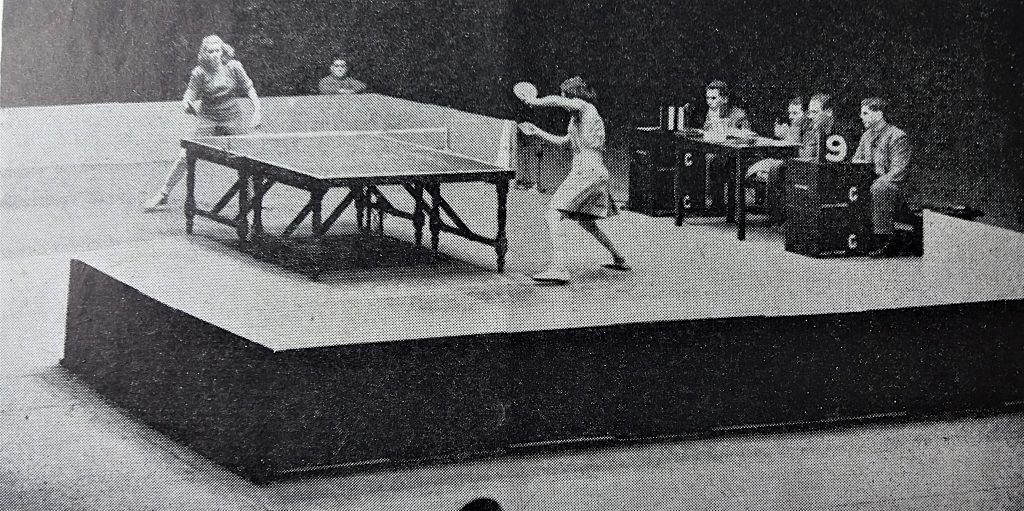
The final saw Thomas get off to a good start, winning the first end 21-18. Farkas levelled and then went ahead with wins in the second and third games of 16 and 18. Thomas evened in the fourth winning 21-16 but then, as last year, the Hungarian got the better of an English player to win the fifth and final game 21-12.
Men’s Doubles
Of the 74 entries, two involving England players reached the semi-finalists, one winning and one losing. The victorious pair who went on the final were Adrian Haydon & Ferenc Soos. Former World Doubles champions from 1939, Barna & Bergmann, were on the receiving end of a -10, -15, -16 semi-final loss against Vana & Stipek, the eventual champions who then went on to defeat Haydon & Soos 18, 15, 10 in the final. Haydon still going strong 20 years on from his first World Championships. Other English players notable for reaching the round of 16 were Geoff Harrower & Ken Stanley, and not so well-known players at international level, Howard Walton & Robert Mackay, and R Langner & G Markwell.
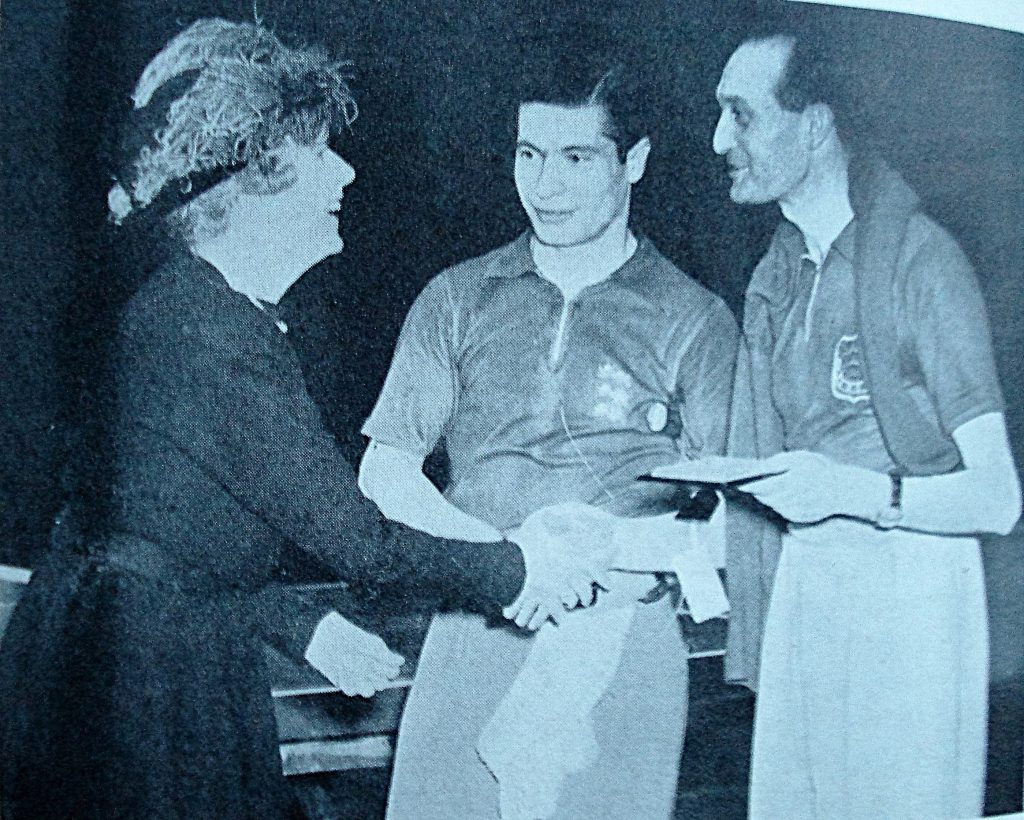
Jack Carrington & Johnny Leach, who played so well in Paris and who we were looking forward to earning even greater honours this time, unexpectedly went out in the first round, despite being seeded, to Ivan Andreadis & F Tuerk of Czechoslovakia -26, 17, -17, 18, 18 in the longest match of the event.
Women’s Doubles
32 pairs vied for the title in the Women’s Doubles and many of the partnerships were with players from different countries, 12 were either all English pairs or had one English player in them. Six made it through to the next round. Here Doris Atherton & Mrs E Griffiths went out, leaving five in the quarter-finals. Inevitably, English players had to compete against each other in some matches and the results favoured Dora Beregi, playing with Helen Elliot of Scotland, who had a win over Mae Clouther, USA, & England’s Pinkie Barnes 10, 16, 13. Audrey Fowler & Irene Lentl too had an excellent win, against England internationals Betty Steventon & Molly Jones -14, 19, 20, -13, 16. Also going through to the semi-finals were Vera Thomas & Peggy Franks who beat Farkas & Maria Kettnerova 17, 20, 16.
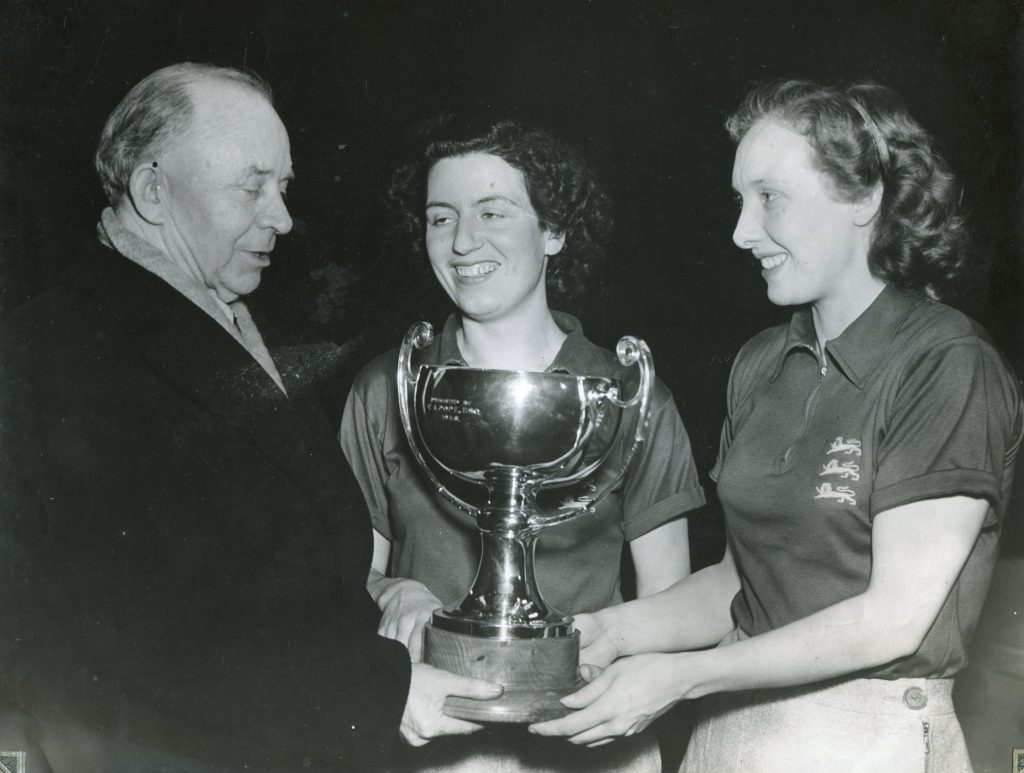
The results set up a semi-final match between Beregi & Elliot and Fowler & Lentl which the former won 13, 17, 4. The second semi-final was between Thomas & Franks, and Leah Thall & Thelma Thall of the USA. This was won by the English pair 14, 14, 17. England had already won a bronze medal courtesy of Fowler & Lentl and were guaranteed gold and silver in the final as well. It was Thomas & Franks who gained the gold with a fine win over Beregi & Elliot -17, 12, 19, 8. Bill Pope was delighted to present the W J Pope trophy to the ladies.
Mixed Doubles
65 pairs entered for 64 places in the main draw, so there was one qualifying match. 22 of the pairs had at least one English participant and eight made it through to the round of 32. The round of 16 saw Ron Litten & Violet Patterson, and Aubrey Simons & Molly Jones leave the event, leaving three English pairs in the quarter-finals. Two lengthy matches saw Barna & Franks lose to Vana & Pokorna -18, 15, 12, -14, 12, and Leach & Thomas to America’s Richard Miles & Thelma Thall 16, -11, -16, 24, 19. Bergmann & Beregi were the only ones to make it through to the semi-finals and guaranteed a further medal. Their win was against Stipek & M Zelenkova, Czechoslovakia.
The two semi-finals went in favour of Vana & Pokorna against Bergmann & Beregi -16, 14, -5, 14, 18, yet another five game match for Bergmann. Miles & Thelma Thall were the other finalists with a 18, 20, -18, 16 win over Ferenc Sido, Hungary & Angelica Rozeanu, Romania.
It had been a long Championships for many of the players and the Mixed Doubles final starting at 11.30pm didn’t lend itself to a classic match. Thelma Thall looked the only player interested in winning, and so she did with her partner, Miles. They won the closely contested final -13, -14, 18, 19, 12. Vana & Pokorna took the silver.
Jubilee Cup
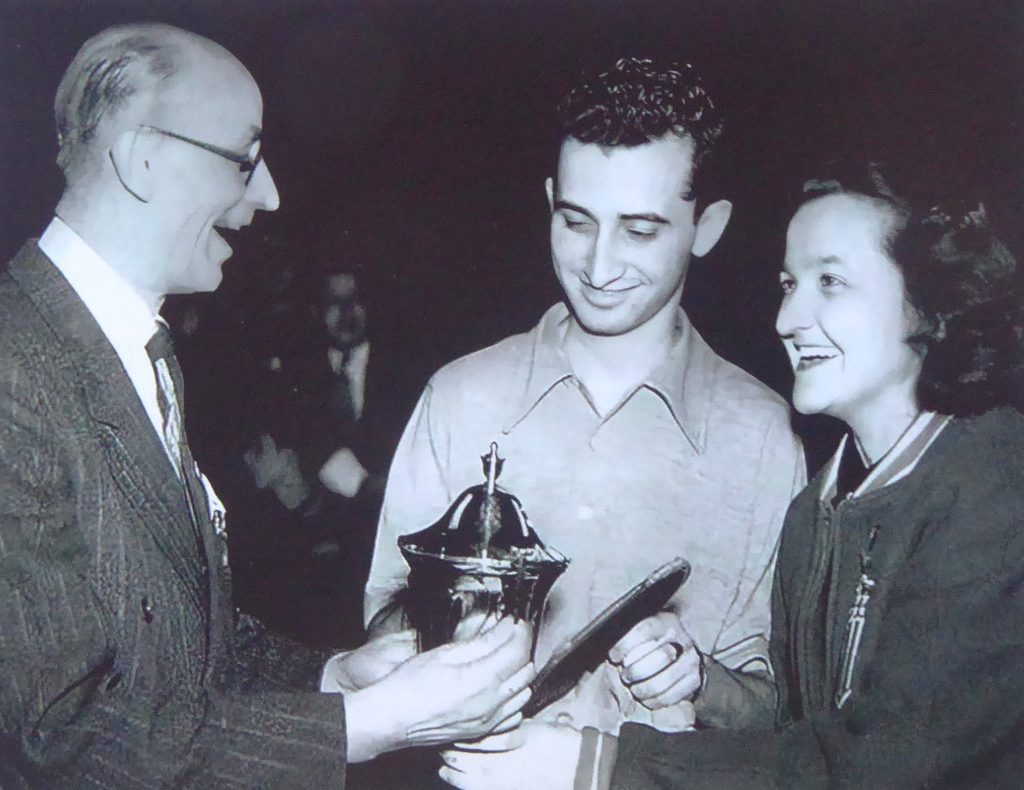
A new event was introduced for the Jubilee Championships, aptly named the Jubilee Cup. The event was open to all who had competed in the first World Championships in the 1926/27 season. It was a mixed event with 14 men and two ladies, Kathleen Graves (nee Berry) and Mrs Dolly Evans, formerly Miss Dolly Gubbins, of Wales.
The final was between England’s Bernard Bernstein and Mr S Stone of Wales and the win went to Bernstein -15, 21, 17 with the same bat he played with 21 years ago. However, as a result of a mix-up Evans did not play her first scheduled match. Subsequently, a special Challenge Match was arranged in which she beat Bernstein 7, 16 and was awarded the Jubilee Medal.
There were some notable names amongst the entrants including Godfrey Decker, Ivor Montagu, Zdenek Heydusek, Bill Pope, Frank Lawes, Zoltan Mechlovits and Charles Mase.
Men’s Consolation Singles
Josef Koczian of Hungary won this event with a 12, 16 win over Englishman, Ron Sharman.
Women’s Consolation Singles
Pinkie Barnes was the winner, beating Mrs A Abou Haif of Egypt in the final -19, 19, 18.
Snippets
- It was the first time men wore shorts.
- Congress had decided that flags and anthems should be banned at World Championships.
- On Saturday evening there was a parade and march past of all the national teams carrying banners in their various uniforms.
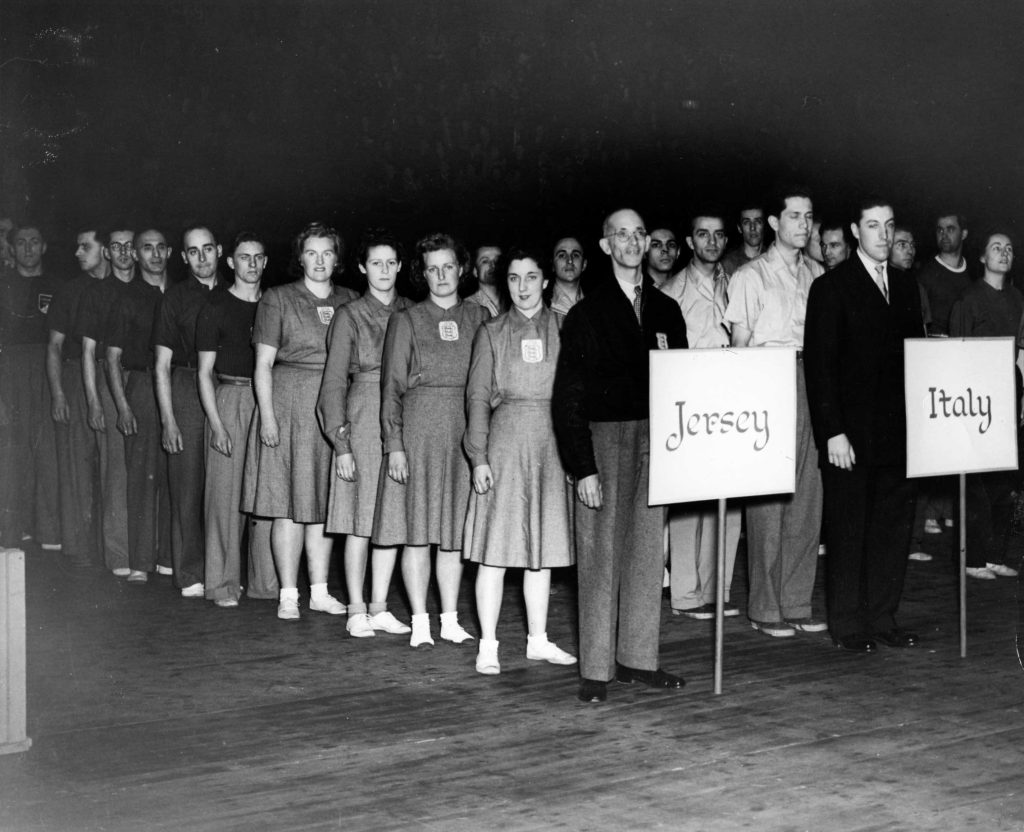
- Rationing was still in force in England and a plea went out to all Leagues asking for one clothing coupon per League to enable the England players to be kitted out in uniform clothing, in the end Umbro came up trumps and provided royal blue shirts for the teams so they ended up looking rather smart in the parade.
- In early 1948 petrol was restricted and private usage was prohibited. The ETTA asked the Ministry of Fuel and Power to be allowed an allocation. This was refused as “the only persons who make their living by sporting events . . . should be given allowances of petrol to enable them to travel to the fixtures where other means of transport ae not reasonably practicable”. However, the request was reconsidered and a small allowance made. The lack of petrol not only impacted the running of the Championships but also the mobility of spectators.
- The Hungarian captain was not satisfied with the result in the Swaythling Cup match against England and it was reported he challenged the England Captain, Adrian Haydon, to a duel.
- Hymie Sofer of South Africa, after making his way to Wembley with no small difficulties, was unable to play as his national Association were not affiliated to the ITTF. He still enjoyed his time in London and had lots of very good practice against top players.
- First philatelic appearance on two stamps from Nicaragua.
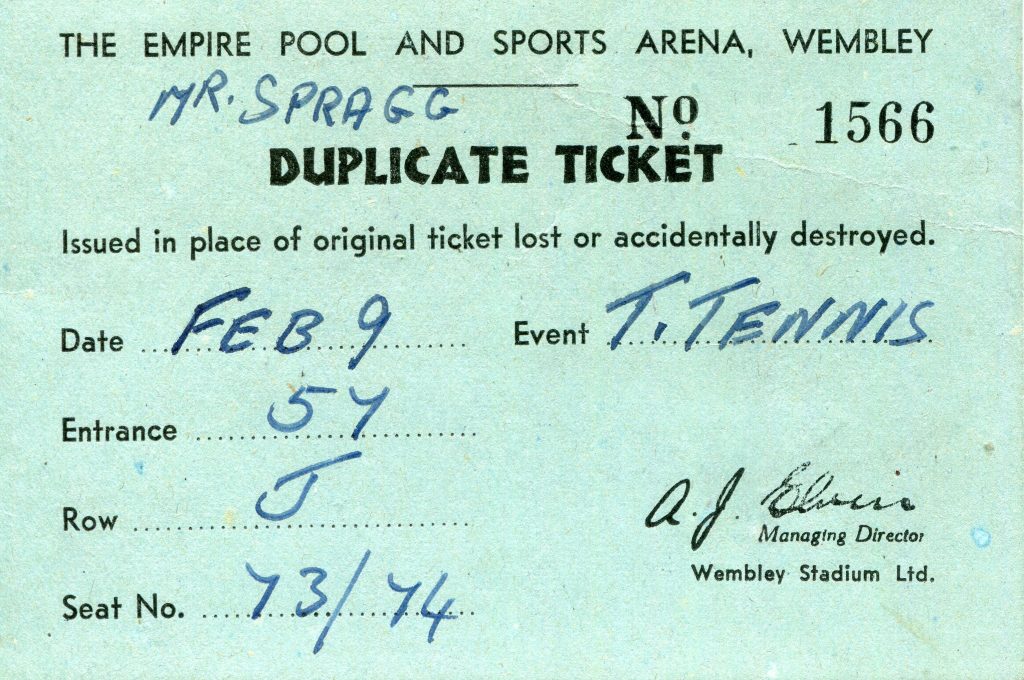
- Spare a thought for a young Harry Spraggs who must have been distraught to find his tickets turned to pulp after they had been left in his trouser pockets and then washed. The Secretary of his Eton Manor Club wrote and asked if replacements could be issued. Happily, this was resolved and young Harry was able to watch the matches. It proved a wise move as Harry went on to be a world-class umpire.
Summary
The Championships were regarded as a huge success. They were exceedingly well run with medals in every individual event for England. There was gold in the Corbillon Cup, Women’s Doubles and Women’s Consolation Singles; Silver in the Women’s Singles, Men’s Doubles, Women’s Doubles, Jubilee Cup and Men’s Consolation Singles; Bronze in the Men’s Doubles, Women’s Doubles x 2 and Mixed Doubles. What an incredible Championships.
With wonderful foresight Bill Vint, ETTA Treasurer, wrote about the extensive and interesting content of the programme “Historians will bless us in years to come that we provided them with so many interesting facts.”
We certainly did, Bill.
With grateful thanks to Gunther Angenendt for the use of his photos.
Dora Beregi
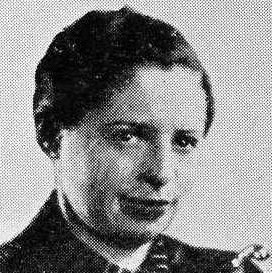
Dora was born in Budapest, Hungary, in either 1915 or 1920, the exact year is not certain. She started playing in 1936 and the next year became the Hungarian singles champion; she became their doubles champion that year too and again in 1938. She represented Hungary in 1937 and 1938 and came to England on tour in the 1937/38 season.
Dora married British soldier Henry Devenney and her allegiance changed to England, helping them win the Corbillon Cup in 1948 and a third place two years later. She won the Women’s Doubles with Helen Elliot of Scotland in 1950 and was runner-up with Helen in 1948. Dora also won a silver medal with Ida Ferenczy of Hungary in 1938. One further medal came her way in 1948 with Richard Bergmann in the Mixed Doubles.
Apart from World Championship matches, Dora was awarded England caps against Ireland, Scotland, the USA and Wales.
At the English Open, Dora won the Women’s Singles twice, the Women’s Doubles in 1939/40 with Jean Nicoll and again in 1945/46 with Vera Dace. She also won the Mixed Doubles with Victor Barna in 1939/40 and with Eric Filby in 1945/46.
She was the winner of the Irish, Welsh and Australian Opens in all three categories she was eligible for, a total of 12 titles. Dora won nearly 20 other Open titles. Another 10 titles came her way in the Exeter Closed and the Western Counties Closed.
On 4 May 1950, Dora emigrated to Australia and shortly after arriving started coaching and went on to open “The Dora Beregi Table Tennis College”. She won the Australian Inter State Championships in 1950/51and was captain of the NSW team. She won three consecutive Australian Women’s Singles and played internationally for her third country.
Dora was ranked No 1 in England and six in the world. She received the ETTA Player Achievement Award in 1983 and made a Vice-President of the International Club of England in 1964.
Molly Jones
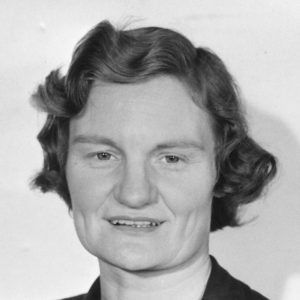
Molly was born in Gloucester on 19 May 1918 and played in four World Championships with her best result in 1948 in London when she reached the Women’s Doubles quarter-finals with Betty Steventon. She also played in World Championships in the Netherlands and Sweden. Playing in the National Trials, she was undefeated in 1947.
She played in four international matches, against Ireland, Scotland, the USA and Wales and the team won on every occasion. Her first cap was against Scotland on 25 March 1947 in Sunderland. A fixture won by England 10-1 and although Molly lost her singles match she won her two doubles with Violet Patterson and Aubrey Simons. Playing for Gloucestershire County on 18 October 1948, Molly played against Czechoslovakia in Cheltenham and won her singles match.
At the English Open Molly was a semi-finalist in the Women’s Doubles in 1947/48 with Jean Mackay and reached the quarter-finals of the various events a number of times. She won the Bournemouth Open Women’s Singles and Doubles in 1952/53, the Women’s Singles Bristol Open in 1946/47, the Women’s Doubles Buckinghamshire Open in 1946/47 with Aubrey Simons and the Metropolitan Open Women’s Singles in 1946/47, as well as several runners-up and semi-final places.
Molly continued playing as a veteran and had great success at the World Veteran Championships gaining a silver medal in the Over 80 Singles category in 1998 in Manchester and a bronze with Australian, Dorothy De Loew in the Over 80 doubles. At the European Veteran Championships Molly won the Over 85 Women’s Singles in 2003, she also won four bronze medals.
Gloucestershire was Molly’s county and she represented them from 1948-61; in the Cheltenham League she was a representative in 1948 and still going strong in 1983. Her highest England ranking was at 4.
An ETTA Approved Local Coach in 1950/51, Molly’s contribution to table tennis was recognised when she became a Vice-President of Gloucestershire County TTA and an Honorary Life Member of Gloucester TTA.
Irene Lentl
Irene played well in the 1948 Championships reaching the Women’s Doubles semi-final with Audrey Fowler, a non-international player. Born Miss Cox in London on 24 March 1912, Irene gained one international cap against Czechoslovakia on 23 October 1948, a match played in Liverpool which England lost 9-0 against strong opposition.
Irene was a very strong doubles player and built up a fine partnership with Connie Miles and the pair won numerous titles at Open tournaments, as did Irene with Audrey Fowler. She won the Wembley & Harrow League Closed Women’s Singles title four times, either side of the war and had one win the Women’s Doubles and Mixed Doubles. A regular member of the Middlesex County team and a player who won the County Championships with Middlesex from 1947 to 1949. Her highest ranking in England was at number seven.
Elizabeth ‘Betty’ Steventon
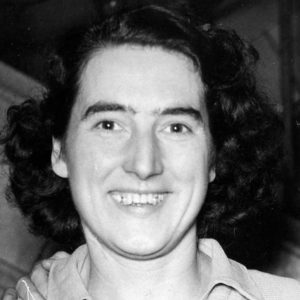
Betty came from Staffordshire where she was born on 31 May 1912 in Shenstone. She was coming to prominence before the Second World War playing her first match for England against Wales on 22 April 1939 in Birmingham. A fixture the team won 7-2. Betty won her singles match and doubles with Phyllis Hodgkinson. It was a long wait until her next international appearance at the World Championships in London in 1948 where she was part of the Corbillon Cup winning team. She was also a reserve for the team the following year. 1948 saw a quarter-final placing with Molly Jones in the Women’s Doubles.
The Europe Cup in 1949 saw England runners-up in the team event. It was an interesting venue to hold the trials – Bishopgate Police Station. Betty also played in international matches against Czechoslovakia, 23 October 1948 and Scotland on 13 January 1949.
At the English Open, Betty was a semi-finalist in the Women’s Singles in 1938/39 having beaten the holder Dora Beregi and the same stage in November 1947, she twice reached the semi-finals in the Women’s Doubles.
Betty was a prolific player at Open tournaments and had over 30 wins along with many runners-up spots. She won titles in the Birmingham & District TTL Closed, the Midland Closed, the Nottingham and District Closed plus seven titles in the Civil Service Championships.
Betty first played representative matches for Birmingham in November 1935, was an Inter-city team member of the Birmingham League in 1936-37, first played for Warwickshire in the 1928/39 season. Her home club from 1937 onwards was the Birmingham City Club until her move to Edinburgh and later Nottingham.
Bety was an Executive Committee Member of the International Club of England in 1965 when she was then known as Mrs Griffin, having married Cecil Griffin in 1957 in Sutton Coldfield.
Ronald ‘Ron’ Litten
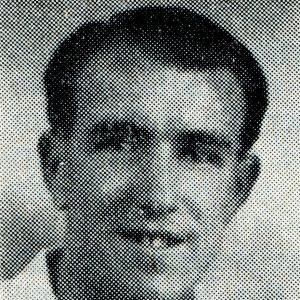
Ron was born in Exeter, Devon, in February 1915. His senior England debut was against the Irish Free State on 18 January 1936 in Dublin, a match England won 10-1 with Ron winning his singles and doubles with Charles Davies. He went on to win three more caps, one against Scotland in 1947 and two against Wales in 1939 and 1948.
At the World Championships in 1948 he got as far as the round of 32 in the Men’s Singles, the same round in the Men’s Doubles with Aubrey Simons and the round of 16 with Violet Patterson in the Mixed Doubles. With Simons he was a bronze medallist in the English Open in 1947.
Playing in the Exeter League he won the Men’s Singles, Men’s Doubles and Mixed Doubles and the West of England Team Championships in 1935/36. He won a number of Open tournaments.
In 1949 Ron emigrated to South Africa, Betty Blackbourn also went at this time and he was a winner with her in the Mixed Doubles in their Closed Championships in 1951/52, also winning the Men’s Doubles that year with R Edwards.
In South Africa Ron was ranked at three and in England at four in the Men’s Doubles with Aubrey Simons and 11-20 in the Men’s Singles.
Dennis Miller
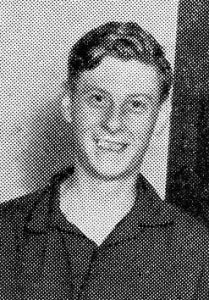
From Walthamstow in London, born on 15 September 1928, Dennis’s senior England debut was on 19 January 1948 versus Wales in Bath. The team won 9-2 and although Dennis lost his singles he did win his doubles match with Johnny Leach. He played three more times for his country, first against France on 5 April 1949 in Paris winning two singles and losing one in the team’s 9-2 victory, a reverse fixture against the French on 16 December 1949 in Wolverhampton resulted in another 7-2 team win but this time only one singles result to his credit.
In early November 1949, Dennis was part of a group that toured Czechoslovakia which played in Cela Kovice, Hradec Kralove, Jablonec, Novy Bor and Horni Litvinov plus one international match which England won 5-4.
In the English Open Dennis won the Junior Boys Singles in 1945/46 and also won two junior events at the Central London Open and one at the Merseyside Open. At senior level he won over 25 Open titles, mainly in doubles events. Dennis won the Essex Closed in 1947/48 and the Middlesex Closed the following year along with the Mixed Doubles title with Rosalind Rowe. League Closed titles came his way in the East London League, London League and North Middlesex League.
In July 1953, Dennis participated in The Workers’ Festival Tournament in Paris and with Keith Hurlock and Ivor Jones won the Men’s Team event. A month later he went to Bucharest to play in the World Youth Festival, his team finished third and with Ken Craigie was runner-up in the Men’s Doubles, losing out to Ivan Andreadis and Ladislav Stipek of Czechoslovakia.
Harold Oldroyd
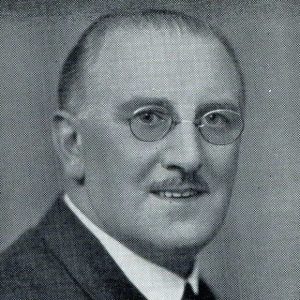
Harold was President of the ETTA from 1931-53 and saw the Association through the war years giving as much support as he could. He was also President of Lancashire County TTA 1947-50, Cheshire County TTA 1950-53, North Western TTA 1932-34 and the first President of Manchester & DTTL in 1928.
An excellent sportsman who started playing table tennis with a vellum racquet in the 1890s, he was one of the fastest bowlers and hardest hitters in the Lancashire Cricket League and had a golfing handicap of two. Harold had one of the first full-size tables in Manchester, in his home, and all were welcome to play on it.
In the first issue of Table Tennis after the war, Harold addressed the membership welcoming all, whether from pre-war days, those who played in camps during the war of newer players. “ . . . We have in our hands a powerful instrument which, if used correctly, may well play a useful part in the necessary work of creating better understanding between peoples of the world, without which that peace for which we all are looking cannot be accomplished.” What wise words and exemplifies why he became the ETTA President.
Bill Pope
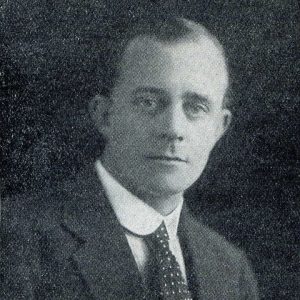
Bill’s influence on the game was immeasurable. Born in Newport, Monmouthshire on 8 February 1888, he was a very good hard-hitting penhold player in the wooden bat era but his strength wasn’t in his playing but in his administration. He even turned down the chance to be capped in 1926 to go to Berlin on the trip which led to the foundation of the ITTF. His enthusiasm and commitment never wavered from that time on despite periods of poor health.
Bill first took up the post of ETTA Honorary General Secretary in 1927 along with the other responsibility of Treasurer, holding both positions until 1929. In 1935 he again took up the General Secretary role and continued until his death in 1950. As early as 1926 he was involved with administration at the top, being ‘Arrangements’ Committee Member, Provincial Committee Secretary, Selection Committee Member and World Championships Tournament Committee Member, he went on to hold many more positions with the ETTA.
At a more local level he was London League President in 1926, Chairman 1927-29 and ETTA representative 1933-36, he was also President of the London Table Tennis Federation and Secretary of the Metropolitan Open.
Bill helped to form the ITTF at that inaugural meeting in 1926 and became an ITTF Ball Committee Member 1927-28, English Language Secretary 1930-31, 1937-39, 1946-47, Equipment Committee Member 1930-31 and Honorary General Secretary 1947-50.
In 1936 Bill was the referee for the first televised match with Victor Barna, Laszlo Bellak and Miklos Szabados. During the war he organised exhibition matches which raised more than £10,000 for the Red Cross and in 1947/48 he was responsible for the allocation and accounting of 50,000 tickets over 20 sessions at the World Championships. His name lives on through the Women’s Doubles Trophy at the World Championships which is in his name ‘The W J Pope Trophy’.
Bill played in three World Championships, 1926, 1935 and 1936 although he never got past the earlier rounds, it was a similar story in the various English Open Championships he played in.
However, bare facts cannot do justice to Bill’s influence and achievements, perhaps an extract from Ivor Montagu’s obituary gives a better sense of what Bill meant to table tennis: “Never was a sports personality so rightly mourned. Never has a sport had one single personality who has meant so much to it. Seldom is tribute so universal. In Madras they stand in silence. In Scotland they join our sorrow . . . he joined us in 1926 and, as General Secretary, made it what it is today. He came from Newport (Mon), shook us up, reconstructed us, and established a democratic basis, insisting that the national organisation should be based on Leagues. He knew everyone of them and his longing to maintain the personal touch ‘in the old way’ cost his physical and mental resources dear.” A true giant of the game.
The ETTA made Bill a Vice-President in 1932 and the ITTF awarded him an Honorary Life Membership posthumously in 1951.
Latest news