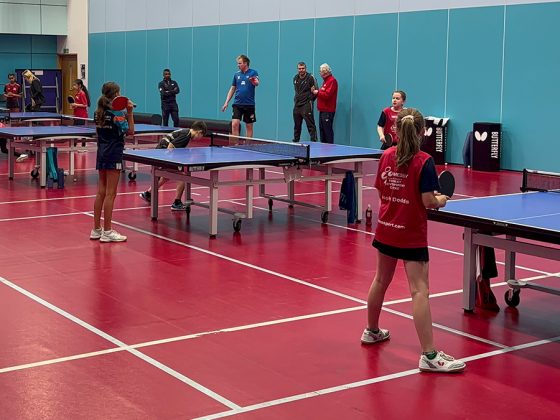
From eight to 13 years old, the England Hopes programme is a key development stage in the careers of promising young athletes.
Under the watchful eye of coaches Charlotte Carey and Ben Barlow, the youngsters are helped to form good techniques and good habits to help them succeed as they progress up the GB pathway.
The Hopes Squad bridges the gap between the Pathway Development Centres and the GB Training Squad. There are regular training camps at the Elite Training Centre in Sheffield, including one last month.
“A lot of them have been on holidays, so we’re just trying to get back into the swing of things,” said Hopes lead coach Charlotte. “So, a lot of footwork exercises, a lot of consistency as always.
“When we have them with us for longer periods of time (at camps), we can put in a lot of effort, get a lot of balls on the table, which is really important for this age.
“Our youngest player is eight and we generally work with the players up until they’re 13 and then hopefully they’ll transition into the cadet programme as well, where myself and Ben Barlow will take them on further. So, we get them for quite a long period of time.”
Camps will see players work on multiball drills with coaches, train with each other and with sparring partners such as Ben Piggott, a Commonwealth Championships medallist who is sharing his skills and experience with the youngsters.
“A lot of the time the partners are planned in advance, obviously trying to match levels,” said Charlotte. “Sometimes it’s useful to have weaker players playing with better players, and we try to keep the club players away from people in their same club. We try to make sure that everyone has a chance to play with Ben as the week goes on too. We try to mix it up a lot and they get a lot of variation.
“It depends what part of the season we’re at, but I think for the Hopes camps we do a lot of repetition, a lot of exercises that are quite simple. And then as the week goes on, we try to bring in a little bit more, around service and matches. But I think the main important thing is just repetition and lots of balls on the table.
“We do a lot of interval training, where each player has a box of balls and they do very simple footwork drills for four minutes, but full power, giving it full intensity. There’s no time wasted picking up the ball because they just take that from the boxes.
“Again, it’s just all about their repetition, trying to fine-tune their technique and their small movements around the table as much as possible.”
For the players, it is a chance to experience high-level training beyond their club environments, and to start to understand the focus required to compete at the top of the sport.
One of the players, Lev Sahmurov, describes one of the exercises he was asked to do:
“Charlotte and Ben told me to do an individual exercise for the camp so I chose forehand wide, forehand middle, backhand wide, forehand middle, forehand wide. But you can also do forehand from the backhand side.
I think this is a very realistic exercise. Firstly, it trains your forehand, trains repetition, makes you improve consistency. But then also it’s very much realistic because maybe if (your coach or opponent) sends you out wide, then they can go middle or backhand – you never know, so you have to be ready for that.
Sophie Dodds from the Ormesby club in Middlesbrough, said: “I’ve been practising forehand open up, backhand open up and close to the net.
“There’s a really strong structure and I just find it fun because everybody’s nice and it’s pretty good.
“I’d like to hopefully eventually get to the Worlds. Charlotte really helps a lot, and Ben does. The standards are really high, and it’s just a privilege to be here.
“It means quite a lot like to me and my family. It’s a really big achievement for me.”
Latest news