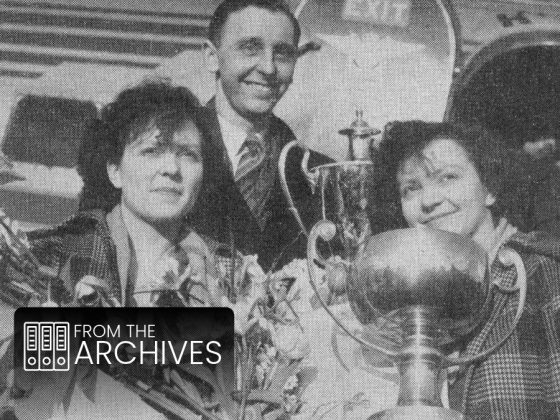
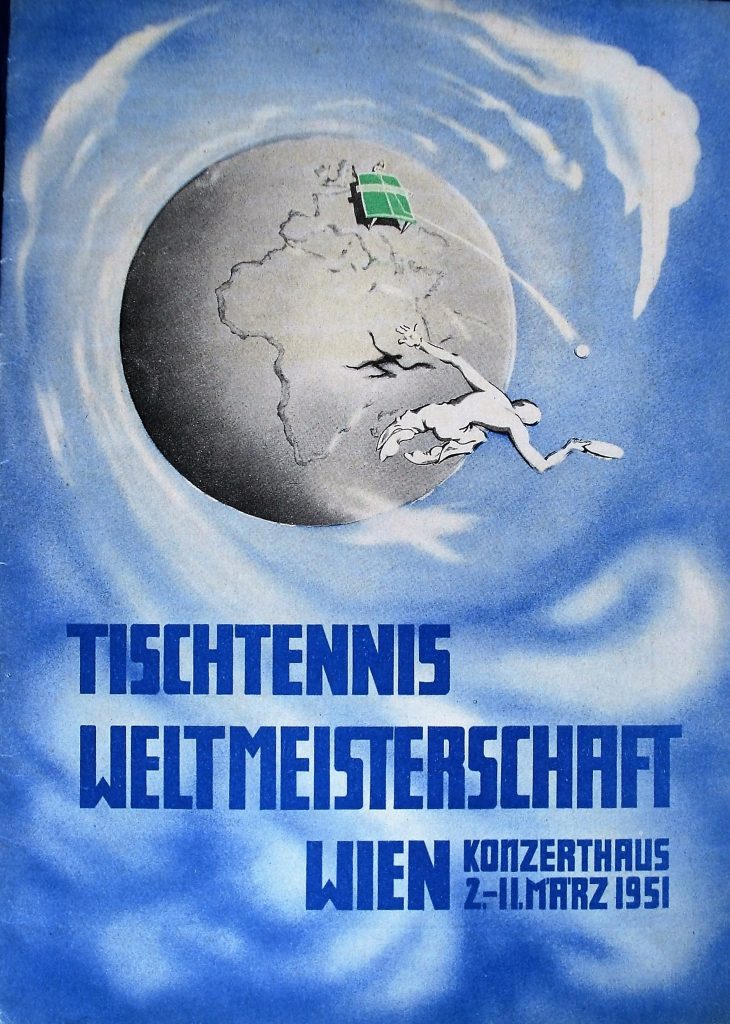
In the latest instalment of our series on England’s World Championships performances over the years, Diane Webb (Chair of Archives, Museum and Records Committee) turns to 1951 in Vienna.
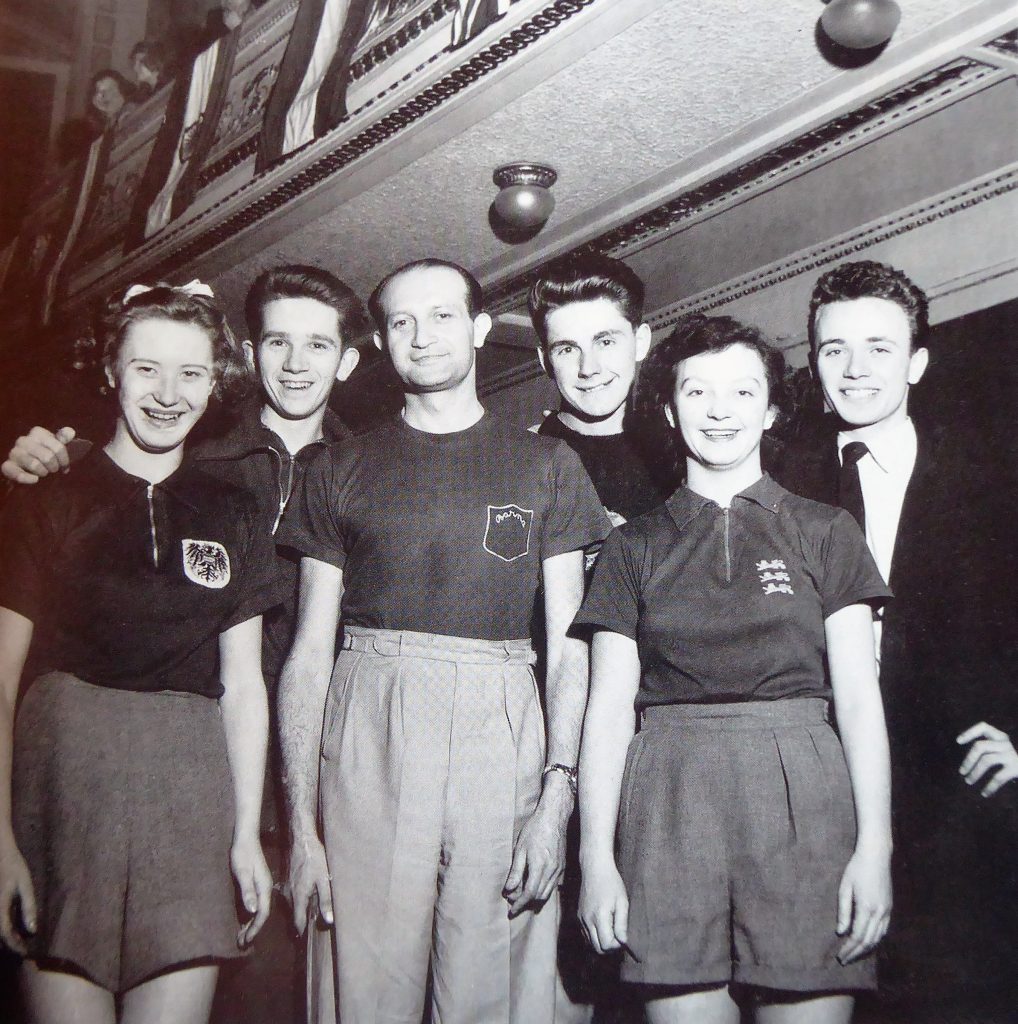
There were no trials this year and the initial automatic selection went to Brian Kennedy, Johnny Leach, Aubrey Simons, Diane Rowe and Rosalind Rowe. Ron Crayden, Michael Thornhill, Joyce Roberts and Vera Thomas were added later.
There was quite strong criticism about some of those selected as there were several players ranked much higher than those chosen. Criticism was particularly levelled against Ivor Montagu’s favouritism and several comments about the selectors being a body of yes-men.
Thomas had to drop out at the last minute due to illness and was replaced by Peggy Franks. As the closing date for entries had passed it was uncertain if she would be allowed to play. The ITTF Congress needed to give permission and, fortunately, they did so.
Richard Bergmann had been suspended indefinitely from 30 June 1950 as “he had taken part in table tennis activities abroad for remuneration without first seeking approval and sanction of the ETTA, also that he then played while suspended”.
Bergmann disputed the allegations and was unhappy that the decision had been made while he was out of the country so could not represent himself in person.
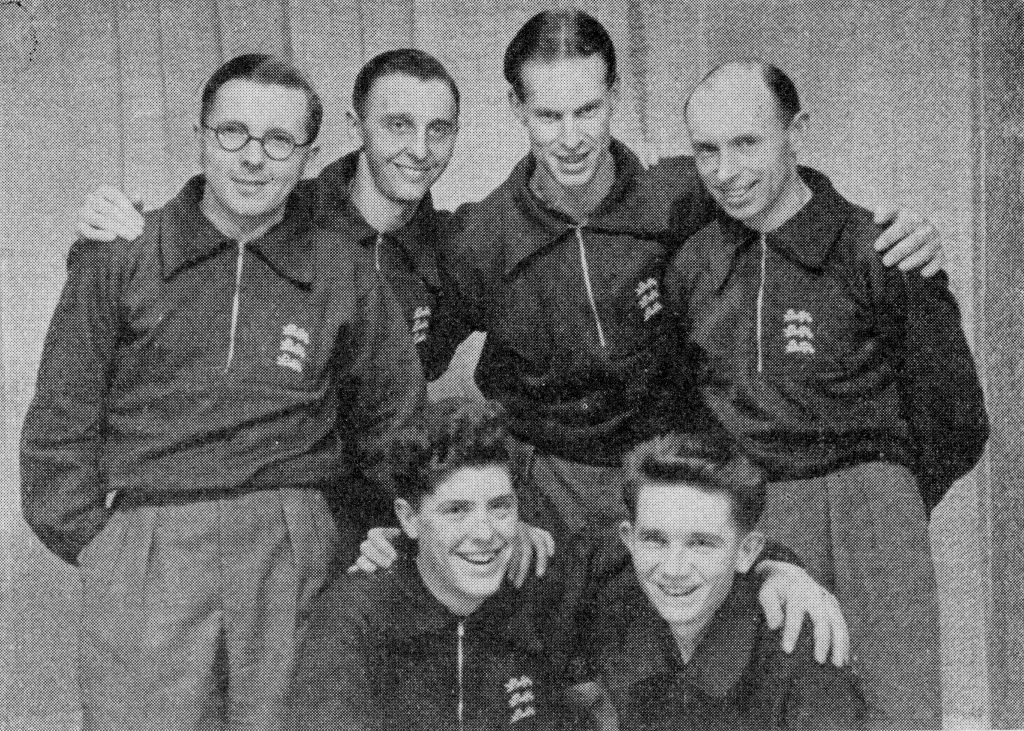
The team looked very smart as they had been fitted out with special shoes, team shirts, tailored shorts and best of all a royal blue tracksuit with “England” emblazoned across the back and with the three leopards in gold on the front.
The Journey
Due to a railway strike it was touch and go whether all the team would arrive in time at the Waverley Hotel in London for departure. The players all made it but the non-playing captains, Adrian Haydon and Margaret Knott, didn’t and had to follow on. Permission had been refused to fly over Russian-occupied territory so the route was via Amsterdam, Frankfurt and Munich. This resulted in the travellers not arriving until 8pm the evening before the first match. Fortunately, the hotel was not far from the venue and very comfortable, so they had a restful night.
Playing Conditions
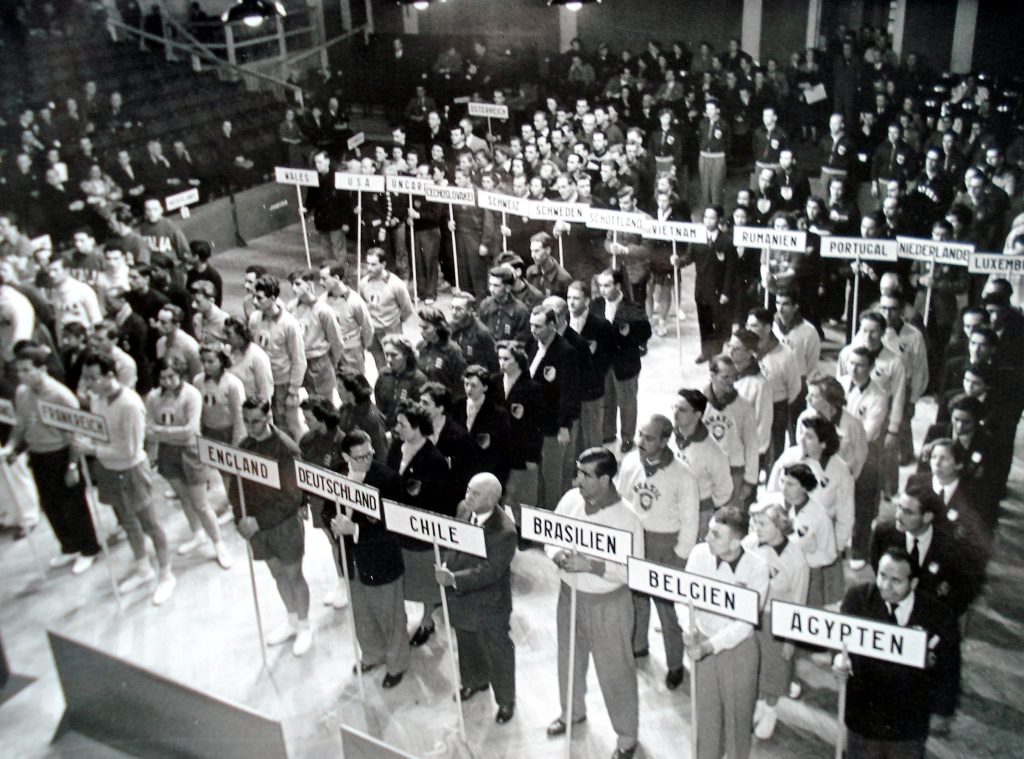
The setting in the Vienna Concert House was spectacular and the conditions regarded as the best yet. The flooring was better than at Wembley as it was not sprung and the lighting was bright without daylight interference. The surroundings were warm with seats for the players which were comfortable and near the courts. 12 Jaques tables, the best in the world, had been transported from England and were surfaces the England players were used to.
Swaythling Cup
There were enough teams to make three groups of eight teams. The top from each group went through to a three-way final.
England in Group A met Yugoslavia, Sweden, Brazil, Wales, Egypt, Italy and Luxembourg, they were expected to win the group and be part of the three-way final play-off. The first match was against Italy and a good 5-0 start, blooding new Swaythling Cup players Kennedy and Crayden. Simons was the third player. Leach replaced Simons against Wales with the result 5-1, Kennedy losing the one match.
Sweden were the next opponents and here Leach won three, Simons his two and the two defeats from Crayden resulted in 5-2 in favour of England. Sweden were without their top two players, Tage Flisberg and Bengt Grieve, so the result was expected.
It was another 5-0 win against Egypt with the team of Crayden, Simons and Thornhill. Leach, Simons and Kennedy were next on the table against Brazil to make it five wins from five.
Yugoslavia was going to be the challenge and so it proved. It was England’s strongest team of Leach, Simons and Kennedy. Leach had three wins against Josip Vogrinic, Josip Gabric and Vilim Harangozo. Simons only beat Gabric and Kennedy did not get on the scoreboard. He went on the table at 4-4 against Gabric, a match England needed to win, it must have been daunting for the young man. Regrettably, he was not able to beat his opponent, which put Yugoslavia into the final.
England’s final match was against Luxembourg and they finished on a high with a 5-0 win for Crayden, Kennedy and Thornhill.
Leach had won all his nine matches, Simons won nine and lost two, Kennedy won six and lost four, Thornhill won all his four and Crayden won six and lost two.
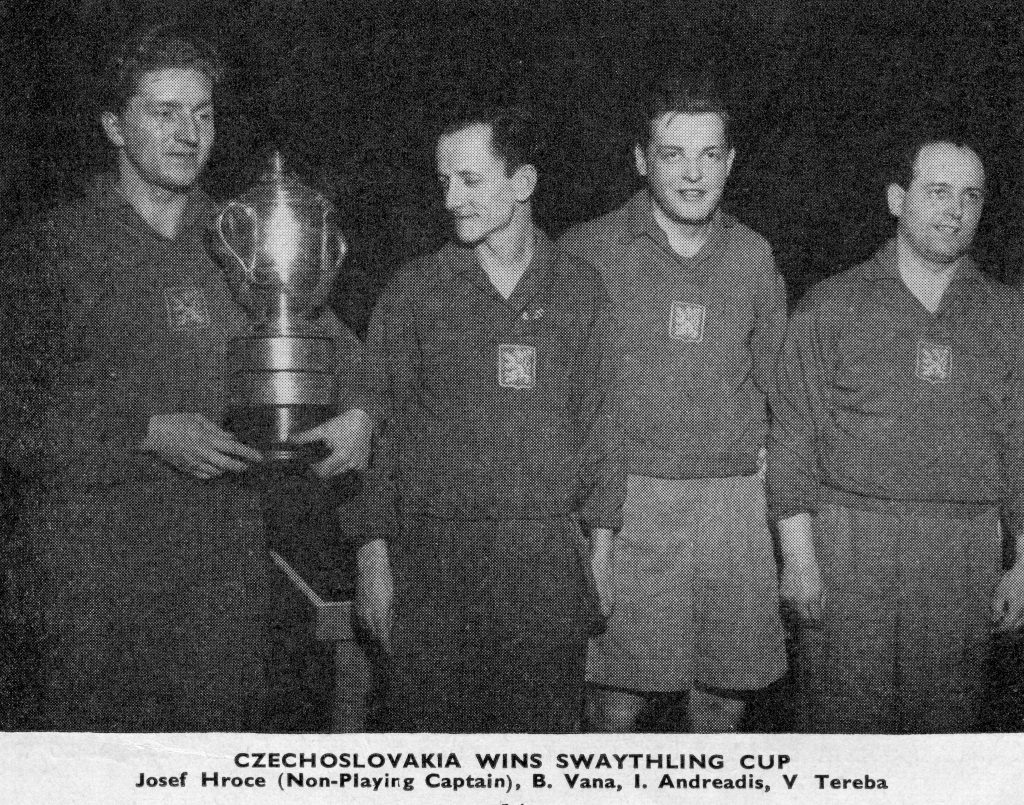
Group B was won by Hungary who played against France, Vietnam, Germany, Austria, Holland, Portugal and New Zealand. Group C was Czechoslovakia, USA, India, Switzerland, Belgium, Iran, Israel and Greece. It was the reigning champions Czechoslovakia who topped Group C winning all matches 5-0 with the exception of the USA, who took one game off the Czechs.
The final was a three-way play-off between Czechoslovakia, Hungary and Yugoslavia. Yugoslavia lost to Hungary 5-3 and Czechoslovakia 5-1. The deciding match was between last year’s two finalists and again it was Czechoslovakia who beat Hungary, the score 5-4. Ivan Andreadis was the hero of the day for Czechoslovakia, winning his three games. Bohumil Vana and Vaclav Tereba won one apiece. For Hungary, Ferenc Sido and Joszef Koczian both won two games but Kalman Szepsi did not get on the scoresheet, the lack of his wins was the difference between the two teams.
Corbillon Cup
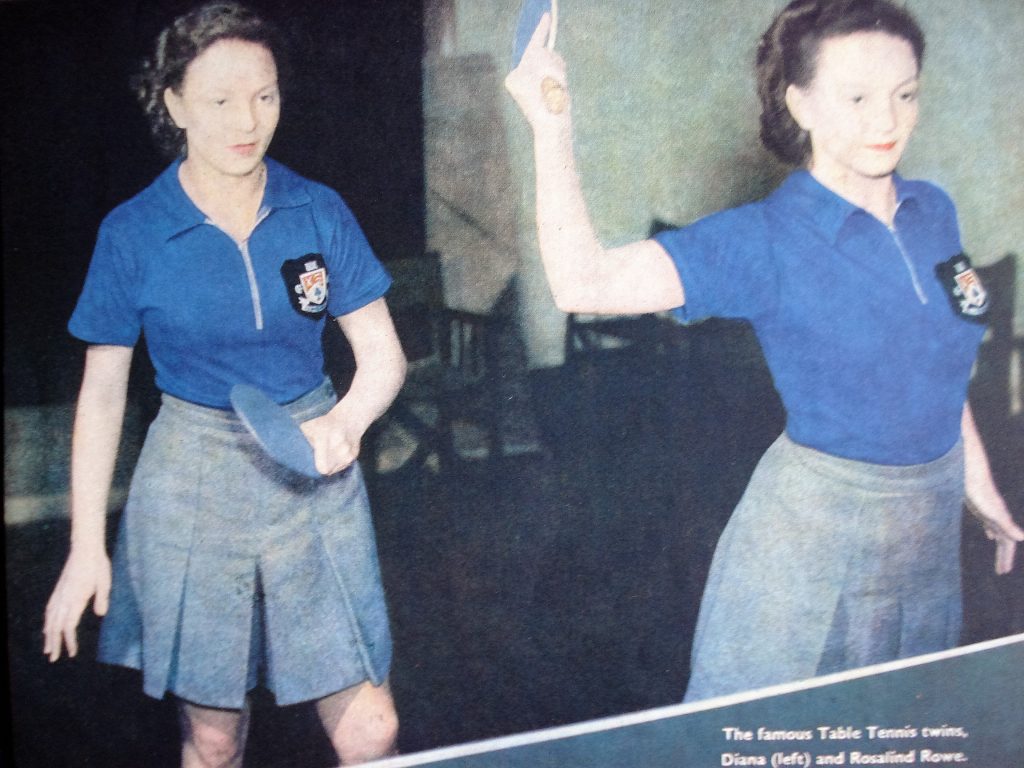
England were in Group A and there were some tough matches ahead and some which were not quite so challenging. The two youngsters, 17-year-old Diane and Rosalind Rowe, played the major part in the team, well supported by Peggy Franks and Joyce Roberts.
The first match should have been against Brazil, but a no-show from the Brazilians gave our ladies some breathing space to recover from their journey. The second day of play and England took to the table against the USA. The twins got England off to a good start. They both beat Peggy Ichkoff but lost to Leah Thall-Neuberger. Their strong doubles partnership was the decisive match and meant it was a 3-2 win for England.
Hungary were next and the match followed the same pattern as against the USA. Diane and Rosalind both lost to Gizi Farkas but defeated Edit Sagi. The doubles win against Farkas & and Rose Karpati meant another 3-2 win. Yugoslavia was the third match with the singles played by Franks and Roberts and the doubles by Diane and Rosalind. A straightforward 3-0 result.
Franks and Roberts played in all three games against Italy, and it was another 3-0 win. Germany were up next and Diane and Rosalind went to the table, 3-0 again. Switzerland were next and Franks and Roberts took the reins for another 3-0 victory.
It was between England and Austria to decide who would be in the final. Although Diane and Rosalind won the doubles, a clean sweep, played five, won five, they were unable to get on the scoreboard in the singles. Both lost to Trude Pritzi and Rosalind lost to Linde Wertl. 3-1 to Austria, who progressed to the final.
There were nine teams in Group B and Romania won all their matches to put them in the final again. It was 3-0 against Wales, Egypt and Holland and 3-1 against Scotland, Belgium, Czechoslovakia, France and India. Star of the Indian team was the elfin, 3ft 6 in 13-year-old, Sayeed Sultana, who had already won the Championships of India twice. She won more than half her matches and was the only player to take a game off Rozeanu.
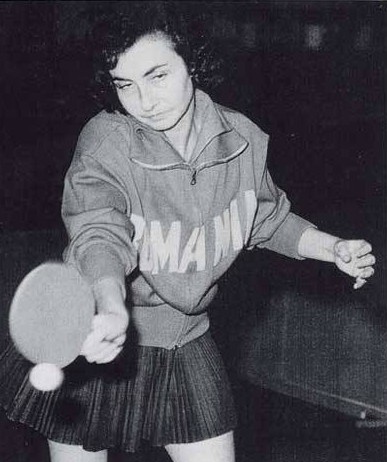
7 March 1951, commencing 11.45pm was the date and time for the final. Austria were the firm favourites with their duo of 16-year-old Linde Wertl and Trude Pritzi. Romania had world champion Angelica Rozeanu and Sari Szasz in their corner. It started well for Romania with Rozeanu beating Wertl 17, 16. Szasz then beat Pritzi 15, 10. The doubles went the way of the Austrians -13, 16, 21. The match was still in the balance. Onto the table went Rozeanu and Pritzi, the score 21-7, 21-2 to Rozeanu with the second game ending on the 20-minute time limit. The Championship title went to Romania.
England and Wales were the bronze medallists being the runners-up in their groups. The Welsh team comprised Audrey Bates, Audrey Coombs and Betty Gray.
Men’s Singles
Johnny Leach faced American Marty Reisman in the fourth round and it was an easy victory for the Englishman 9, 17, 17. He then beat Frenchman, Rene Roothoft in the quarter-finals and this was considered the decisive match in Leach’s ultimate triumph. There was little between the two players with the first going to Roothoft 21-17. Leach won the next two 21-14, 21-16 and had two match points in the fourth before Roothooft saved those and eventually won the that end 24-22. In the fifth and final game Roothoft was leading 10-7 at the change of ends but Leach pulled ahead to 20-15, Roothoft won the next four points but finally, Leach hit a winner to win 21-19.
In the semi-final Leach met Vaclav Tereba and won in four -21, 9, 22, 11. The other semi-final was between Ference Sido and Ivan Andreadis and it was the Czech who beat the Hungarian 21-14, 21-19, 13-21, 22-20.
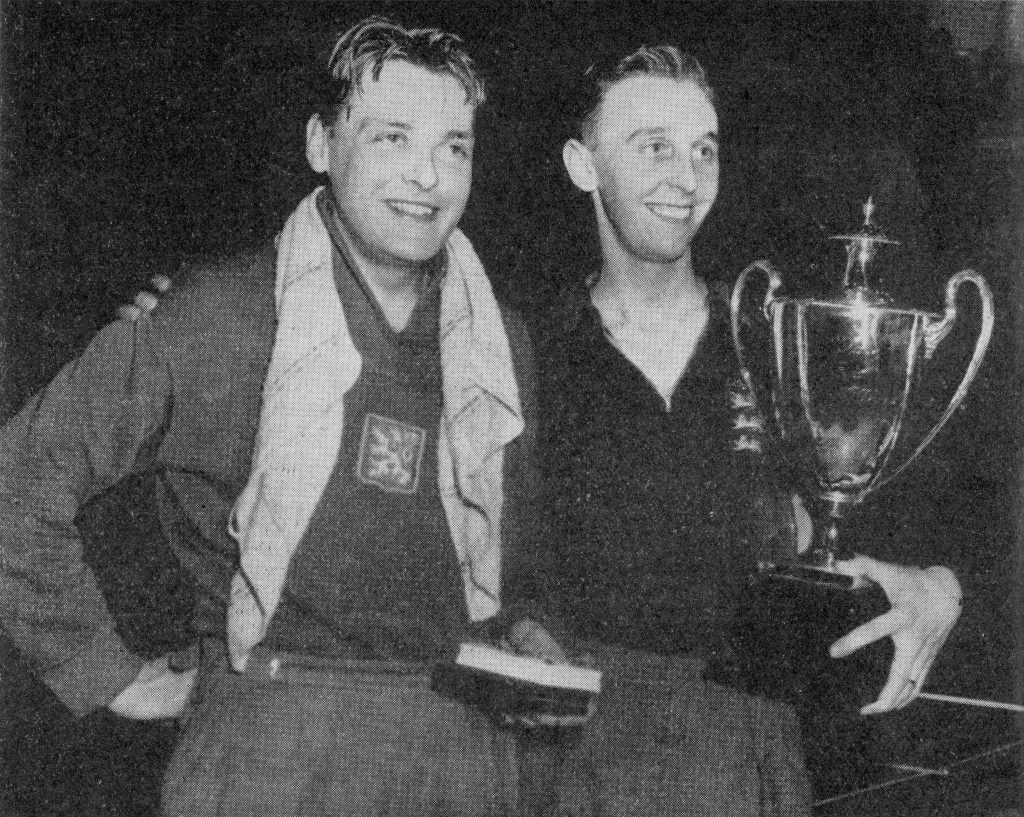
Andreadis had been on top form throughout the Championships, including winning his three matches in the Swaythling Cup final to help Czechoslovakia retain that trophy. In the final it was Andreadis who started well winning the first end 21-16. Leach was the 21-18 winner of the second game. It was 18-all in the third before Leach won the next three points, 2-1 to Leach. This seemed to deflate Andreadis who was 18-3 down in the fourth game and although he fought back it was Leach who got over the line 21-13. Leach was champion of the world for the second time.
Before the Championships, Leach had been undertaking fitness training at Spurs’ football ground at White Hart Lane but had “transferred” his allegiance to Selhurst Park as Crystal Palace was nearer his new home. It would appear the fitness training was very much to his advantage.
Harrower, Craigie and Carrington went out in round one, the second round saw the exit of Simons, Crayden, Haydon and Venner. After Leach, Brian Kennedy and Michael Thornhill were the next best-placed English players getting through to the fourth round where they lost to American Somael and Czech Vaclav Tereba respectively. Kennedy’s match was a straightforward win for the American 8, 19, 9, Thornhill had the harder match against Tereba and got close, eventually going down 15, -19, 19, 12.
Women’s Singles
As well as the Corbillon Cup players, Miss Robbins from England also entered the Women’s Singles but lost in the first qualifying round. Margaret Knott, back as captain, was also a participant. She came through two qualifying rounds before going out in the round of 64 to Trude Pritzi of Austria, a tough draw. Joyce Roberts also met a strong opponent in the first round, Rose Karpati of Hungary, and went down fighting 17, -16, 18, 11.
Peggy Franks and Diane Rowe made it into the round of 32. Franks lost to Scot Elizabeth Pithie 19, 21, 13 and Diane Rowe to Josee Wouters of Belgium -20, 20, -19, 15, 18. The star of the team was Rosalind Rowe who reached the quarter-finals going out to American, Leah Thall-Neuberger. She won the first two ends but the last three went against her, the final score -18, -17, 16, 12, 12.
One semi-final was between Angelica Rozeanu, Romania and Trude Pritzi, Austria. Rozeanu won 17-14, 14-13 and 5-4, all matches going to time limit. The other semi-final was more straightforward with a win for Gizi Farkas, Hungary against Neuberger 14, 19, 22. The final saw Rozeanu win for the second year running 10, 15, 13.
Men’s Doubles
Ivor Montagu playing with Austrian Robert Thum, and Jones & Taylor went out in the qualifying rounds. It wasn’t to be for Keith Hurlock & Harry Venner and Ken Craigie & Geoffrey Harrower who went out in the first round. The round of 32 saw Frecker & Peter Walton, and Brian Kennedy & Michael Thornhill exit the competition. The next to fall in the round of 16 were the old hands Victor Barna & Adrian Haydon, both in their 40th year, they still put up a good show against the eventual champions Ivan Andreadis & Bohumil Vana 15, -16, 13, 8.
Two English pairs were left in the quarter-finals, Ron Crayden & Aubrey Simons, and Jack Carrington & Johnny Leach. Here, Crayden & Simons went out to Ladislav Stipek & Frantisek Tokar 17, 13, 12. However, Carrington & Leach beat Egyptians Abuheif & Fawzi 20, 9, 16, justifying their seeding, and saw them face Josef Koczian & Ferenc Sido in their semi-final match. It was the latter pair who won 14, -20, 20, 10. The other semi-final saw Andreadis & Vana against Stipek & Tokar and it was the former who won 12, -19, 12, -18, 12. They then went on to win the final in three 13, 12, 19.
Women’s Doubles
30 pairs fought for the title in the Women’s Doubles and England’s hopes were for another medal in this event. The first round saw Margaret Knott, partnered by American Patricia McLinn, go out in the first round. Peggy Franks & Scotland’s Helen Elliot made it one step further but lost to Leah Thall-Neuberger & Peggy Ichkoff in a close match 17, 16, -17, -12, 17.
Joyce Roberts, playing with another Scot, Elizabeth Pithie, went through to the second round where they won 15, -18, -16, 18, 18 against Austrians Staffelleithen & Gertrude Wutzl. Their quarter-final opponents were the English pair of Diane & Rosalind Rowe, and it was the twins who were victorious 19, 17, 12. The twins were guaranteed a medal at their first World Championships.
Their next match was much more challenging as they faced Gizi Farkas & Rose Karpati, a match they won in five 14, -16, 15, -15, 12. In the other half of the draw Angelica Rozeanu & Sari Szasz had progressed to the semi-final where they beat Thall & Ichkoff 17, 19, -16, 19, after having seen off Trude Pritzi & Linde Wertl in their quarter-final match -13, 20, 19, 14.
As well as playing against their opponents the two 17-year-olds were also playing against the crowd with 90% cheering on the Romanians, Rozeanu & Szasz. However, the twins seemed unbothered by nerves and played their usual game hitting everything with their youthful energy. The first four games were close with Diane & Rosalind winning the first two 22-20, 21-19. The next two went to Romania 21-19, 22-20. The fifth saw Diane & Rosalind get a commanding lead and it was 10-4 when they changed ends. They increased their advantage getting nine of the next 13 points to make it 19-9 before getting over the line 21-12. Jubilation in the English camp for the young 17-year-olds, the youngest to win a world title since Victor Barna & Miklos Szabados 23 years earlier.
Mixed Doubles
It was a first-round loss for Ron Crayden with Elizabeth Pithie of Scotland. Also going out in this round were Jack Carrington & Margaret Knott. The round of 32 saw the departure of Harry Venner & Hobik of Austria who had Michael Thornhill & Peggy Franks as their opponents. Aubrey Simons & Rosalind Rowe also went out at this stage losing to Josef Koczian & Rose Karpati 13, -15, 17, -18, 15.
The round of 16 was the turn of Michael Thornhill & Peggy Franks as well as Victor Barna & Scotland’s Helen Elliot to leave the event, the former going out to Schneider & Horn of Germany and the latter to Brian Kennedy & Joyce Roberts 15, 19, -9, -15, 18. Kennedy & Roberts subsequently lost to Vilim Harangozo & Linde Wertl 8, 17, 14 in the quarter-finals.
This left Johnny Leach & Diane Rowe who had won their first-round match against USAs Jimmy McClure & Leah Thall-Neuberger 24, 15, 18. Their second-round match was victory over Josip Gabric & Covic of Yugoslavia 4, 22, 11. Next up was Ferenc Sido & Gizi Farkas and another win, -21, 15, -15, 18, 17 which put them through to the quarter-finals where they faced Somael & Trude Pritzi, another positive result -15, 10, 11, 20. Into the semi-final where they met Harangozo & Wertl. This was as far as they reached, going down 11, 17, -13, 10.
The other semi-final was between Bohumil Vana & Angelica Rozeanu, and Joszef Koczian & Rose Karpati. It was the former who won 22, -26, 13, -17, 15. Harangozo & Wertl versus Vana & Rozeanu in the final and it was Vana & Rozeanu who became champions, winning 19, 9, 14 which gave Rozeanu her third gold medal of these Championships.
ITTF Congress
35 nations were represented at the ITTF Congress. Ivor Montagu was re-elected as President and presented with a trophy to acknowledge his 25 years’ service to the Federation. Bill Vint was re-elected as Honorary Treasurer and Geoff Harrower were appointed Chairman of the Equipment Committee. England still had major influence at international level.
Summary
Two gold medals and three bronze medals meant an excellent Championships for England. It was the start of wonderful careers for Diane and Rosalind Rowe, their first gold added to which was one bronze for Rosalind and two for Diane. There was continued success for Johnny Leach, winning the blue riband event plus bronze in the Men’s Doubles and Mixed Doubles.
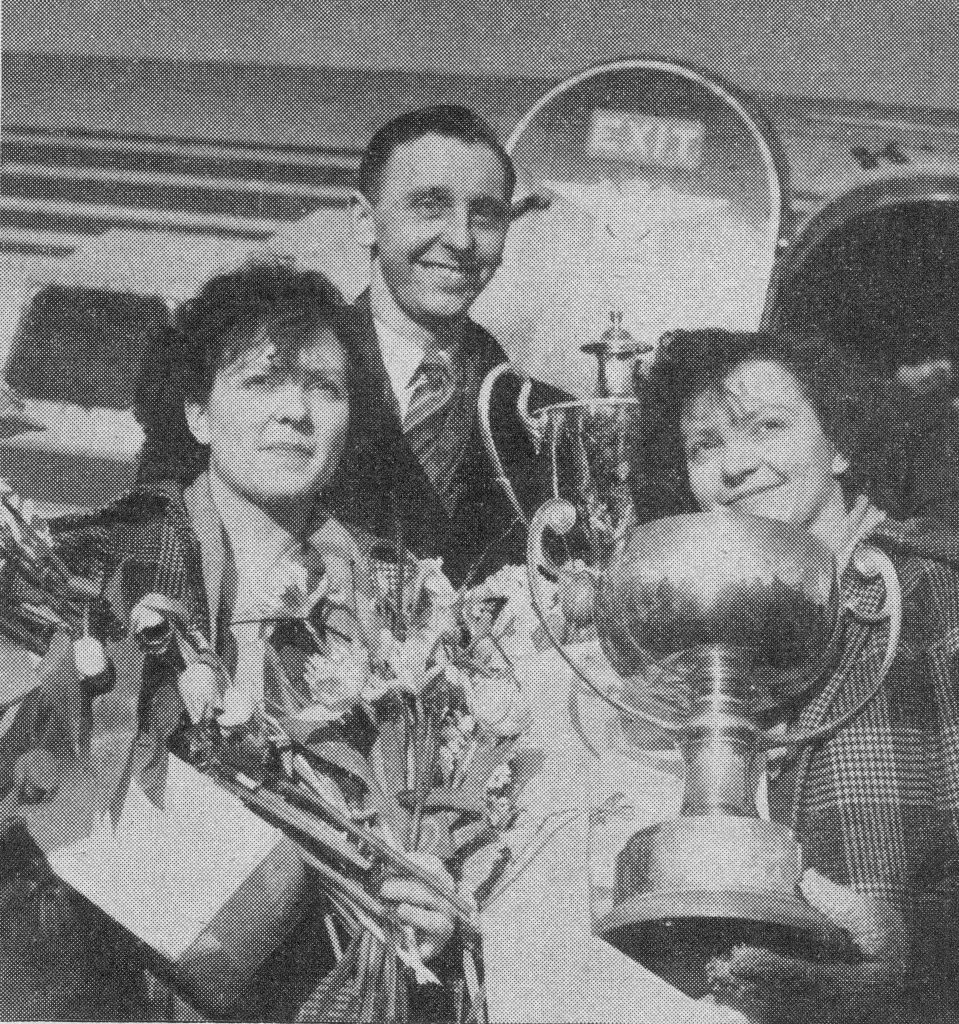
Amongst the archive papers is a report from the Men’s Team Captain, Adrian Haydon. He starts by saying: “As you all know we have every right to be jubilant in as much as the World’s Singles title has again returned to a British-born player – Johnny Leach – two years after he first won it in Stockholm. And may I add he is a worthy champion in every way whose behaviour on and off the table reflects great credit to his country and to English Table Tennis.”
Haydon then goes on to list the results and comments in the Swaythling Cup matches and listed are comments on the three top players: “Johnny Leach won 9, lost 0. He was a tower of strength to the team and did not lose a single match throughout the whole of the tournament.
“Aubrey Simons won 9, lost 2. Both losses were against the Yugoslavs and he appears to have developed a bout of nerves which must be conquered before he can return as a World ranking player. There was a lack of bite in his game which was so characteristic of his games in England and which was so noticeable against Vana last year. Even so he is still England’s No 2 – and a grand team man and he won’t be easy to displace.
“Michael Thornhill won 4, lost 0. Here undoubtedly we have our best prospect if only he could build up his physical strength. He has ability, brain, and I am hopeful that he will fill the No 3 position next season.”
To sum up: “The lesson we learn then was the obvious one, that you cannot afford to carry a passenger at No 3 against first-class teams. Even so we are so near the top that I am sure we can with luck win the Swaythling Cup in the next 2/3 years. Although we lost our group may I say the team were wholeheartedly behind me and I couldn’t have had a better set of chaps to control.
“On the whole then it was a most successful trip and the English team looked very smart in their new tracksuits and shirts and shorts. In fact, they earned the admiration of all by their general good fellowship. In conclusion then may I express my appreciation of having to hand two such very able administrators in Ivor Montagu and Bill Vint to help smooth over any difficulties and last but not least the thanks of the whole team to Mrs Pegg for her sterling work on behalf of the team’s equipment.
“You may not realise that my quest for a winning Swaythling Cup medal has so far gone on 23 years but I am hopeful of achieving my goal in the very near future.”
The ETTA accounts show England’s expenditure for the Championships as £1,044 12s 1d with income £526 9s 1d. This included £50-£60 for anyone accompanying the team to Vienna.
Joyce Roberts (Miller/Bogoni)
Joyce was born in London in 1926, the year the foundation meeting of the ITTF was held. She lived through the blitz, was a WAAF working at Bletchley Park before playing in two World Championships, winning a bronze medal in the Corbillon Cup and was a member of the England squad which had an eight-match tour of East and West Germany in 1951. Joyce later went on to be a Founder Member of the National Autistic Society and later still helped establish two homes for people with learning disabilities on the Isle of Wight.
It was while at Bletchley Park where Joyce saw Sergeant Cadet K Sebestak and Private E Berger of the Czechoslovak Army and England’s Cyril Merrett and Maurice Kriss in a war-time final. This enthused her enough to take up a bat seriously and it wasn’t long before she was representing the WAAF against the WRENs and other services, along with Betty Blackbourn, who later went on to win a World Championship gold medal in the Corbillon Cup. Excellent company indeed.
Nearly all the canteens in the WAAF had table tennis tables and it wasn’t long before Joyce was beating all the men, which didn’t always go down too well. However, it was after the war that her game really blossomed and by the late 1940s she was winning a considerable number of Open tournaments in singles and also in doubles with Peggy Franks – a World Championships multiple gold medallist.
Joyce’s first international took place in 1949 before she went on to play in two World Championships. The first was in Vienna in 1951 where with Peggy Franks, Diane and Rosalind Rowe, the Corbillon Cup team took home a bronze medal. She reached the quarter-finals in the Women’s and Mixed Doubles that year too. Joyce also played in the 1954 Worlds on home territory at Wembley.
Further caps came when Joyce was selected to go on a tour of Germany in September 1951, the first visit after the Second World War. Matches were played in both East and West Germany as well as an international against a combined team, they were warmly welcomed in most cities. Eight matches were played in total and England won them all. Having lived through the Blitz in London it gave Joyce a very special feeling when the National Anthem was played after the win in the international. Ivor Montagu accompanied the team which comprised Kathy Best, Ken Craigie, Aubrey Simons and Michael Thornhill.
Joyce played in other internationals and also achieved success at the English Open when she was runner-up in the Women’s Doubles with Peggy Franks in 1952, at the time the English Open was regarded as only second in importance on the world stage to the World Championships. The French Open the following year also proved a good hunting ground when Joyce won the Mixed Doubles with Brian Kennedy and a silver medal in the Women’s Doubles with Ann Haydon. Joyce won over 30 Open tournament titles in England. She also won the Middlesex Women’s Singles in 1949/50 and 1950/51, the Women’s Doubles with Pinkie Barnes in 1950/51 and the Mixed Doubles in 1948/49 with Victor Barna. Moving to Surrey, Joyce also won Women’s Singles and Mixed Doubles in their county championships.
Joyce reached England No 3 but in an era when England’s ladies were on top of the world this was no mean achievement with Betty Blackbourn (WR 2), Vera Dace (WR 3), Rosalind Rowe (WR 3), Diane Rowe (WR 5), Dora Beregi (WR 6) and Peggy Franks (WR 7). Joyce was described as sporting, good-natured, one of the most popular players in the game and her attitude was never, never give up. An attitude which served her well in later years.
Following her marriage to Bruce Bogoni which lasted nearly 60 years, Joyce’s interest in table tennis waned as Bruce had little interest in the game and when Joyce gave birth to her son, who was autistic, her energy and drive were directed into helping found the National Autistic Society. Later, when the family moved to the Isle of Wight, Joyce went on to help establish two homes for people with learning difficulties.
Joyce still meets up with old friends and colleagues at Bletchley Park for an annual reunion and on their open day the former WAAF ladies are paraded before those who are willing to pay £250 for the privilege of meeting them.
At 96, Joyce retains her vibrant personality and looks back with affection on her truly remarkable life. A very special lady.
Ken Craigie
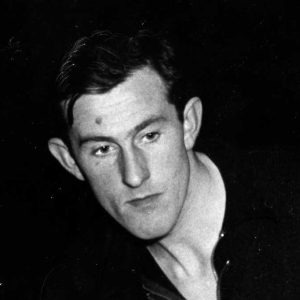
Ken was a Londoner born in Lambeth on 15 April 1924. He played in three World Championships in 1948, 1951 and 1954 and it was in the latter he played in the Swaythling Cup team which came third. His best result in the individual events was also in 1954 when he reached the quarter-finals with Alan Rhodes.
Ken played in 12 international matches in total, against Belgium, Czechoslovakia, France, Germany, India, Ireland, New Zealand and Wales. He was part of the squad which toured Czechoslovakia in November 1949.
At the English Open, Ken reached the Men’s Singles semi-final in April 1953 and he was also a semi-finalist with Jill Rook that year too. The Welsh Open saw success in the Men’s Singles in 1958/59 and the Men’s Doubles twice in 1953/54 with Alan Rhodes and 1957/58 with Len Adams.
He won nearly 70 domestic Open tournaments. Ken won the Middlesex County Open Men’s Singles in 1953/54, the men’s Doubles in 1953/54 with Derek Burridge and the Mixed Doubles with Margaret Cherry in 1954/54. He also played in the Surrey County Closed and won the Men’s Singles in 1951/52, the Men’s Doubles in 1951/52, 1957/58 and 1960/61, all with Harry Venner, and 1961/62 with Jackie Head, added to which was four Mixed Doubles titles, in 1951/52 and 1952/53 with Joyce Roberts, 1954/55 with Margaret Cherry and 1957/58 with Peggy Piper.
Ken took part in the first few National Championships and his best result was in January 1960 when he was a semi-finalist with Harry Venner in the Men’s Doubles. In the National Team Championships Wilmott Cup Ken was part of the team which won the trophy for the London Civil Service League in 1956/57 with Len Adams and Ken Sheldon.
Ken was an ETTA Approved County Coach in 1950/51, an Approved Coach in 1951/52 and received his Basic Coaching Diploma in 1953/54. He put his qualifications to good use with two of his star pupils being the Rowe twins, who he coached at the West Ealing Club.
An all-out attacker, Ken was an entertaining player to watch who got an England cap before playing for his county A team. Ken was a multi-talented sportsman, getting school colours for soccer and hockey, and played a good game of squash. However, his second game was lawn tennis, he won the Junior Lawn tennis Championships of GB Doubles in 1942, the Army Doubles in 1948, he represented the Army and also Cambridgeshire County and the Civil Service.
Ron Crayden
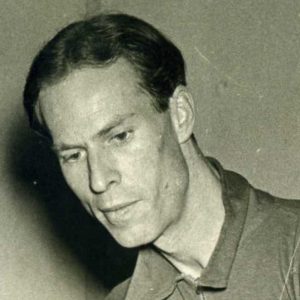
For anyone who has an interest in the history of table tennis, the name of Ron Crayden will be the one that immediately comes to mind. His list of achievements is immense.
Before his name was associated with numerous coaching, writing and various roles, Ron was a top player. Born in Lambeth, London on 8 July 1920, Ron’s England debut was against Wales on 15 January 1949 in Swansea, a fixture the England team won 7-2 with Ron winning his singles and doubles with Ron Sharman. He went on to play in 16 representative matches including against Ireland and Wales.
Ron played in five World Championships, 1948, 1951, 1954, 1955 and 1961. He was a member of the Swaythling Cup team in 1951 which finished fourth, winning six of his eight matches. In 1961, he took advantage of travelling to China as the Men’s and Women’s Captain by also playing in the Men’s Singles and Men’s Doubles. He did the same at the European Championships in 1960, combining playing and captaining.
Ron’s one international Open win was with Johnny Leach in 1950 at the Irish Open. He won 25 domestic Open titles, many of them in doubles and numerous silver and bronze placings. There was success at his Surrey County Closed winning the Men’s Singles twice, the Men’s Doubles four times and the Mixed Doubles once. In the South London Closed Ron won 24 titles, as well as titles in the London Closed, London Business Houses Closed, Printing & Allied Trade league Closed and the Wandsworth Closed. He toured Sweden in 1949 and Yugoslavia in the 1950/51 season.
Brian Kennedy
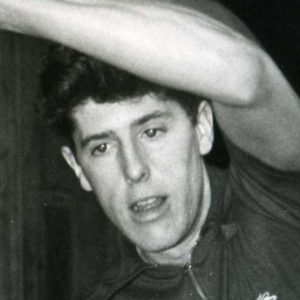
Brian was a Yorkshireman born in Leeds on 11 June 1931. He played in the first ever junior international on 2 February 1948 at Wimbledon YMCA against Sweden, a fixture England won 7-2 with Brian winning two of his three matches. A month later he gained his first senior cap against Ireland in Dublin. Here he lost his singles but won his doubles with Johnny leach in the team’s 9-2 victory. Brian was a regular in the England team for over 10 years and played against Australia, Belgium, France, Hungary, India, Ireland, Japan, Rumania, Scotland, Sweden, USA, Wales and Yugoslavia in a total of 20 international matches.
Playing in nine World Championships, Brian was a member of the England Swaythling Cup team that won the coveted trophy in 1953, he also gained two bronze medals in 1954 and 1955. In the individual events he reached the Men’s Doubles quarter-finals in 1953 with Aubrey Simons and the same placing in the Mixed Doubles with Joyce Roberts in 1951 and Kathy Best in 1953 and 1954. Brian played in one European Championships when the team finished fifth in 1958.
On the home front, Brian played in first National Championships in September 1960 when he was runner-up in the Men’s Doubles with Johnny Leach. At the English Open it was one gold in November 1953 with Aubrey Simons in the Men’s Doubles and three silver medals. He won 18 international Open titles and 83 domestic Open titles at junior or senior level. Unsurprisingly, Brian was England No 1. At the Yorkshire Closed, Brian won both the Men’s Singles and the Junior Singles titles in 1947/48.
Brian toured Sweden in 1951/52 and also went on a mid-European tour with Johnny Leach and Diane and Rosalind Rowe. In 1953/54 Brian went on a four-month winter coaching tour in India. He also coached at Butlin’s Holiday Camps for four seasons.
He was the first leading English player to adopt sponge after seeing the Japanese play with it at the World Championships in Utrecht. A good move as he won his first three tournaments playing with the new substance.
In 1959, Brian retired from playing competitively to concentrate on his business, he had set up a coffee bar in Leeds. This eventually led to working with television and film companies providing food on the set for such well known programmes as Emmerdale Farm, The Liver Birds, Last of the Summer Wine and The Likely Lads.
In recognition of his achievements Brian was made a Vice-President of Yorkshire in 1976, a VETTS Vice-President in 1987 and received the ETTA Players Achievement Award in 1983. He was also ETTA 100 Club Chairman in 1976.
Latest news
- WTT events
- From the Archives
- Clubs