What if table tennis balls had dimples like golf balls? How would that change the sport? Ray D’Alonzo has written a mathematical paper analysing exactly that hypothesis!
Ray is a retired PhD analytical chemist and a former collegiate table tennis player in the United States.
Many years ago, he began wondering what would happen if a table-tennis ball had a dimpled surface, and he recently revisited the question with the help of artificial intelligence.
His analysis looked into the effect of dimpling on ball speed and aerodynamic drag; spin and the Magnus effect; and the trajectory of the ball following its bounce from the table.
Here is the result of his work.
Suppose someone made a table tennis ball with dimples like a golf ball. Would it travel faster, spin differently or bounce in a new way? Nobody can answer that with certainty until such a ball is made and played with. But established physics lets us make some educated predictions – and the results are intriguing.
A question borrowed from golf
Table tennis has changed its equipment many times, but the ball remains a remarkably simple object: a light, hollow sphere with a smooth surface. That raises a question I have wondered about for years. What would happen if we put dimples on it?
Golf provides the obvious inspiration. Nineteenth-century golfers noticed that old gutta-percha balls that had become nicked and dented could fly farther than smooth new ones. Makers began adding surface markings deliberately, and over time those experiments evolved into the engineered dimples on modern golf balls. The golfers discovered the effect first; the aerodynamic explanation came later.
This table tennis exercise turns that history around. Instead of making a ball first and discovering what it does, can we use what is already known about aerodynamics to predict what a dimpled ball might do before anyone manufactures one? This is not a proposal to change the official ball. It is a thought experiment – and perhaps a challenge for someone who eventually wants to make a prototype.
1. Would it be faster?
Every table tennis player knows that a hard-hit ball slows as it crosses the table. Air resistance – drag – is responsible. Because a table tennis ball weighs only 2.7 grams while presenting a relatively large surface to the air, drag matters a great deal.
Dimples do not make a ball magically accelerate. Their possible advantage is subtler. On a sphere, surface texture can change the way air flows around the ball and where that flow separates from its rear surface. Under the right conditions, that can reduce drag. Under the wrong conditions, dimples could do the opposite. The size, depth and spacing of the dimples would matter.
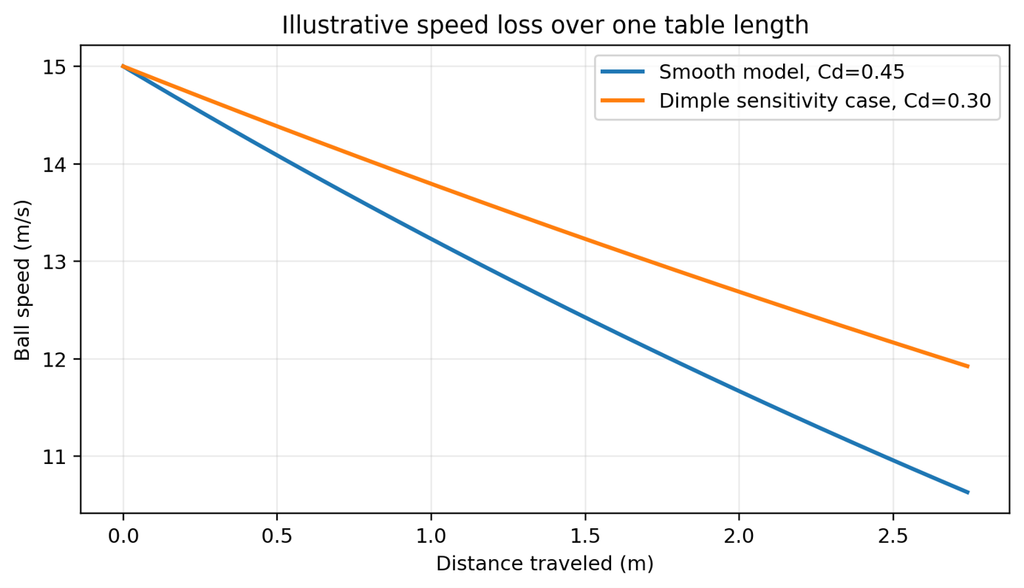
To see the scale of the effect, I asked AI to model two otherwise identical balls struck at 15 metres per second (about 34 mph). For illustration, the model assigned the smooth ball a drag coefficient of 0.45 and the hypothetical dimpled ball 0.30. Those figures are not measurements of a real dimpled table tennis ball – no such data are available to us – but they let us ask what would happen if dimpling produced a drag reduction of that size.
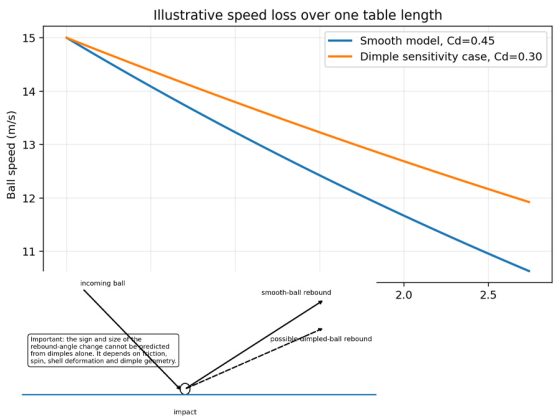
Over the 2.74-metre length of a table, both balls slow down. In the simplified calculation, the smooth ball falls from 15.0 to about 10.6 m/s, while the dimpled example retains about 11.9 m/s. In other words, the dimpled ball does not get faster; it simply loses less speed. The opponent would therefore receive a somewhat faster ball even though both balls started at exactly the same speed.
2. What would happen to spin?
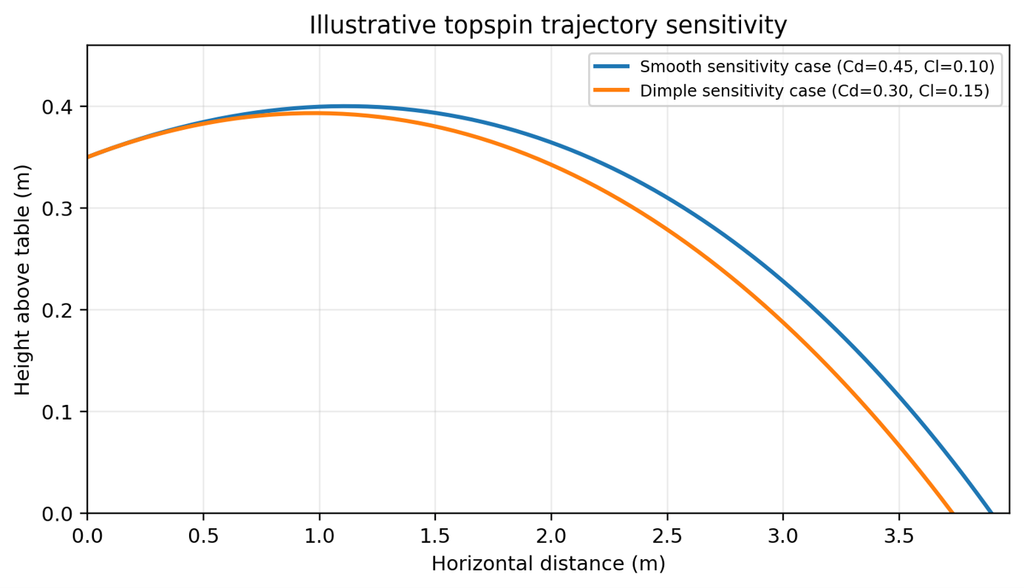
This may be even more interesting to players. A spinning ball pushes on the surrounding air asymmetrically, producing the familiar Magnus effect. Topspin helps pull the ball downward; backspin can make it float; sidespin bends it sideways. That interaction between spin and air is fundamental to table tennis.
Recent computer-fluid-dynamics research on table tennis balls has examined realistic combinations of ball speed and rotation and confirms that drag, lift and the aerodynamic effects of spin change with playing conditions. A dimpled surface would alter the airflow, so there is good reason to expect it to alter the effect of spin as well. What we cannot responsibly predict, without specifying and testing an actual dimple pattern, is exactly how much.
A successful design might make a topspin ball dip more sharply, make sidespin curve more, or change how quickly spin dies away in flight. Another dimple design might have a much smaller effect, or even move things in the opposite direction. That uncertainty is part of what makes the idea interesting.
3. What would happen when it bounced?
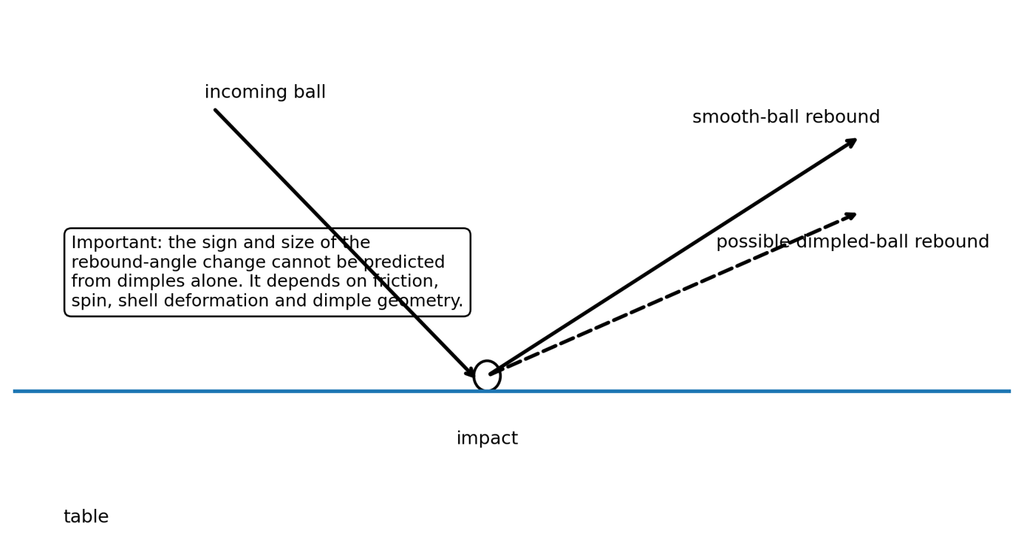
The bounce is the hardest part to predict. When the ball strikes the table, several things happen in a tiny fraction of a second. The shell deforms, the ball rebounds, and friction between ball and table exchanges forward motion and spin. The incoming speed, angle and spin all help determine the outgoing path.
Dimples could add another variable. A dimple in the contact area could change the local contact and friction, but the thin shell also flattens during impact. We therefore cannot simply say that a dimpled ball would bounce higher, lower, steeper or flatter. The aerodynamic changes before impact would also alter the speed and spin with which the ball reaches the table.
So the most defensible prediction is also the least dramatic: the bounce could be different, perhaps noticeably so, but theory alone cannot tell us the direction or size of the difference. That requires a real ball.
So what might a player notice?
If the right dimple pattern reduced drag, a player might first notice that a hard-hit ball carries more of its speed to the far side of the table. Changes in the aerodynamic response to spin could then affect how sharply topspin dips, how sidespin bends and how a ball behaves on its way to the bounce. Finally, any change in the contact between the textured surface and the table might alter the rebound itself.
Put those effects together and a dimpled ball could present players with a genuinely different problem. Serious athletes often thrive on new challenges. They learn, adjust technique and develop new tactics. A dimpled ball might demand exactly that kind of adaptation – or players might simply dislike it. Physics cannot answer that question.
The only real test: make one
The next step would not require changing the Laws of Table Tennis. It would simply require making a few experimental balls. Ideally, smooth and dimpled versions would have the same diameter, mass and material. High-speed video could compare how quickly they lose speed, how their spin changes in flight and how they rebound from the table. Skilled players could then answer the question that equations cannot: does the ball create an interesting new playing challenge?
That is where the golf comparison becomes especially appealing. Golfers discovered empirically that surface irregularities changed ball flight before the physics was understood. Here we are doing the reverse: using established physics to predict that something interesting might happen before the ball exists.
The theoretical answer is therefore not ‘dimples would make table tennis better.’ It is much more modest: a deliberately dimpled table tennis ball could plausibly behave differently enough to be worth an experiment. Only producing one and putting it into the hands of good players would tell us whether that difference is useful, challenging, entertaining – or merely curious.
A note on the AI experiment
The question and concept for this article are mine. I asked OpenAI’s ChatGPT to search the relevant scientific literature, construct a simplified theoretical model, perform the illustrative calculations and help prepare the figures and draft. I reviewed the work to the best of my ability. Where no experimental data exist for a dimpled table tennis ball, the article says so explicitly.
Editors and reviewers are expressly invited to check the analysis independently, including with other AI systems if they wish. Comparing those independent assessments may itself be an interesting test of how reproducible and robust an AI-assisted theoretical analysis can be.
For readers who want the science
The technical version below gives the equations, assumptions, aerodynamic coefficients, sensitivity calculations and full reference list. The central physics uses the standard drag relationship (air resistance increases roughly with the square of speed) and the Magnus-force description for a spinning sphere. The numerical example is a sensitivity calculation, not an experimental measurement of a dimpled table tennis ball.
Latest news